PLANTS | ANIMALS | ECOLOGY | FUNGI | GEOLOGY | GARDENING | TOOLS
MEXICAN PLANTS & ANIMALS HOME

Excerpts from Jim Conrad's
Naturalist Newsletter
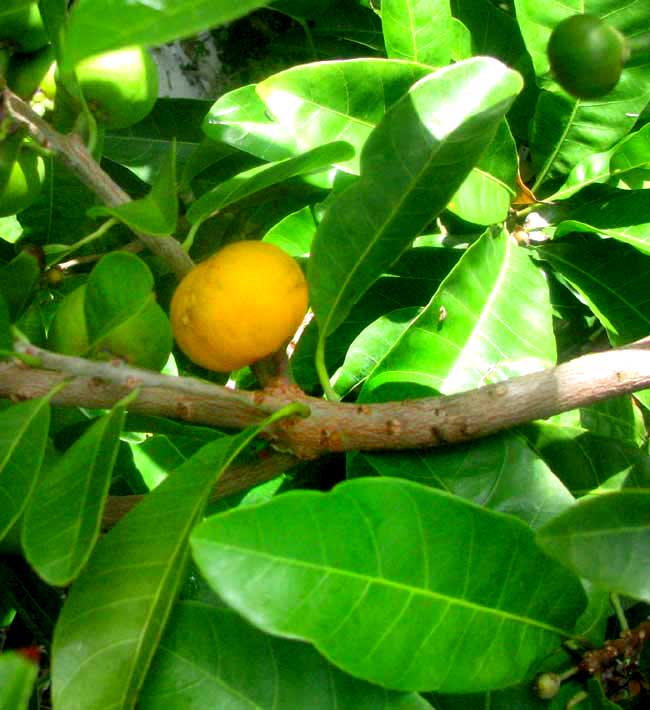
from the July 3, 2011 Newsletter issued from Mayan Beach Garden Inn 20 kms north of Mahahual; Caribbean coastal beach and mangroves, ~N18.89°, ~W87.64°, Quintana Roo state, MÉXICO
A CARIBBEAN PERSIMMON
Along the road there was a certain tree with slowly enlarging, spherical fruits and glossy leaves with herringbone pinnate venation. At first I thought it was one of several kinds of American fig trees found here. However, some of the tree's fruits were ripening, turning an orangish yellow, so I walked over to pick one, which is shown above.
When I tugged on the fruit, however, it broke apart in an unfiglike way, revealing four large seeds, as shown below:
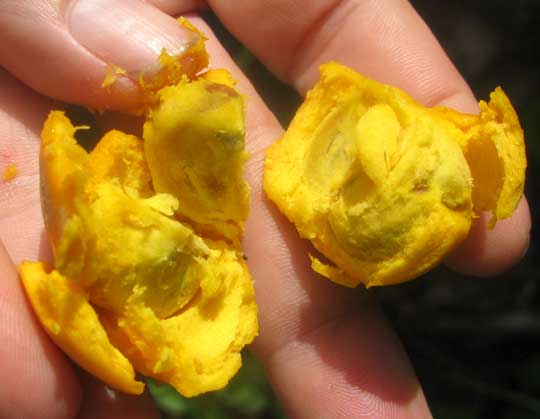
Seeing the large seeds I began thinking "persimmon." Remembering that the Common Persimmon of eastern North America produces delicious fruits subtended by a calyx that with age enlarges and turns woody, I examined one of this tree's calyxes and saw what's shown below:
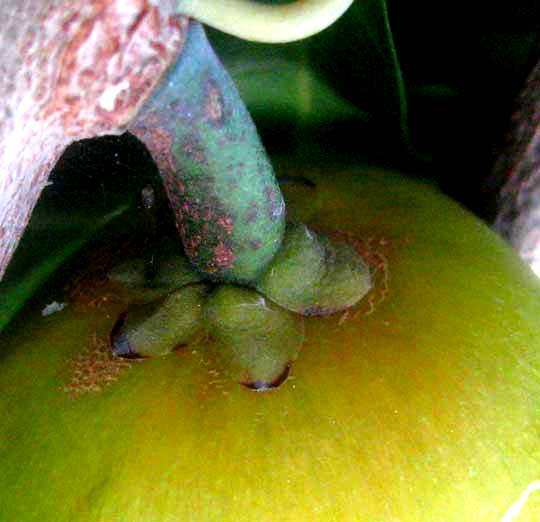
That calyx isn't nearly as oversized and woody as those on North America's Common Persimmon fruits, but it's larger and tougher looking than an average calyx, so maybe it was indeed some kind of persimmon. Now I tasted the fruit, and it was good. It wasn't as sweet and gummy as a northern persimmon picked just after the first frost. It was more like a dry, crumbly, baked sweet-potato, which wasn't bad.
So, a bit of Googling revealed that really it was a persimmon tree, a species occurring only in the Yucatán, Belize, Guatemala, Cuba and several other Caribbean Islands. In its English-speaking locations sometimes it's called Wattle Tree. It's DIOSPYROS TETRASPERMA.
The Maya of course know all about the tree, calling it Sak Tsilil. For my part, it looks as if for the next month or two whenever I visit the hawks I'll get to snack on persimmons. In return for the pleasure I'll spit the big seeds along the road as I bike back home, planting new ones.