PLANTS | ANIMALS | ECOLOGY | FUNGI | GEOLOGY | GARDENING | TOOLS
MEXICAN PLANTS & ANIMALS HOME

Excerpts from Jim Conrad's
Naturalist Newsletter
from the December 4, 2011 Newsletter issued from Hacienda Chichen Resort beside Chichén Itzá Ruins; limestone bedrock; elevation ~39m (~128ft), N20.675°, W88.569°; central Yucatán state, MÉXICO
SWEET ORANGES
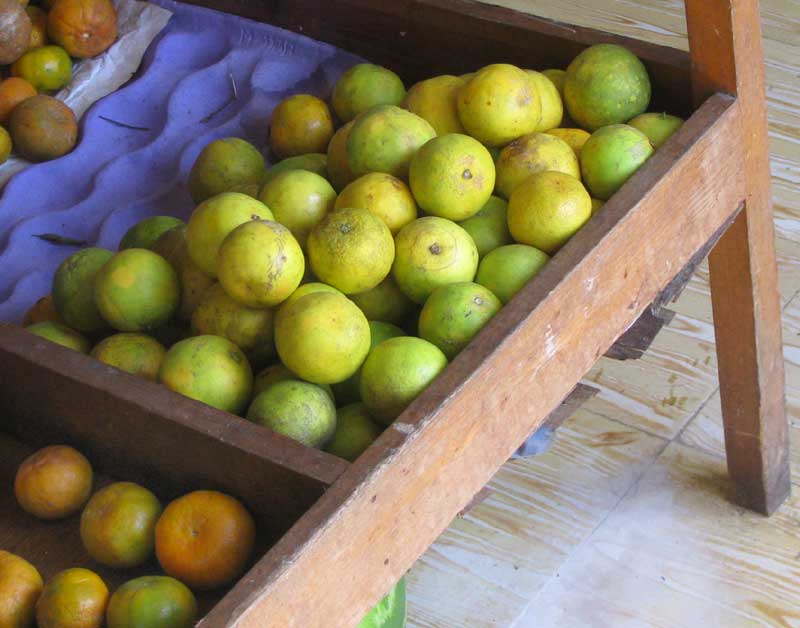
What a wonderful time to be eating oranges. After the hot, rainy growing season of the last few months, the Yucatán's orchards luxuriate with dark-green-leafed trees festive-looking with innumerable orange adornments. You can see what our local oranges look like heaped in a bin at the frutaría in Pisté above.
Notice that these very sweet, super-flavorful oranges at the peak of perfection for eating are not as orange colored as the tangerines next to them, or oranges in North American supermarkets. That's because the notion that a good orange must be very orange colored is a marketing ploy. Marketers tout the orangeness of oranges because it's easier to make oranges look orange than to deliver exceptionally tasty oranges to distant customers. People here are sophisticated orange eaters and they know that to determine a good orange you check for blemishes, you might feel the firmness, you smell them, but you certainly don't buy the orangest oranges.
Many orange cultivars exist, too many bred mainly with very tough, very orange rinds with shipping and marketing mainly in mind. The ones in the bin are especially thin-skinned and juicy, perfect for squeezing orange juice from, though I just eat them. Since this cultivar's peel is hard to remove, I've developed a special way of eating them.
First I cut them in half, then I push inward at the back of a half so that it splits in the way shown below:
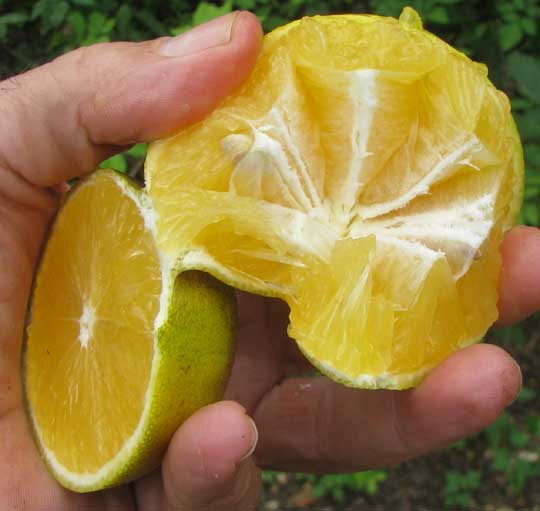
Once the half is split as in the picture, it's easy to tug the wedges from their peel with the teeth. When I'm pressing the half from behind some of the juice packets burst, but when I'm pushing I'm also slurping up all the sweetness. It doesn't matter that I get a seed from time to time, for it's all so sweet and sensuous that I even like the seed's mild bitterness, and the slight burning sensation where the peel touches my lips, and the juice that gets into my beard. How wonderful to have such oranges, and to be able to eat them exactly as I like!
The Orange tree is CITRUS x SINENSIS, "sinensis" meaning "Chinese," which explains why the local word for sweet oranges is "chinas." The Orange plant is thought to have arisen in southern China. Until now it's been debated whether Orange plants derive from a wild species no longer occurring in its natural state, or whether it's a hybrid. Early this year the issue was settled by a team of Chinese researchers using gene sequencing techniques. They determined that Oranges are hybrids between Tangerines (also called Mandarins), Citrus reticulata, and Pummelos, Citrus grandis. This study, which also reveals the ancestry of several other citrus taxa, is found online at http://www.sciencedaily.com/releases/2011/01/110118101600.htm.
Today the orange is the most commonly grown tree fruit in the world, and there's a world of cultivars to choose from. In the US, most of the oranges grown in California are either 'Washington Navel' or 'Valencia'. Florida's commercial cultivars are mainly 'Hamlin' (early); 'Pineapple' (mid-season), and; 'Valencia' (late).
Our frutaría oranges look like Valencias, known to be the cultivar most planted in the tropics, and one producing relatively small but very juicy, rich- tasting fruits that often don't develop a deep orange color.
from the January 29, 2017 Newsletter issued from Rancho Regensis north of Valladolid, Yucatán, MÉXICO;
elevation ~40m (~130 ft), N~20.876°, W~88.170°
SWEET ORANGES FLOWERING
About three weeks ago, passing by the citrus orchard began to be a heady experience. The oranges were flowering, and orange blossoms were smelling good. This week the very last blossoms were falling off, and I took a look at them. Below, you can see one:
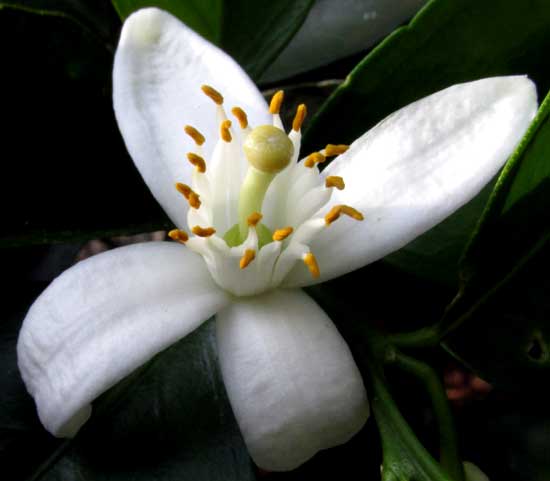
Normally Sweet Orange blossom corollas bear five petals but the one in our picture has four. The flowers are about two inches wide (5cm). Flowers usually bear 20-25 stamens composed of white, stem-like filaments topped with brownish yellow, banana-shaped anthers; ours seems to have about 20. Some Sweet Orange flowers are solitary on a stem but sometimes up to six cluster together. Below, you can see a cluster of three flowers, each at a different stage of maturity:
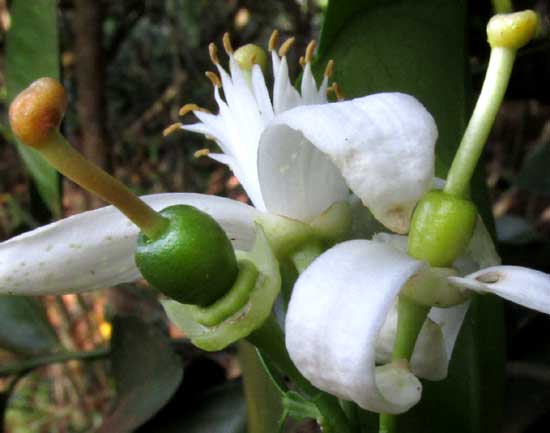
In that picture the blossom at the rear is at its peak, while on the right pollination has taken place, some of the petals and all of the stamens have fallen off, and the green ovary has begun expanding. At the left all that's left of the flower is its green, rapidly expanding ovary topped by its match-stick-like style and stigma, which are brownish, since now they're superfluous and about to fall off.
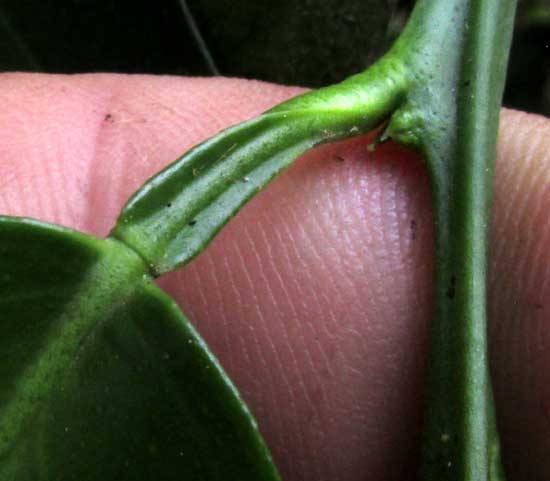
Last week we saw that similar-looking Bitter Orange trees bear leaves with widely flaring or broadly "winged" petioles. You can compare those petioles with the Sweet Orange's "narrowly winged" petiole shown below: