PLANTS | ANIMALS | ECOLOGY | FUNGI | GEOLOGY | GARDENING | TOOLS
MEXICAN PLANTS & ANIMALS HOME

Excerpts from Jim Conrad's Naturalist Newsletter
from the October 20, 2008 Newsletter written in Yokdzonot, central Yucatán, MÉXICO
NONI IN THE NEIGHBORHOOD
In fruit markets here sometimes you see heaps of greenish-yellow, potato-size fruits you never saw just a few years ago. It's one of those
"wonder fruits with a great future" introduced with great fanfare as an important, alternative, money-making crop. The fruits and the small tree producing them are called Noni. The plant is MORINDA CITRIFOLIA, a member of the large, mostly tropical Coffee Family, the Rubiaceae.
Occasionally in the Yucatan I've seen small plantations of Noni trees but this is the first time I've seen them planted along roads and in folks' backyards. You can see a fertile Noni branch below:
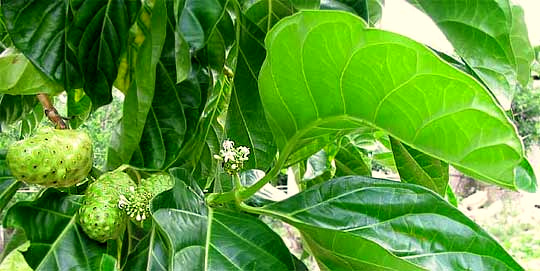
If you Google Noni fruits you'll find extravagant claims about the medicinal value of Noni fruits, and see that much research has been done on the chemicals in them. The fruits certainly taste medicinal, more bitter than sweet. In fact, usually when I see them in markets they're just lying there rotting because very few people buy them. Some Noni producers tell me that they've found markets for their fruits but others say they can't sell them, so I just don't know if this alternative crop is living up to its earlier promise. The fellow who sells me bananas is the owner of the tree in the photograph. He says he makes a drink from Noni juice, softening its bitterness with orange juice, and he looks like he's 45 but says he's 63, so...
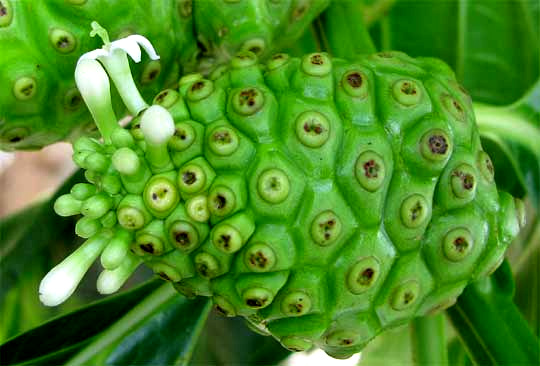
Above you see an immature Noni fruit with flowers attached to it. This picture explains why Noni fruits are so bumpy and each bump bears a little "eye." For, Noni fruits don't develop from single flowers. Rather, as the flowers on the left show, each bump on a fruit develops from a flower's ovary. The Noni "fruit," then, is a "multiple fruit," consisting of several to many packed-together simple fruits. Mulberries, Osage Oranges, pineapples and figs are other examples of multiple fruits, which are to be distinguished from "aggregate fruits," which look like multiple fruits, but each bump on a multiple fruit develops from one of several separate pistils in a single flower -- one flower with several pistils. Diagrams are provided at www.backyardnature.net/frt_3grp.htm.
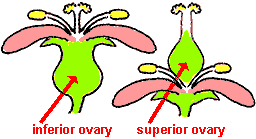
One important feature distinguishing the Coffee Family is that its flowers have " inferior ovaries" -- the calyx and corolla arise atop the ovary instead of below it, as in most flowers. An explanatory diagram is at ../inf_sup.gif.
Therefore, the eyes on each bump of a Noni multiple fruit are scars where the calyx and corolla of individual flowers have fallen off.
from the February 14, 2010 Newsletter issued from Hacienda Chichen Resort beside Chichén Itzá Ruins, central Yucatán, MÉXICO; limestone bedrock, elevation ~39m (~128ft), ~N20.676°, ~W88.569°
NONI STIPULES
Noni trees are grown at Hacienda Chichen and despite the fruits tasting a bit like rancid washrags I usually eat one fruit a day, and I've almost come to like the robust taste. Some time ago we experimented with blending a little Noni juice into orange juice, with a few shakes of nutmeg added, and that was quite good.
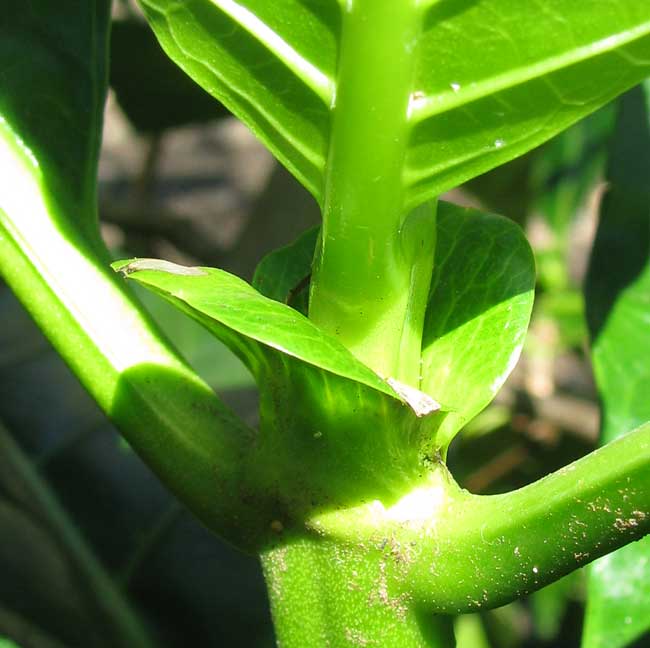
Noni trees bear very conspicuous stipules, and since many people have problems visualizing stipules, you can see the Noni's big ones below. Those two roundish, green things occupying the picture's center are stipules.
from the July 17, 2011 Newsletter issued from Mayan Beach Garden Inn 20 kms north of Mahahual; Caribbean coastal beach and mangroves, ~N18.89°, ~W87.64°, Quintana Roo state, MÉXICO
A NONI-EATING FOX
Not long after dawn, while the sand road beyond the northern bend was still somberly shadowed, something wandered across the lane too far ahead to make out what it was. On the bike I coasted to a stop, the critter paused, too, stared at me, and then crossed the road again. When I drew closer it became clear that here was a Gray Fox, UROCYON CINEREOARGENTEUS.
As I watched, the fox kept going back and forth across the road, slowly working in my direction. I stepped behind a roadside bush hoping he'd keep approaching, and he did. After a few minutes he arrived carrying something white in its mouth, as shown below:
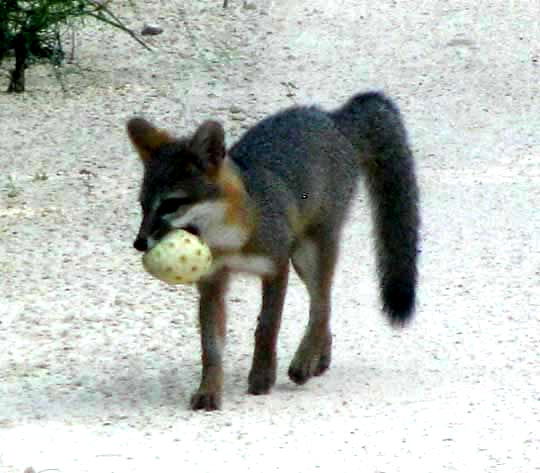
The white object was a Noni fruit, which the fox deposited at a certain spot among the weeds along the road, then kept coming in my direction.
issued on August 4, 2019 from near the forest just west of Tepakán; elev. ~9m (~30 ft), N21.053°, W89.052°; north-central Yucatán state, MÉXICO
NONI USED MEDICINALLY FOR SKIN TUMORS
The picture below shows a junked coffee jar filled with shredded Noni fruits, leaves and young, emerging stems, soaked in alcohol for several months.
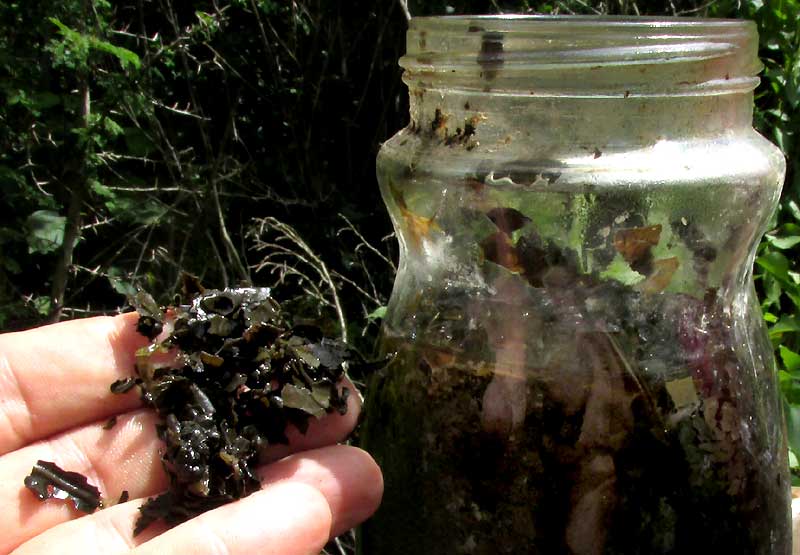
I'd read that in some studies Noni seemed to cause certain tumors and cancers to recede. For the last two years I've had some growths on my arms, so I tried my own Noni treatment on two different kinds of tumor. Within days both were smaller. After two months, one has practically disappeared and the other is much reduced. This proves absolutely nothing. It could be coincidence, the placebo effect working on my mind, or whatever. Moreover, if you have your own suspicious growths you need to see a doctor.
I think one of my tumors was a carcinoma, a little red volcano topped with a callous-like growth hard as a fingernail. I'd cover that one with petroleum-jelly-based lip balm, then stick a big flake of Noni leaf on it. The lip balm was a fair adhesive for an hour or so.
The second growth was like a red mole, but it wasn't, and wouldn't go away. I've had several like that in my life and they always disappeared until now. I placed over that tumor a wad of leaves like that in the picture, and held it in place with a cloth band wrapped around my arm. Once the tumors were much reduced, sometimes I'd go for three or four days without any treatment. I was surprised that the tumors appeared to be continuing to reduce at the same rate as ever.
Someday for some reason or another health service may be hard to come by for any but the very rich. I'm keeping Noni in mind just for that eventuality.