PLANTS | ANIMALS | ECOLOGY | FUNGI | GEOLOGY | GARDENING | TOOLS
MEXICAN PLANTS & ANIMALS HOME

Excerpts from Jim Conrad's
Naturalist Newsletter
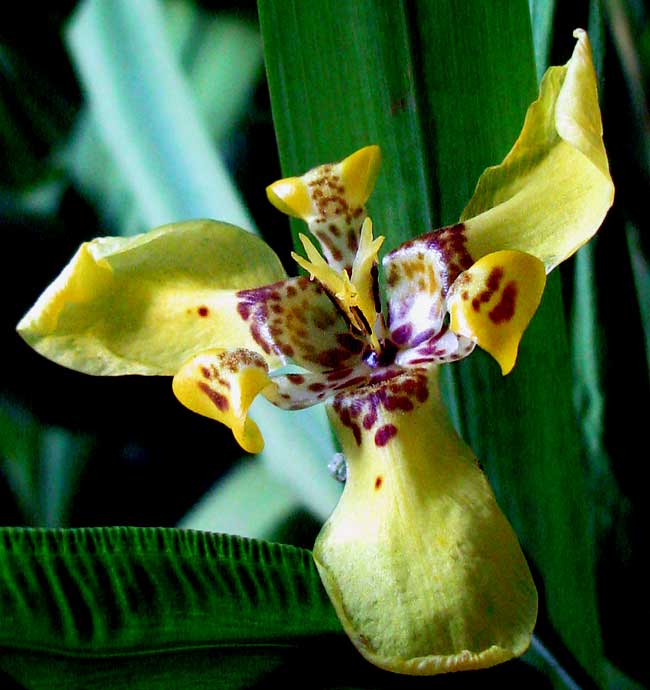
from the December 13, 2009 Newsletter issued from Hacienda Chichen Resort beside Chichén Itzá Ruins, central Yucatán, MÉXICO; limestone bedrock, elevation ~39m (~128ft), ~N20.676°, ~W88.569°
WALKING IRISES
Above you see a two-inch broad (5cm) blossom open here nowadays. It's the Walking Iris, sometimes called Toad-Cup, NEOMARICA LONGIFOLIA, native to western Africa and South America. Despite its name it is not an iris -- not a member of the genus Iris, though it's very closely related. Gardeners think of them as a substitute for "real irises" in places too shady for irises. Normally the blossoms last for only a day, but each flower cluster, or inflorescence, bears several flowers, which bloom on consecutive days. They bloom during our rainy season, which is ending now.
The "walking" part of the name arises from how plantlets form in the inflorescence, then when the inflorescence bends to the ground at the flowering season's end, the plantlets root, form new plants, and the population year and year "walks" to a new place.
The flowers are so similar to iris flowers that it's interesting to note what sets them apart. But to understand the differences you need to grasp basic iris-flower anatomy, which is diagrammed and explained at www.backyardnature.net/fl_iris.htm.
On that page pay particular attention to the "style arms." In most plants not in the Iris Family the style is no more than the neck or stem connecting the female ovary -- the future fruit body -- with the stigma, which is the part that future male pollen will germinate on. In the Iris Family, however, styles do strange things. In irises themselves they look like colorful petals rising in the flower's center.
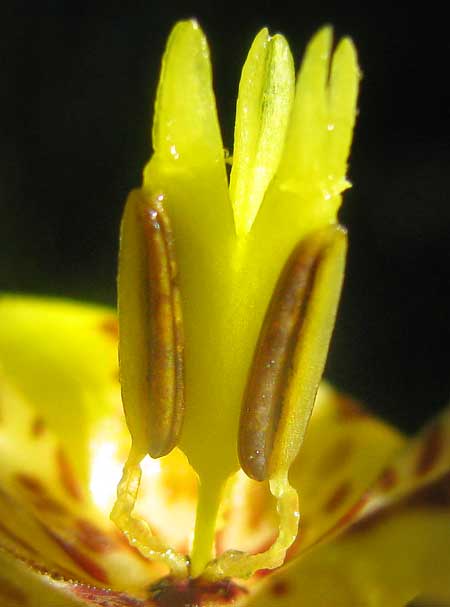
Above you see none of that. The large, yellow structure in the middle of the picture comprises three branches of the style, each style branch bearing inconspicuous stigmatic zones at their tips. These style branches do not expand into petal-like appendages as they do in Irises, so that's something important setting the two genera apart.
It's also pretty neat how the anthers -- the brownish, baglike, frankfurter-shaped, pollen-bearing part of the male stamen --adhere to the style arms. Since the style arms hold the anthers in place, the stemlike filaments below the anthers, which normally do the job of holding anthers in place, look exceptionally weak and useless.