PLANTS | ANIMALS | ECOLOGY | FUNGI | GEOLOGY | GARDENING | TOOLS
MEXICAN PLANTS & ANIMALS HOME

Excerpts from Jim Conrad's
Naturalist Newsletter
from the October 9, 2011 Newsletter issued from Mayan Beach Garden Inn 20 kms north of Mahahual; Caribbean coastal beach and mangroves, ~N18.89°, ~W87.64°, Quintana Roo state, MÉXICO
A MUD-TURTLE'S BARBELS
I don't pick up turtles, not wanting to upset them, but this week I was with some visitors who just had to see one at eye level, so they picked up a Red-cheeked Mud Turtle, KINOSTERNON SCORPIOIDES, found crossing a road during a nature tour. You can see a nice close-up of the face below:
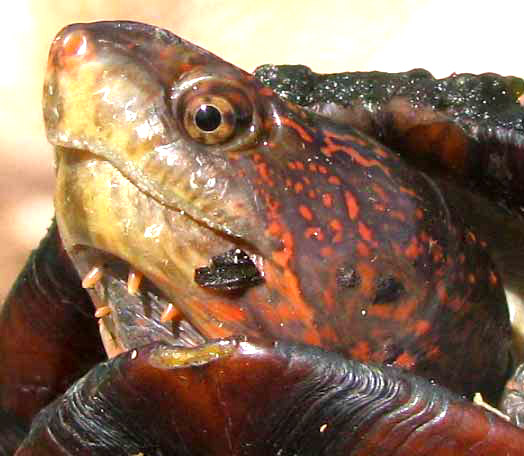
That picture very nicely shows four tiny, fingerlike, fleshy projections dangling from the turtle's throat area. Those are "barbels," which occur on many species of fish and turtles. A catfish's whiskers are barbels. When identifying fish and turtles, often the number and placement of barbels serve as good field marks.
You can imagine that barbels provide some kind of touch guidance as the turtle forages atop the mud in dark, muddy water, but it seems that they're capable of much more than that. Turtle barbels contain olfactory nerve endings, which means that the barbles are used for smelling. Turtles on dry land can smell odors as we do, but in water turtles with such barbels have this extra odor-sensing method. As the turtle scoots its chin atop submerged mud, through its barbels it's smelling what passes below it.
from the March 18, 2018 Newsletter issued from Rancho Regenesis near Ek Balam ruins in Yucatán, MÉXICO
YOUNG MUD TURTLE WITH WHITE LIPS
This Tuesday, after our surprise rain the day before, as I was photographing frolicking Gulf-Coast Toads in one of the rancho's little ponds, a white-lipped mud turtle surfaced right beside a pair of mating toads, and at last -- once he'd shaken off a male toad wanting to mate with his head -- I got a good view of the turtle's white lips. They're shown below:
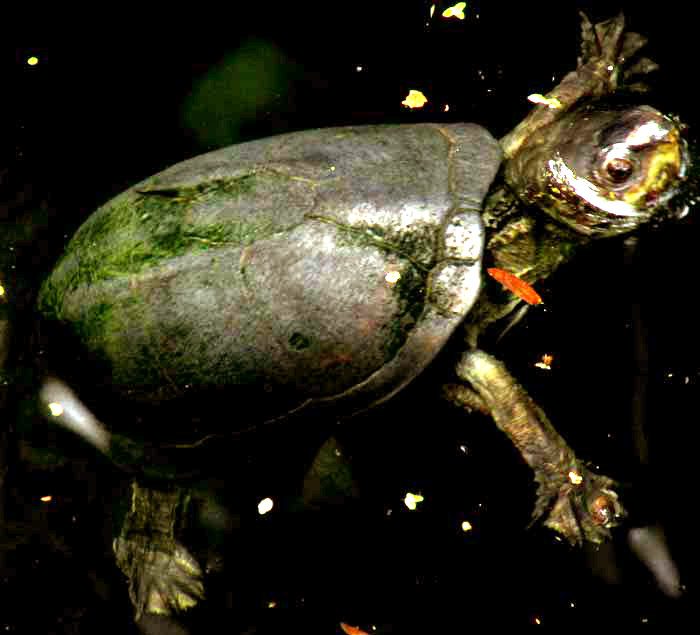
At first I assumed that this was the White-lipped Mud Turtle, Kinosternon scorpioides, but when I uploaded the image to iNaturalist, user "pedro_nahuat" recognized a Red-cheeked Mud Turtle without particularly red cheeks, but striking white lips. {see next entry}
from the August 9, 2018 Newsletter issued from Rancho Regenesis in the woods ±4kms west of Ek Balam Ruins; elevation ~40m (~130 ft), N~20.876°, W~88.170°, central Yucatán, MÉXICO
A YOUNG RED-CHEEKED MUD TURTLE
At the rancho's cement-lined little pond I sat waiting for something to happen. Then something stirred beneath the layer of submerged decaying tree-leaves at my feet. Prodding beneath the leaves, I retrieved the juvenile turtle shown below:
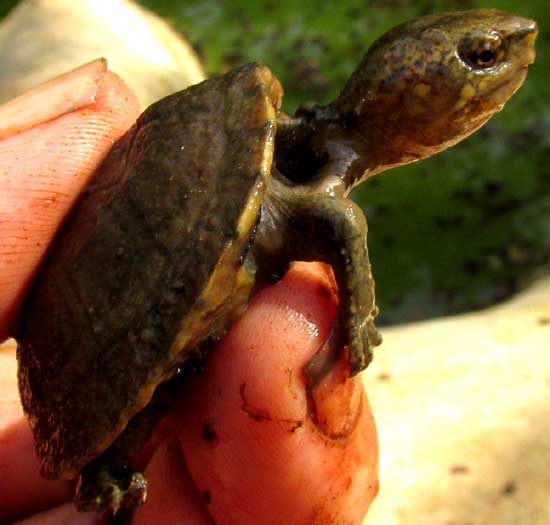
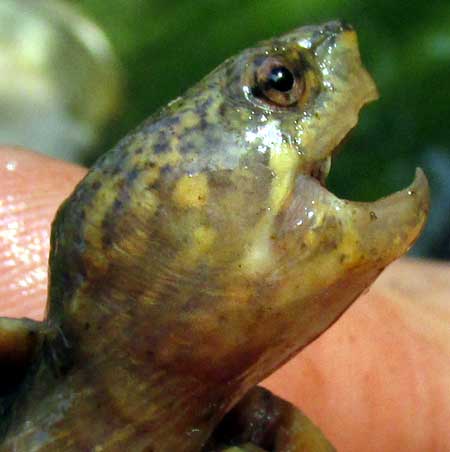
Since White-lipped Mud Turtles already had turned up in the pond and this one had pale lips, I figured that it was that species. However, there are always surprises, so while this little critter was in hand I knew to take what pictures were needed for a definite identification. First a head picture better showing the pattern of blotches' pattern, seen below:
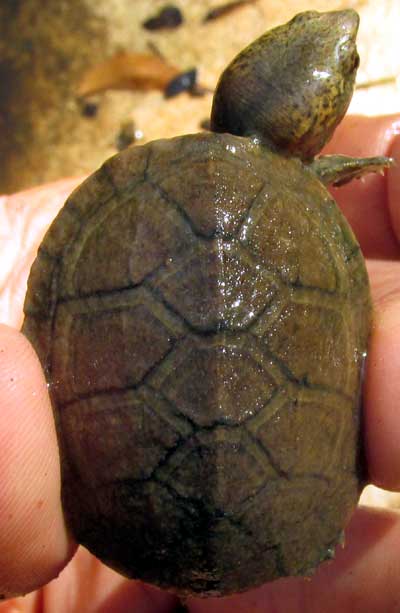
Now the top shell, the carapace, showing the pattern of its scales, or scutes, or "epidermal lamellae," and a low crest or "keel" across the top:
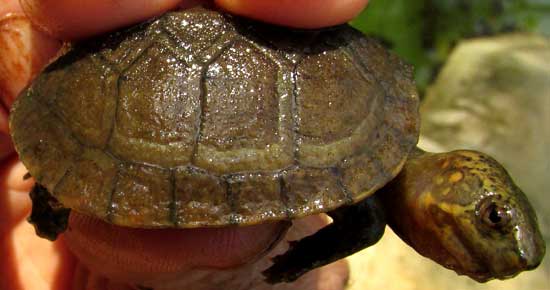
A side view:
And a bottom view of the alga-covered plastron:
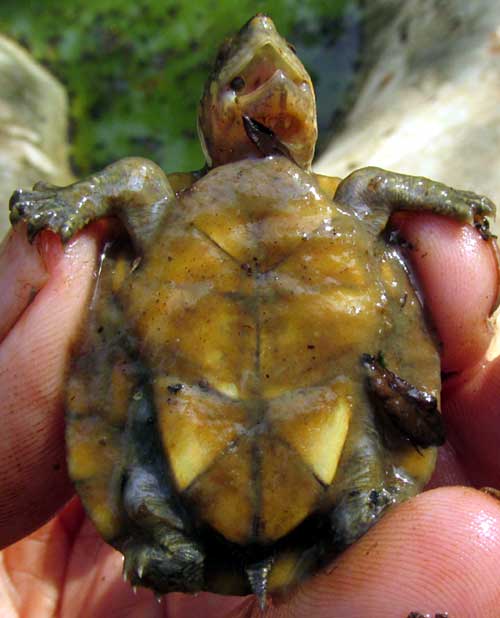
Thing is, when I double-checked on the scute patterns, they didn't match those of the White-lipped Mud Turtle. They did match those of the Red-cheeked Mud Turtle, so apparently those red cheeks develop only on more mature individuals.
Red-cheeked Mud Turtles are widespread, distributed from northeastern Mexico all the way south through Central America to northern Argentina in South America. Subspecies are recognized. In the Yucatan ours are KINOSTERNON SCORPIOIDES ssp CRUENTATUM.
Jonathan Campbell in his Amphibians and Reptiles of Northern Guatemala, the Yucatán, and Belize describes the species as omnivorous and living in streams, rivers and lakes. Now to that we can add "cement-lined little ponds."