PLANTS | ANIMALS | ECOLOGY | FUNGI | GEOLOGY | GARDENING | TOOLS
MEXICAN PLANTS & ANIMALS HOME

Excerpts from Jim Conrad's
Naturalist Newsletter
from the November 2, 2014 Newsletter issued from Río Lagartos, on the Yucatan Peninsula's northern coast (~N21.60°, ~W88.16°), Yucatán state, MÉXICO
MORELET'S CROCODILES
Paco's eyes focused on something below the tangle of Red Mangroves at the water's edge, he cut the boat's motor, and we coasted in close to the vegetation. Then we saw it, too, the open-mouthed crocodile swimming toward us, shown below:
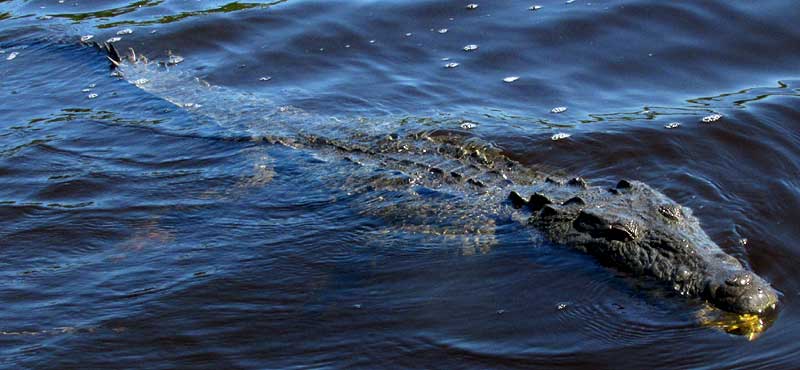
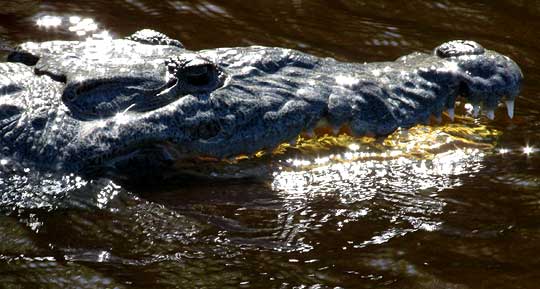
The croc kept his snout wide open as he moved in close, providing a good view of his upper snout, which is useful for identification purposes, shown below:
In fact, he offered a good view of everything because now, still with his mouth open, he came up to the boat's side, maybe expecting a dead fish from the guide's hand. Below, you can see him at the boat's edge:
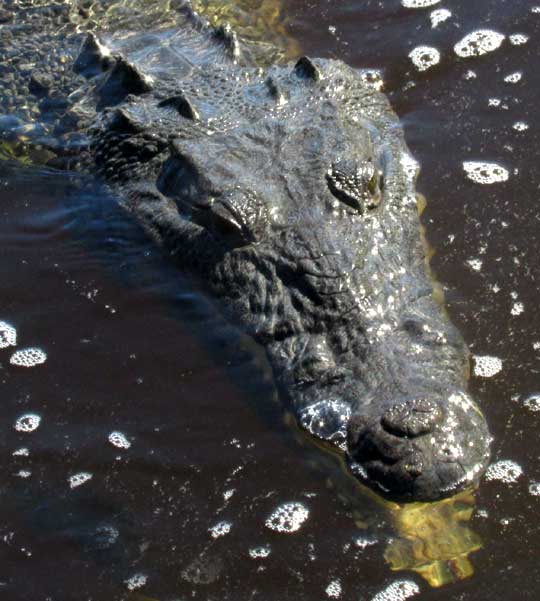
I was glad to have such a close view because in the Ría Lagartos Biosphere Reserve we have two crocodile species -- the American Crocodile, and Morelet's Crocodile -- and I've been having trouble distinguishing them. Both are different species from the US's Alligator.
One reason for the confusion about their identities is that their colors and patterns are variable. Also, usually it's said that the most noticeable difference between them is that the American Crocodile's snout is considerably more slender than the Morelet's. That's true, but often you see immature crocs whose snouts are shorter relative to the rest of their body, confusing the situation, plus you seldom get to see croc from directly above, from which view the snout's slenderness or wideness is most visible. On the other hand, scale configuration in the neck area varies between the species, is invariable, and now I was seeing the scales perfectly, almost from a top view.
Once the last picture was on my computer screen, at Crocodilian.Com I pulled up a diagram of the American Crocodile's head scales, {which used to be} at http://crocodilian.com/cnhc/cst_cacu_am_head.htm.
The corresponding diagram of the Morelet's Crocodile's head scales {used to be} at http://crocodilian.com/cnhc/cst_cmor_am_head.htm.
The most important scales to pay attention to are the larger, sharp-pointed, tooth-like ones atop the neck. Notice at the back of the neck the four large scales forming a rectangle. On both sides of this rectangle arises a smaller scale. In front of the rectangle, four smaller scales form a slightly backward-curving line. Both the American and Morelet's Crocodiles have these scales, but their configurations are different. For one thing, on American Crocodiles the rectangle of big neck scales is narrower, and the scales at the rectangle's sides are smaller than on the Morelet's.
The diagrams indicate that our boat-visiting croc is the Morelet's Crocodile, CROCODYLUS MORELETII, endemic to only lowland eastern Mexico, the Yucatan Peninsula, Belize and northern Guatemala. It likes quiet water, especially backwater lagoons, slow-moving streams and lakes, and in the Yucatan sometimes it turns up in the sinkholes called cenotes. The American Crocodile, Crocodylus acutus, also occurs in brackish water and slow streams, plus it may venture into salty ocean water. It's more widely distributed than the Morelet's, found coastally from west-central Mexico south into South America, and on the eastern coast from the Yucatan to South America, eastward into the Caribbean islands, and north to Florida and a bit up the US's eastern seaboard.
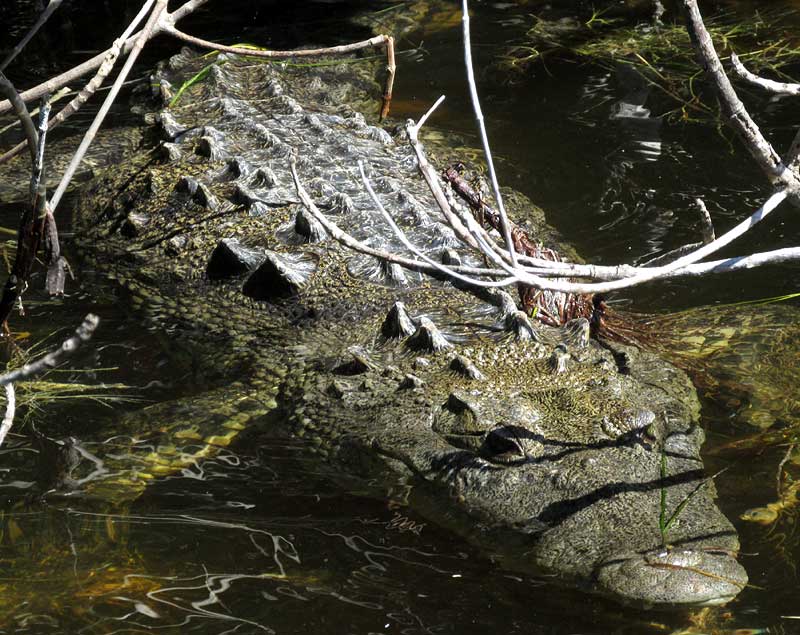
Later we ran into yet another croc, this one larger and more wary, lurking half hidden in the mangroves. Over seven feet long (2m), it's shown at the top of this page.
This second individual is pale, while the previous one was blackish. Also, this one's snout appears to be much broader than the last one's. However, those big scales on the upper neck indicate that once again we have a Morelet's.
Adult Morelet's eat just about anything they want, mostly turtles, small mammals, mollusks, fish, aquatic birds, frogs and other animals. Young ones feed on insects and other small animals on or near the water's surface, including snails, crustaceans and small fish.
Though American Crocodiles definitely are present in the Reserve, having been documented by researchers who know the species well, so far, of the maybe twenty crocs I've seen here, I think all have been Morelet's.
from the January 4, 2015 Newsletter issued from Río Lagartos, on the Yucatan Peninsula's northern coast (~N21.60°, ~W88.16°), Yucatán state, MÉXICO
CLOSE-UP OF A YOUNG MORELET'S
The coastal road running between Río Lagartos and Las Coloradas dips into a marsh rich in waterfowl and crocodiles. At a certain culvert beneath the road, young crocodiles like to bask on a water pipe dipping into the water. Below you can see one about 15 inches long (38cm):
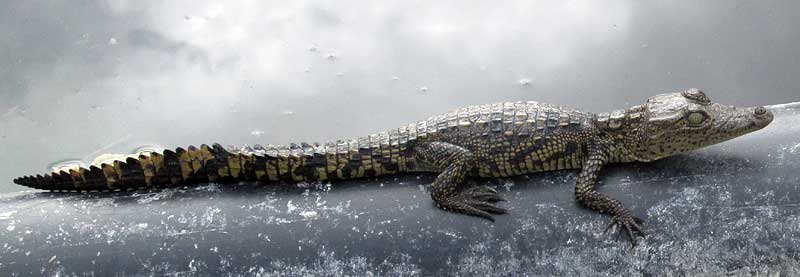
This juvenile is showing us some field marks that normally aren't visible in mostly submerged individuals in the wild. A close-up of the head is below:
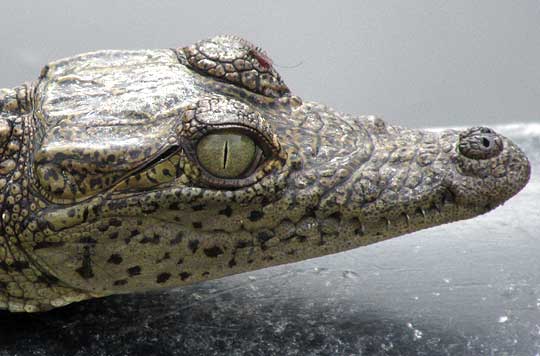
Along the side of the top mandible and toward the front, notice that there's a constriction occupied by an upward-directed tooth. Alligators don't have that upward-pointing tooth, so we know that this isn't an Alligator -- and Alligators aren't found here, anyway. An expert could look just at the above picture and figure out whether it's a Morelet's or American Crocodile, which are the two crocodile species found here, but anyone can see what's behind the critter's back leg, shown below:
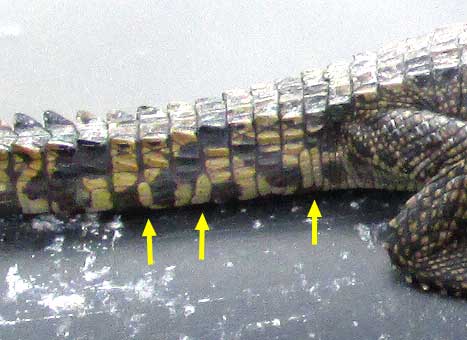
In that picture yellow arrows point to scales curving up from below the tail, wedging themselves between the vertical contact lines separating the upper tail scales that otherwise are neatly stacked atop one another. Such interposing scales on the tail's bottom normally are present on Morelet's Crocodiles but not American ones. The disruption of scale pattern is even more apparent on the animals' bottoms. On American Crocodiles the scale pattern is rigidly grid-like, all scales in neat rows, but on the bottom of Morelet's Crocodiles they're a little haphazard.
from the October 23, 2011Newsletter issued from Mayan Beach Garden Inn 20 kms north of Mahahual; Caribbean coastal beach and mangroves, ~N18.89°, ~W87.64°, Quintana Roo state, MÉXICO
CHRISTINA'S CROCODILE
The other day Newsletter reader Christina near Tulum in the Yucatán sent me some crocodile pictures, asking if I thought she had an American or a Morelet's Crocodile. It was hard to say from the pictures but in the end I figured it was probably a Morelet's, based mainly on the fact that its snout seemed wider than the American's, plus at her inland, swampy location near Tulum Morelet's is what you'd expect. Christina has put together an interesting and well illustrated blog about her family's experience with the croc here.
American Alligators are completely different from crocodiles. You can't see an alligator's teeth when its mouth is closed, but a crocodile's lower teeth are always visible. Also, the alligator's snout is much broader than a crocodile's.
American Crocodiles occur from extreme southern Florida south spottily along the coasts to northern South America, so the Yucatán fall within that distribution area. Morelet's Crocodiles occur only in southern Mexico, Belize and Guatemala. Along the Yucatán's eastern coast American Crocodiles occur mostly in mangroves, coastal lagoons and sand banks, while the Morelet's is found mostly inland in sinkholes, ponds, and flooded savannas.
If you want to know which of our two croc species you have, there's a way to figure it out. Keeping in mind that "maxillary teeth" are those arising in the upper jaw and that they're numbered from the front, Jonathan Campbell in Amphibians and Reptiles of Northern Guatemala, the Yucatán, and Belize tell us the following:
The American Crocodile's snout width at the tenth maxillary tooth is less than or equal to 70% of the distance from the base of the tenth maxillary tooth to the tip of the snout. In contrast, the Morelet's snout is wider -- at the tenth maxillary tooth the snout's width is greater than or equal to 75% of the distance from the base of the tenth maxillary tooth to the tip of the snout.
The tenth maxillary tooth coincides with the snout's constriction about midway the snout's length.