PLANTS | ANIMALS | ECOLOGY | FUNGI | GEOLOGY | GARDENING | TOOLS
MEXICAN PLANTS & ANIMALS HOME

Excerpts from Jim Conrad's
Naturalist Newsletter
from the November 3, 2008 Newsletter written in Yokdzenot, Yucatán, México
MORA, OF KHAKI FAME
The 30-ft-high tree overarching my living space, called Mora by local folks, is flowering nowadays, dangling slender, yellow, three-inch-long aments, seen below:
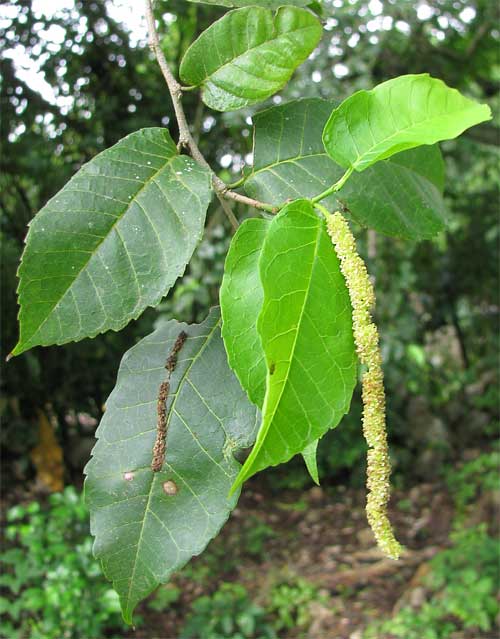
The aments consist of hundreds of simplified male flowers, for Mora is dioecious -- the species comes in male and female trees. If you're familiar with mulberry flowers you might see a resemblance between the two species, and that would make sense because they belong to the same family, the Fig Family, or Moraceae.
In fact, in standard Spanish "mora" means mulberry, but this tree doesn't produce the delicious fruits for which I used to compete with birds back during my hermit days in Mississippi. Mora's fruits are so nondescript that most local people say the tree produces no fruit at all. Certainly the male trees don't, but the females produce small globular fruits about half an inch across (1-1.5 cm).
The Mora in the picture is MACLURA TINCTORIA, and once upon a time this species was much appreciated, not for its small fruits but for its wood. As is the case with North's mulberry wood, Mora woodchips soaked in water produce a yellow dye, and this dye has long been used by the Maya. Certain metals can be added to the soaking water to produce a green dye.
Mora's dyes were most exploited during World War II in the production of the khaki color.
from the July 11,, 2010 Newsletter issued from Hacienda Chichen Resort beside Chichén Itzá Ruins, central Yucatán, MÉXICO; limestone bedrock, elevation ~39m (~128ft), ~N20.676°, ~W88.569°
MORAS FRUITING
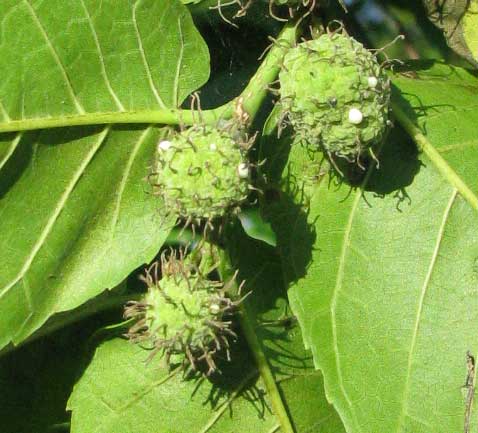
Nowadays the Moras are fruiting, often littering the ground below them with green, softish "fruits." You can see some half-sized, immature ones on a limb below:
In Spanish the word mora means mulberry. The North's mulberries belong to a different genus, but the same family. Thus, Mora "fruits" are very similar to mulberries, but not really the same.
Mora trees are "dioecious," which means that their flowers are unisexual, and each plant bears flowers of only one sex -- there are male and female trees. Back in Yokdzenot we got a boy tree, and here we have a lady. The greenish "hairs" on the above "fruits" are styles, which are the "necks" connecting pollen- receiving stigmas or stigmatic surfaces with the ovaries. Each of the three "fruits" in the picture is technically a collection of many actual fruits packed very closely together. If this arrangement reminds you of the much larger, harder, green, bumpy fruits of the US's Osage Orange trees, that's because Osage Oranges belong to the same genus, Maclura. Osage Oranges, then, are much closer related to Moras than the North's mulberry trees.
The white droplets on a couple of the "fruits" in the picture are milky juice, just like what exudes from vegetative parts of mulberry trees and Osage Oranges when they are injured. The droplets already were visible when I arrived so I guess an insect had tried for a snack and probably the milky sap gummed up its mouthparts and drove it away, which is at least one service the sap provides the plant.
Mora's fruits are edible, and not bad, but not really tasty enough for people around here to go gathering them. If there's a nice one on a branch before them, they might plop it into their mouths. Once Moras were highly regarded because their wood produces a bright, yellow dye. During World War II Mora contributed to the Allied cause by producing a dye used to color soldiers' khaki uniforms. Its commercial name was Fustic.
from the September 12,, 2010 Newsletter issued from Hacienda Chichen Resort beside Chichén Itzá Ruins, central Yucatán, MÉXICO; limestone bedrock, elevation ~39m (~128ft), ~N20.676°, ~W88.569°
MORA SAWDUST
I'd been helping Luis pull Picapica vines from his milpa, or cornfield, and as I was leaving the milpa area I came onto a spot where Luis had felled a dead tree to make way for more milpa. What I saw is shown below:
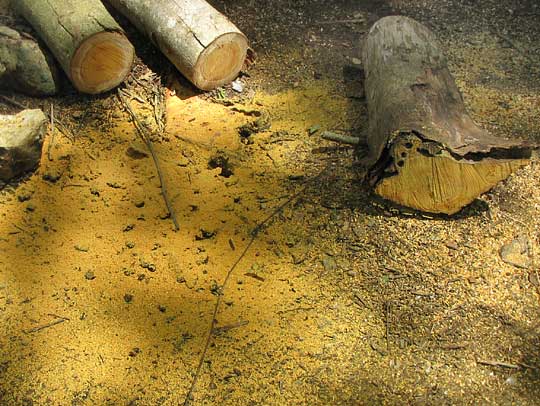
What's interesting is that the sawdust is so orange, which relates to the wood's use as a dye discussed above.
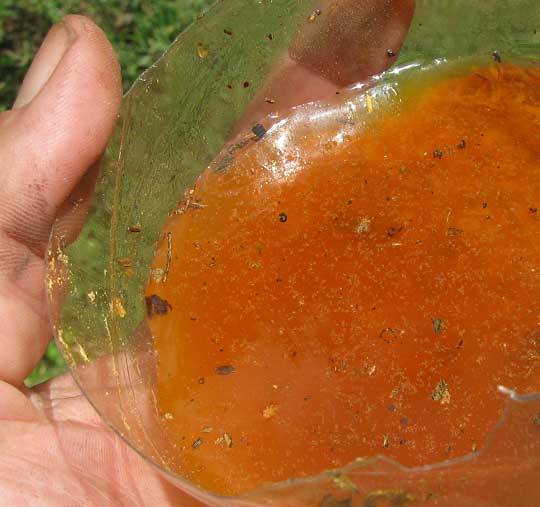
I collected some sawdust and soaked it in water overnight. The result is shown below: