PLANTS | ANIMALS | ECOLOGY | FUNGI | GEOLOGY | GARDENING | TOOLS
MEXICAN PLANTS & ANIMALS HOME

Excerpts from Jim Conrad's
Naturalist Newsletter
from the January 24, 2010 Newsletter issued from Hacienda Chichen Resort beside Chichén Itzá Ruins, central Yucatán, MÉXICO; limestone bedrock, elevation ~39m (~128ft), ~N20.676°, ~W88.569°
MOTHER-IN-LAW TONGUES FLOWERING
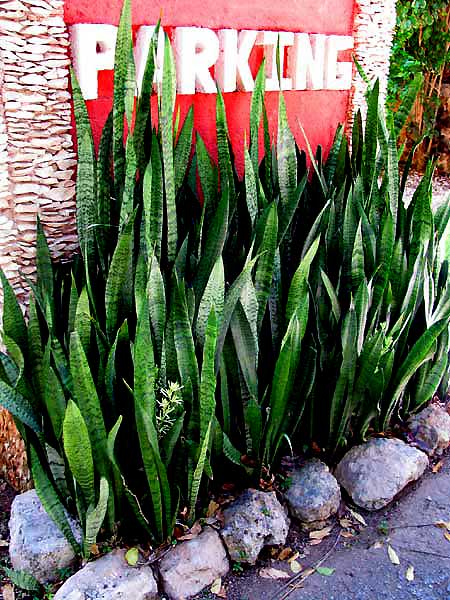
Above most Northerners will recognize Mother-in-law Tongues, SANSEVIERIA THYRSIFLORA, commonly grown indoors as potted plants up North. The ones in the picture, though, are definitely doing well living outside here, and they're doing two things most of you may have never seen potted ones do: They're growing much taller than potted ones up North, and; two plants are flowering, which they seldom do up North.
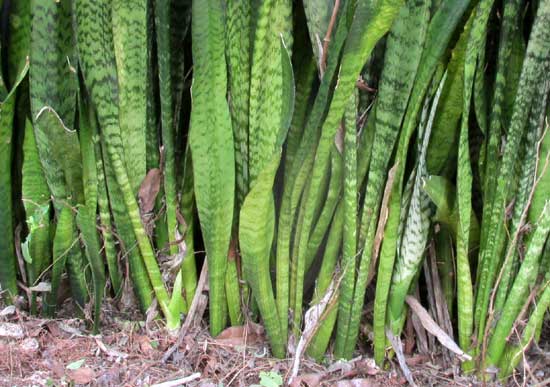
Mother-in-law Tongues, native of southern Africa, down here regularly grow four and five feet tall. Often they "go wild," forming thickets as large as a house and with blades so packed together that a rabbit would have to work hard to get through them.
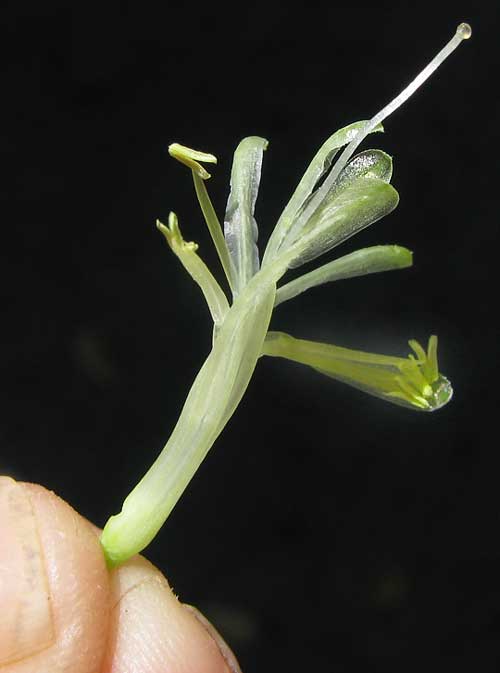
Above you can see that Mother-in-law flowers bear six pollen- producing stamens and six perianth lobes. "Perianth" is the term used for the segments of the corolla-like part of a flower when the calyx and corolla are indistinguishable. In the picture the items looking like frankfurters split about half their lengths with the parts diverging are anthers. Anthers are the baglike part of the stamen in which pollen is produced.
A flower's female part, or pistil, consists of the stigma, style and ovary. In the picture the spherical, translucent item at the picture's extreme top, right corner is the stigma, which is where pollen grains land and germinate. The long, slender, white thing below it is the style, which is the ovary's "neck." The ovary itself is hidden.
from the September 25, 2016 Newsletter issued from Rancho Regensis north of Valladolid, Yucatán, MÉXICO;
elevation ~40m (~130 ft), N~20.876°, W~88.170°
MOTHER-IN-LAW TONGUE FENCES
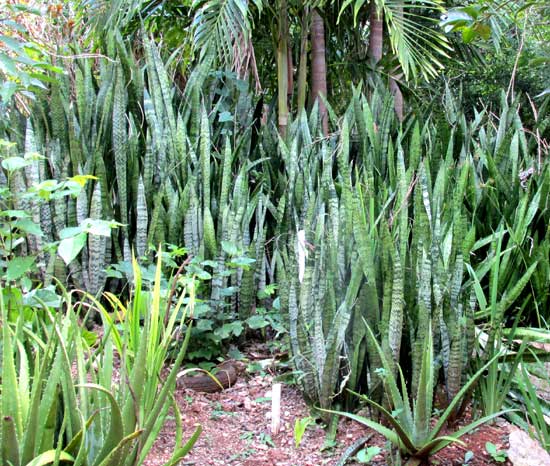
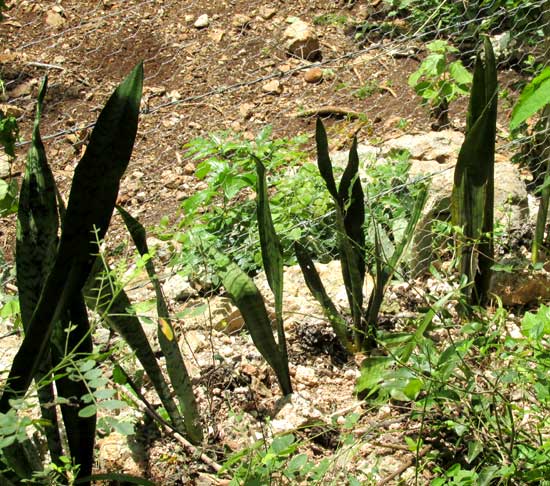
I like to do physical labor each morning so one of my projects at Rancho Regenesis is to transfer Mother-in-law Tongues from a spot where there's too many, to the bases of chicken-wire fences surrounding the chicken pen. Once the plants sprout new shoots and grow together, they'll help keep out chicken-stealing critters like weasels. In areas like ours with naked limestone poking through very thin soil, Mother-in-law Tongue can form impenetrable, uninterrupted communities the size of a house and larger. Below, you can see a small bunch at the Rancho:
The plants issue finger-thick, horizontal rhizomes that creep over the bare rock while themselves producing tough, intricately branching networks of secondary roots. In such shallow soil you can lift up large mats of plants fused together by their interwoven rootlets, as shown below:
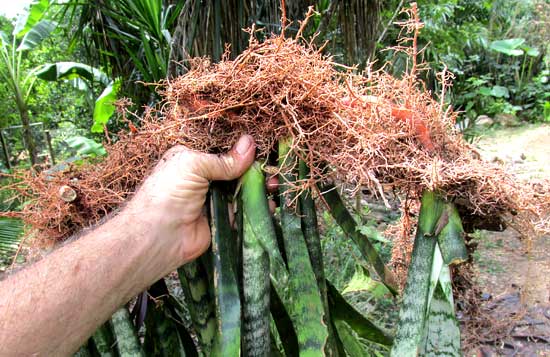
The roots' orangish color is striking. I've read about other species with orangish roots in which the orangish element consisted of mycorrhiza -- a kind of fungus living symbiotically with the roots, often helping the host plant with its nutrition. I'm unsure if that's happening here, but it's a good guess.
The soil here is too thin to bury the chicken wire in, so the wire's flaring-out bottom is simply covered with shoveled-on dirt and gravel. The Mother-in-law Tongues are rooted as well as they can be in this same dirt. After the plants' roots and the chicken wire all grow together, they should form a good barrier. Below, you can see newly rooted plants:
Once each plant develops a few new sprouts, the openings between plants will close up. Below, you can judge for yourself the effectiveness of the resulting above-ground barrier by looking at a spot where they've already grown together: