PLANTS | ANIMALS | ECOLOGY | FUNGI | GEOLOGY | GARDENING | TOOLS
MEXICAN PLANTS & ANIMALS HOME

Excerpts from Jim Conrad's
Naturalist Newsletter
from the May 17, 2015 Newsletter issued from Río Lagartos, on the Yucatan Peninsula's northern coast (~N21.60°, ~W88.16°), Yucatán state MÉXICO
MEXICAN PONYTAILS FLOWERING
These days at the dry season's end are the hottest, driest of the year for us. I'm grateful to be on the coast where nice breezes off the Gulf begin stirring in early morning, and by afternoon can raise white caps on the estuary. The wind feels good, and imparts to the landscape a wild, hard, edgy feeling, a kind of nervous tension that keeps one alert. Especially out in the dry scrub or thornforest south of town the wind howls, tree branches gyrate, and the occasional tall cactuses and Mexican Ponytails suggest ragged giants laughing in the wind. Below, you can see a Mexican Ponytail, BEAUCARNEA PLIABILIS -- but remember that the blades of its grass skirts convulse and the wind whistles around its stiff stems:
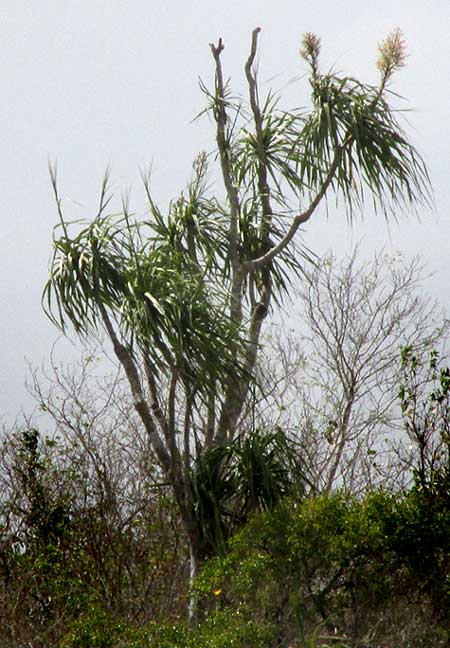
I first learned about Mexican Ponytails back in 1972 when I bought a potted one at the Missouri Botanical Garden, where I'd just taken a job. It was about two feet high then but years later it reached the ceiling. Its stem remained unbranched, but you can see that the big ones around here branch freely. The reason I've waited until now to feature our wild Mexican Ponytails is that now they're flowering. A close-up of a diffuse panicle-type flower cluster, or inflorescence, is shown below:
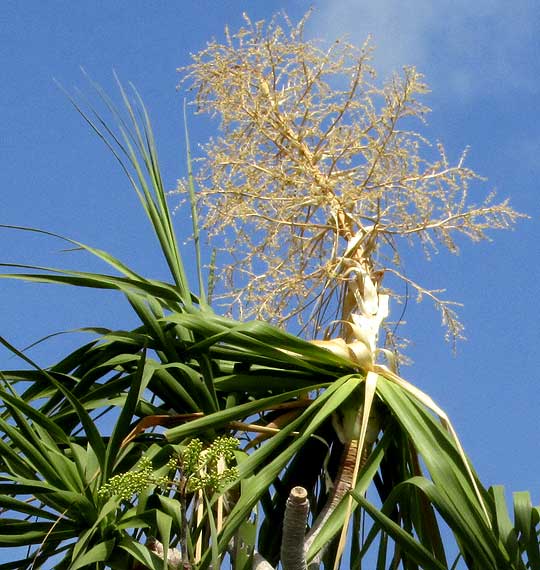
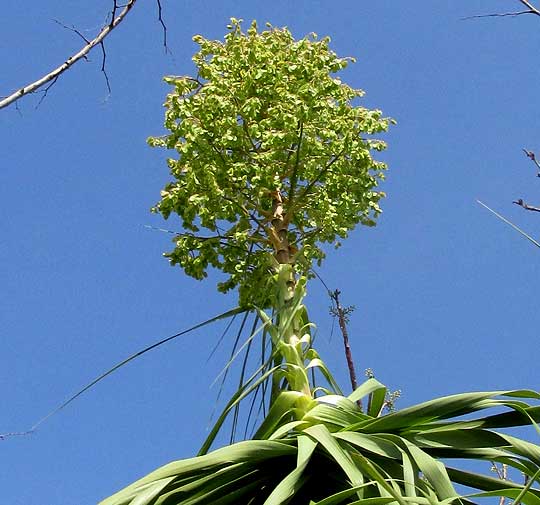
I assume that that inflorescence bears or bore only small male flowers, for other plants nearby bore dense panicles heavy with fruits, as seen below:
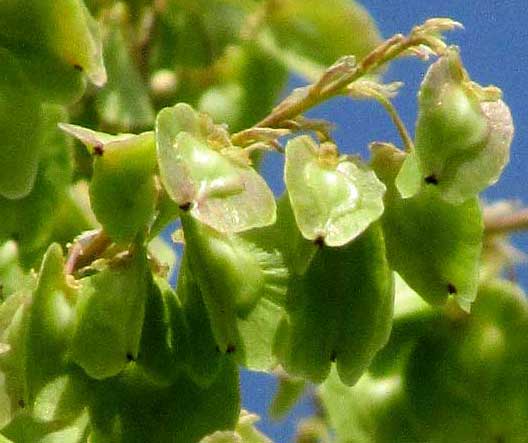
Up close the fruits showed themselves to be three-cornered, with each corner bearing a papery "wing" that eventually will help with wind dissemination, as you can see below:
Other names for Mexican Ponytail are Ponytail Palm, Red Ponytail Palm, and Bottle Palm, which miss the point that Mexican Ponytail is not the least a palm -- not a member of the Palm Family. In Spanish its main name is Despeinada, which means "un-combed" or, more loosely translated, "Shaggy-head," and that may be the best common name.
If Mexican Ponytails aren't palms, what are they? Taxonomists still disagree about that, having shifted them between a variety of families in and around the Lily Family branch of the Phylogenetic Tree of Life. Currently the trend is toward the Asparagus Family, the Asparagaceae, but some retain it in the Nolinoideae, which used to be the Ruscaceae, and in the old days they were all part of the Lily Family, so who knows? But they're not palms.
In fact they are just a distinctive and character-imparting member of the thornforest vegetation here, and a species unlike anything else here. When its long leaves swoosh in the hot, fitful afternoon wind beneath such a bright sky, it feels good just to see it being itself.
from the November 27, 2006 Newsletter issued from Diego Nuñez's office above Restaurante "Isla Contoy," in Río Lagartos, on the Yucatan Peninsula's northern coast (~N21.60°, ~W88.16°), Yucatán state, MÉXICO
MEXICAN PONYTAIL
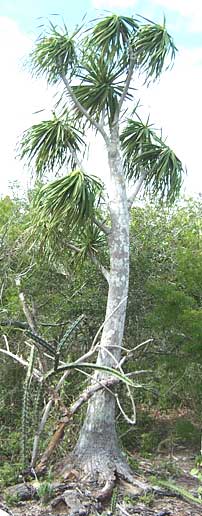 Most of my hike back to town took place in cattle-chewed, cactus-rich scrub. On my second night out I camped next to a plant some potted-plant-loving North Americans might find vaguely familiar, the one shown at the right.
Local Mexicans call it Palmilla, saying it's a kind of palm, but if you look closely you'll see that it's very unpalmlike. For one thing, it's stem branches, and palm trunks rarely branch. For another, the leaves are neither palmately nor pinnately compound, like the vast majority of palms, but rather are long and slender like a sword's blade.
In fact, this palmlike tree is a member of the Lily Family, not the Palm. In North America small potted specimens with gray trunks expanding enormously at their bases, and topped with topknots of arching, slender, green blades are sold under the trade names of Mexican Ponytail, Ponytail Palm, Bottle Palm, Elephant's Foot and other names as well. The species sold in pots is usually Beaucarnea recurvata.
This Mexican Ponytail rose above the surrounding low, thorny scrub rather majestically, lending the landscape an extra touch of exotic feeling. In the picture you can see its swollen trunk-base, explaining one of it's names, "Elephant's Foot." This swollen trunk serves as a water-storage structure. Overwatered, store-bought potted specimens often possess grotesquely large, spherical boles with teeny, green topknots.
On the night I pitched my tent next to the Beaucarnea in the picture the wind roared across the scrub from dusk to dawn. Several times in profound darkness I awakened and just listened to the wind streaming through the tree's jutting-out branches and causing its stiff blades to flap and clack against one another. It was a homey feeling lying beside such a distinguished being, knowing its roots ran beneath where I lay on the ground.
In the morning an endemic Yucatan Wren came with its husky krrohrrrrr complaint glaring at my tent as he hung onto the Beaucarnea the way you expect a wren to do, even an endemic one.
"Krrohrrrrr yourself," I replied similarly huskily, feeling just splendid, with a full night of wind-roar and Beaucarnea-flapping and -clacking energy churning around inside me.
from the November 10, 2008 Newsletter written in Yokdzonot and issued from a ciber in Pisté, Yucatán, MÉXICO
MEXICAN PONYTAILS
Here and there in the woods and sometimes planted around people's homes you run into a succulent-stemmed plant you've probably seen many times as a potted plant or indoor-garden ornamental. It's shown below:
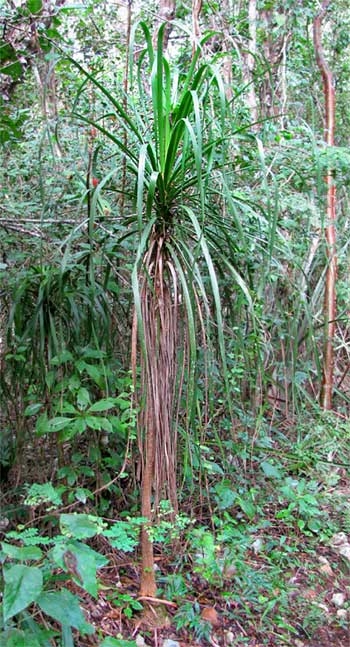
At its base the plant abruptly enlarges into a bulbous water-storage organ, in the picture mostly concealed by leaf litter. In plant shops often the overwatered plants on sale consist of nothing but brown, turnip- like bases from which long, green blades sprout. A Mexican Ponytail may grow for years maintaining its single slender stem but eventually if given a chance side branches develop. I've seen much-branched plants 15 feet tall and taller.