PLANTS | ANIMALS | ECOLOGY | FUNGI | GEOLOGY | GARDENING | TOOLS
MEXICAN PLANTS & ANIMALS HOME

Excerpts from Jim Conrad's
Naturalist Newsletter
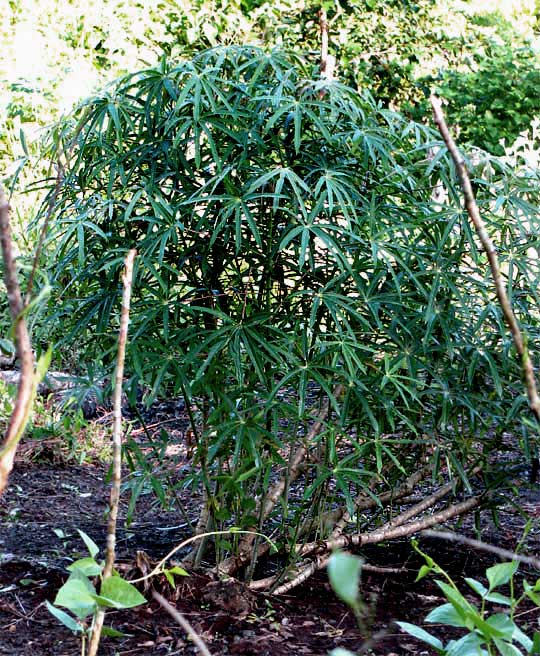
from the November 3, 2006 Newsletter written in Yokdzonot, Yucatán, MÉXICO From time to time here you run into a garden in which is planted the digitately-compound-leafed shrub shown above. That's the Manioc plant, sometimes called Tapioca-Plant or Cassava in English, and here usually referred to as Yuca, which is very confusing to those with Joshua-Tree Yuccas on their mind. It's MANIHOT ESCULENTA, native of Brazil and cultivated throughout the world's tropics for its large, fleshy roots, which when boiled produce a starchy food not unlike boiled potatoes. In certain parts of the world it's the main staple but in Mexico where corn and beans reign it never reached as high a status as in some places. It's not common here, probably because it's a bit too dry for it. Cassava's digitately compound leaves may remind you of both the Marijuana plant and the Castor-Bean. The similarity with Marijuana is purely incidental, but with regard to the Castor-Bean it makes since because Cassava and Castor-Bean belong to closely related genera in the same family, the Euphorbia or Spurge Family, the Euphorbiaceae. The plant in the picture grows beside several other Cassavas at the edge of a neighbor's bean patch. At the bottom left you see a bean vine twining up a pole stuck there for the purpose. Squash vines also were planted there. In the old days of my backpacking in Guatemala I ate a lot of "Yuca," buying it in white, bite-size cubes sold by Indian ladies from cloth-covered baskets. It was a carbohydrate even cheaper than tortillas and in its own way just as tasty. This plant should be grown more in the tropics, and it's a shame it doesn't last long in temperate gardens. One problem with Cassava's root is that it must be boiled pretty vigorously to soften it and break down its very poisonous chemicals.
CASSAVA/MANIOC/TAPIOCA/YUCA
from the November 19, 2017 Newsletter issued from Rancho Regensis north of Valladolid, Yucatán, MÉXICO;
elevation ~40m (~130 ft), N~20.876°, W~88.170°
CASSAVA FLOWERING
At Rancho Regensis we grow Cassava but no one who knows how to tend the plants has been caring for them, so either they've been producing no edible tubers, or else the tubers have turned out too woody to eat. I'm experimenting with them and hope later to show you how I produced a bounteous crop, but who knows what luck I'll have. Meanwhile, my plants, which are about 12ft tall (3.7m) are flowering. Below, you can see a few Cassava blossoms at the top of a plant:
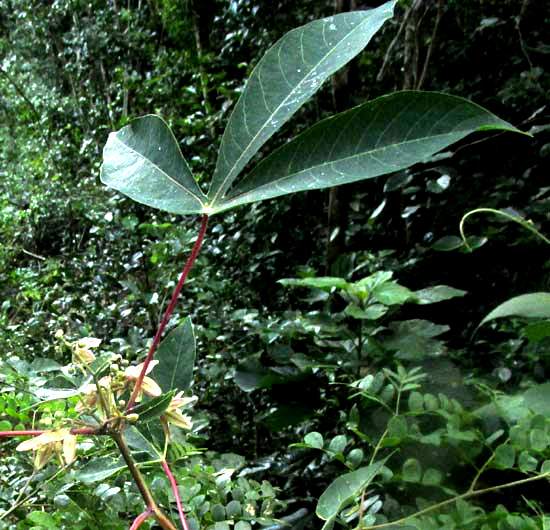
Cassava belongs to the Euphorbia/ Poinsettia Family, the Euphorbiaceae, in which plants produce unisexual flowers either together on the same plant (in which case the plants are said to be monoecious) or on separate male or female plants (diocious). Cassava plants are monoecious, so each plant may bear both male and female flowers. One of my Cassavas' surprisingly handsome male flowers is shown below:
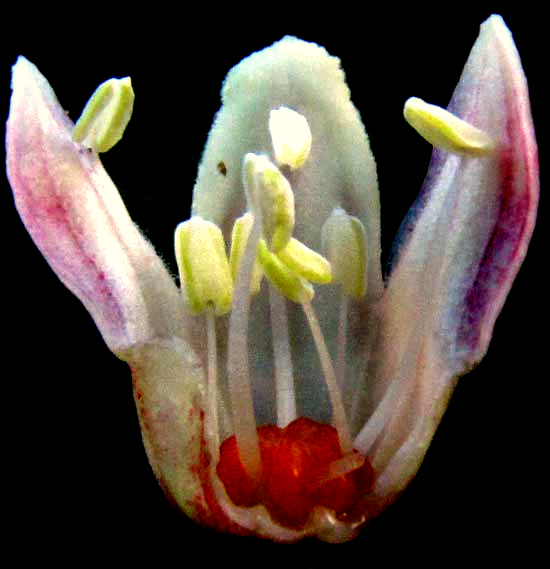
Interesting features to note incoude that there is no corolla, but rather the calyx, which is green in most flowers, is colored and assumes the role of the corolla. Also, the pollen-producing stamens are of two distinct lengths, one series with its anthers on very short filaments and arising from the inside faces of upper calyx lobes, while the others produce anthers atop long, slender filaments arising from between lobes of a reddish-orange disc in the calyx's bottom. This is very different from that of a female flower shown below:
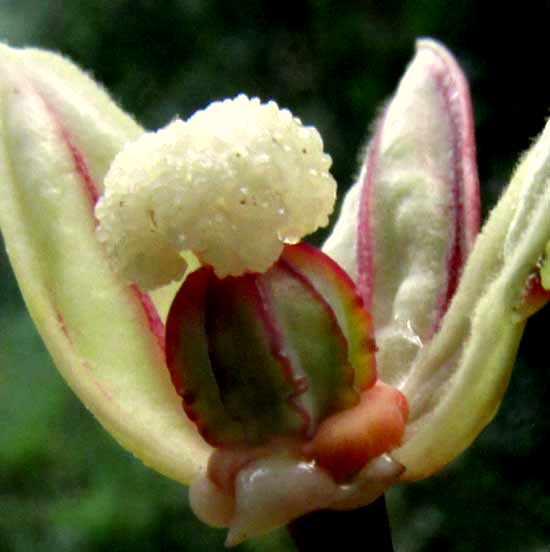
The white, cauliflower-like thing atop the ribbed ovary is the stigma. The ovary will ripen into a ±spherical, or "globose" capsule about half an inch across (12mm), and displaying six winged angles. In the above picture, note the milky liquid below the orange disc. It's normal for members of the Euphorbia Family to exude white or other-colored sap from its wounds.
Later I hope to show how I harvested, prepared and ate some big Cassava roots.
from the December 10, 2017 Newsletter issued from Rancho Regensis north of Valladolid, Yucatán, MÉXICO;
elevation ~40m (~130 ft), N~20.876°, W~88.170°
DIGGING CASSAVA
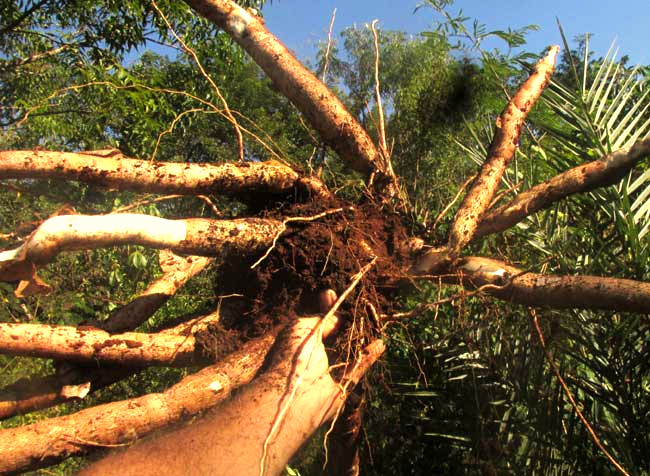
This week I pulled up one of my 12ft tall (3.7m) plants, and found what's shown below:
The roots' most swollen, edible parts cut and piled into a heap are shown below:
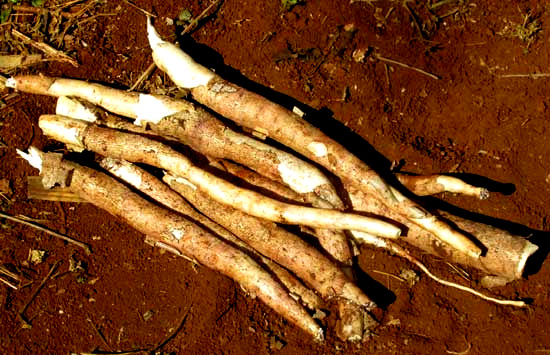
To prepare the roots, first with a knife blade I scraped off the brown skin, which was paper thin and easy to detach. Beneath the skin the flesh was pure white. Then I cut the roots into finger-long sections, and put them in water in a pot over a campfire. After about 45 minutes of cooking, a fork could be inserted into them as easily as if they were well cooked potatoes.
Not only does cooking soften the flesh, but also it neutralizes toxins in the root. Those toxins repel root-eating animals , and present a danger to humans who eat them raw. The cooking water must be thrown out. I've been told that the roots must be cooked twice, the second time after the water is discarded, but my Maya friends who grow it and eat it regularly say they just cook theirs once. I cooked mine once, had no problems, and the roots tasted a lot like boiled potatoes, just as they are supposed to.
Running down the centers of most roots there were slender, stringlike, somewhat woody strands. I'm told that this is normal, but wonder if roots grown under ideal conditions, or at least in a rainier climate and looser soil, would have them. I don't see such strings mentioned in Internet discussions about the root.