PLANTS | ANIMALS | ECOLOGY | FUNGI | GEOLOGY | GARDENING | TOOLS
MEXICAN PLANTS & ANIMALS HOME

Excerpts from Jim Conrad's
Naturalist Newsletter
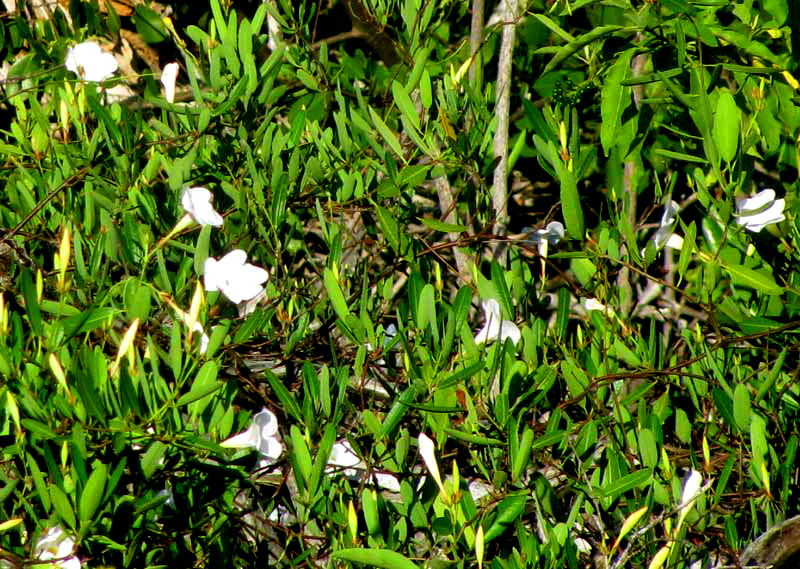
from the July 17, 2011 Newsletter issued from Mayan Beach Garden Inn 20 kms north of Mahahual; Caribbean coastal beach and mangroves, ~N18.89°, ~W87.64°, Quintana Roo state, MÉXICO
MANGROVE VINE
Lately dense, vine-overgrown edges of mangrove swamps have been breaking out with white, yellow-throated, 1.5-inch-wide (4cm) morning-glory-like flowers, shown above. A close-up showing how white corolla lobes expand from the top of fairly slender corolla tubes is shown below:
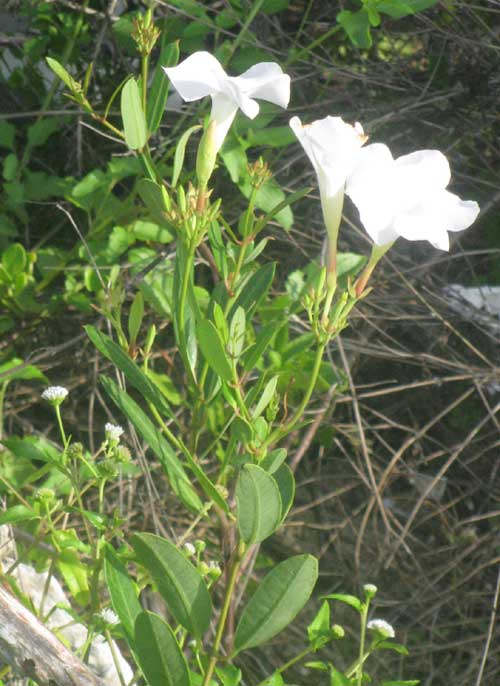
These aren't morning-glories, though. If you make a longitudinal section of a flower you see what's shown below:
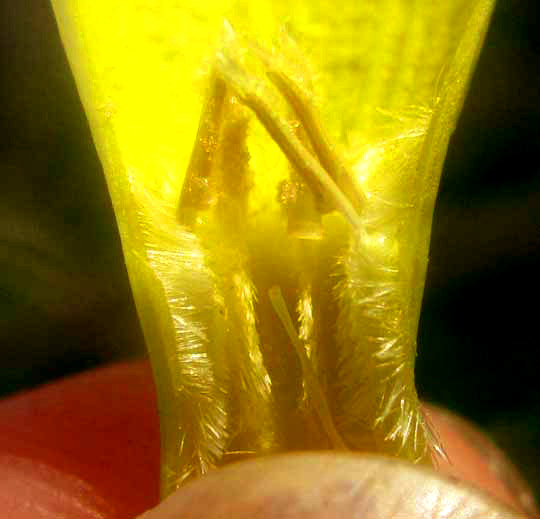
So, you have a blossom composed of a narrow tube at the top of which five petal-like lobes expand out, and at the flower's throat five pollen-shedding anthers with very short or missing filaments converge like a tepee over the stigma. All this is exactly like the flower of the commonly cultivated Madagascar Periwinkle. A conspicuous difference, however, is that the pluglike stigma head is missing. In the mangrove blossom, the stigma is slender -- lacks the "plug". In the last picture you can see the slender, hairless style with its tiny stigmatic tip making its way up the center of the split-open corolla tube.
This vine, which lives in mangroves and marshes from southern Florida and southern Mexico south through northern South America, goes by the English names of Mangrove Vine, Rubber Vine, and Mangrove Rubber Vine. It's RHABDADENIA BIFLORA, and as you might expect with such structurally similar flowers, it belongs to the same Dogbane Family as the Madagascar Periwinkle, the Apocynaceae.