PLANTS | ANIMALS | ECOLOGY | FUNGI | GEOLOGY | GARDENING | TOOLS
MEXICAN PLANTS & ANIMALS HOME

Excerpts from Jim Conrad's
Naturalist Newsletter
from the November 27, 2006 Newsletter iwritten at Hacienda San Juan near Telchac Pueblo, northwestern Yucatán, México
RED MANGROVE'S SELF-ROOTING FRUITS
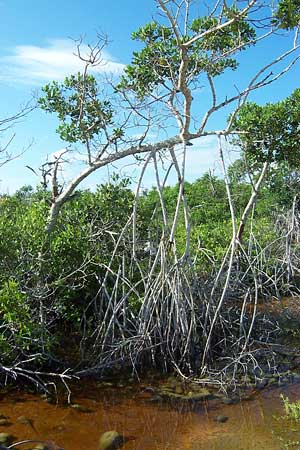
Of the four mangrove tree species constituting the mangroves here, Red Mangrove, RHIZOPHORA MANGLE, is the most eye-catching. It's the one with gangling "stilt-roots," as shown above. Red Mangrove inhabits the deepest water of the four species, and its fruits are the most curious-looking. You can see a fruit photographed during my hiking trip below.
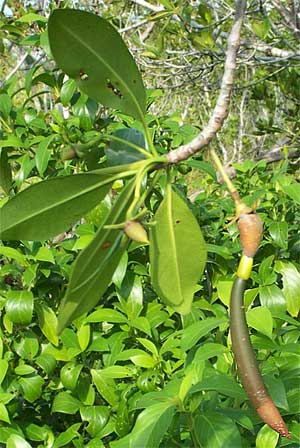
That picture shows two Red Mangrove flowers with fruits developing from the ovaries in the flowers' centers. The fruit on the right is much more developed, as indicated by the fact that inside it a seed has already germinated and now a very sizable root (technically the radicle, since it's the seed embryo's first "root") is emerging from the fruit, pointing downward.
The dangling "root" is about eight inches long. Sometimes when the fruit falls from its flower the "root" stabs into the mud, thus planting a new Red Mangrove right beneath the parent tree. More typically, however, the fruit with its "root" falls into water and floats away. When the "root" makes contact with mud it grows into it and then the tree develops as you'd expect. Still, it's fun to know that a Red Mangrove fruit, at least under certain conditions, can actually plant itself.
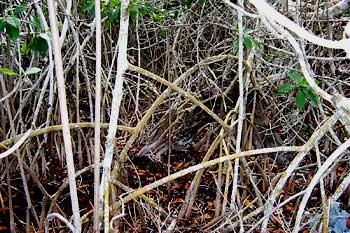
Mother Nature almost always prefers for offspring to settle farther away from the parent so that parent and offspring don't end up competing for the same resources. Red Mangrove may constitute an exception, however, since one of Red Mangrove's traits is that they often grow so closely together that their stilt roots interlock, forming impenetrable thickets that are the delight of shelter-seeking wildlife. Also, they catch soil particles that otherwise would wash away, building up the land. You can see a view through a maze of Red Mangrove stilt-roots below.
from the September 25, 2011 Newsletter issued from Mayan Beach Garden Inn 20 kms north of Mahahual; Caribbean coastal beach and mangroves, ~N18.89°, ~W87.64°, Quintana Roo state, MÉXICO
RED MANGROVE FLOWERING
The Red Mangrove's long-rooted fruits hanging on the tree are so attention-getting that the flowers preceding them often are overlooked. You can see how the pale yellow, leathery, star-shaped flowers arrange themselves in few-flowered, long-stemmed clusters from leaf axils below:
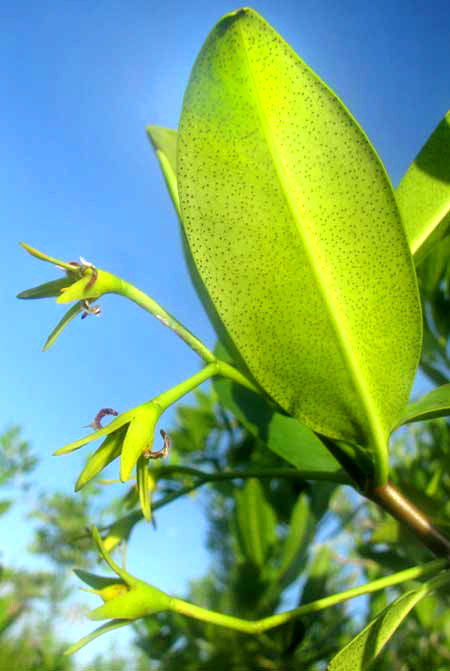
A picture of a little-less-than-inch-wide (2cm) flower with four pale yellow, leathery sepals and four whitish petals with cottony hairs on their inner surface, and eight stamens, can be seen below:
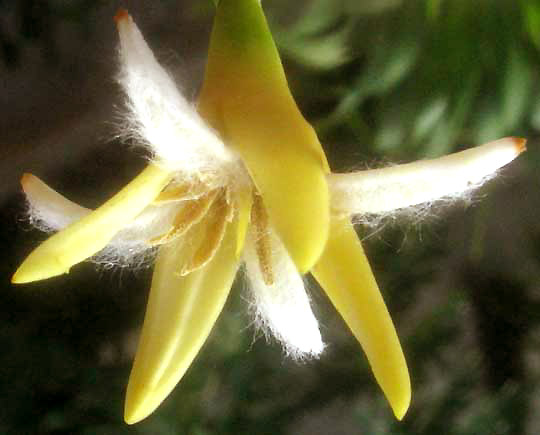
I'm guessing that the petals' hairiness provides footholds for visiting pollinators. The ovary is " inferior," meaning that the other main floral parts arise at the ovary's top instead of at its base. The resulting fruit is a little over an inch long (3cm), dark brown, and contains one seed which, as we saw, germinates while still on the tree. Plants producing such seeds are said to be "viviparous."
from the May 31, 2015 Newsletter issued from Río Lagartos, on the Yucatan Peninsula's northern coast (~N21.60°, ~W88.16°), Yucatán state, MÉXICO
SALT, & YELLOW RED-MANGROVE LEAVES
We've seen that Black Mangrove and White Mangrove take up seawater through their roots, then excrete excess salt through pores, or salt glands, on their leaves and/or petioles. I'd been told that the Red Mangrove's technique for ridding itself of excess salt was by simply dropping its older, salt-saturated leaves, at which point the leaves would have turned yellow. Here at the end of the dry season when the estuary's waters are most salty, I'm seeing more yellow leaves on Red Mangroves than during rainier times, so I've been assuming that there were more yellow leaves because now the trees have more salt to rid themselves of. Below, you can see a typical Red Mangrove branch with yellow leaves:
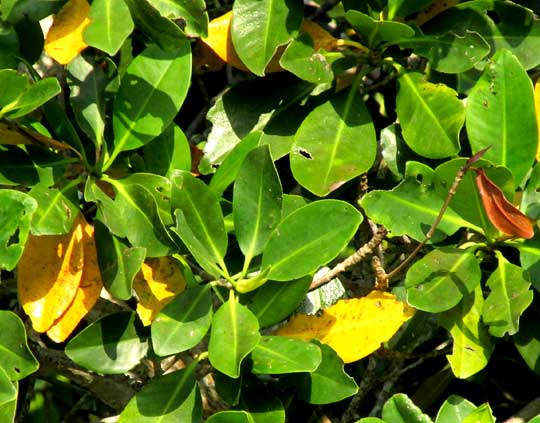
But, I like to confirm things I hear, and I can't confirm this neat little story about Red Mangroves disposing of excess salt by dropping yellow leaves. On the other hand, I've found reference to plenty of evidence that Red Mangroves filter most salt from saltwater before it enters their roots.
Instead of relying on salt excretion, Red Mangroves practice salt exclusion.
So, who knows why nowadays more yellow leaves appear on the Red Mangroves than usual?