PLANTS | ANIMALS | ECOLOGY | FUNGI | GEOLOGY | GARDENING | TOOLS
MEXICAN PLANTS & ANIMALS HOME

Excerpts from Jim Conrad's
Naturalist Newsletter
from the November 20, 2010 Newsletter issued from near Río Lagartos, northern Yucatán, MÉXICO
GRASSHOPPER DISORIENTATION
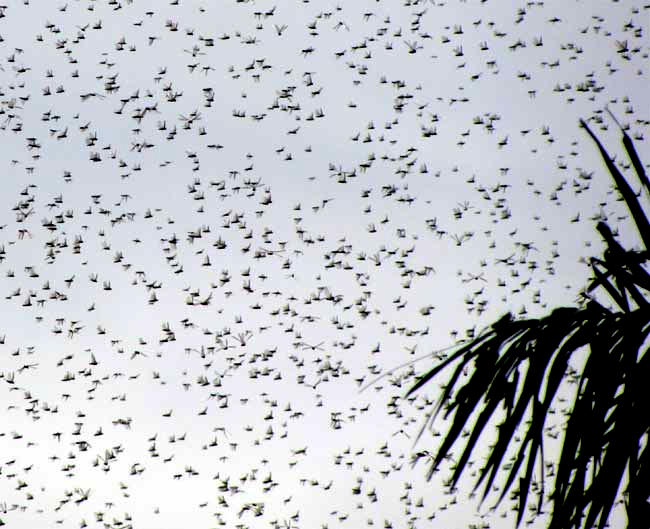
Tuesday morning I was walking along the road to Las Coloradas when movement caught my eye in the weeds, and there was a rustling sound. At first my mind couldn't digest what I then saw and heard. The impression was of grass smeared heavily with something greasy, crumby and Tabasco-sauce red. The movement was diffuse and uncoordinated. There were fluttering sounds, and sounds like cellophane being rustled.
This disorientation lasted only a second or two but it was creepy enough to do for a long time. I took a picture of what I was looking at and you can see it below.
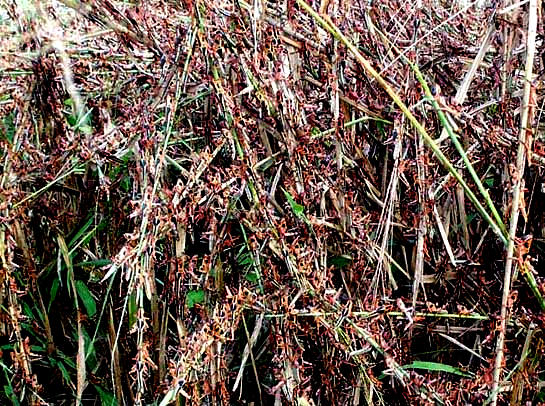
I got closer, and details emerged. Grasshoppers, millions of them... The picture below shows what I saw.
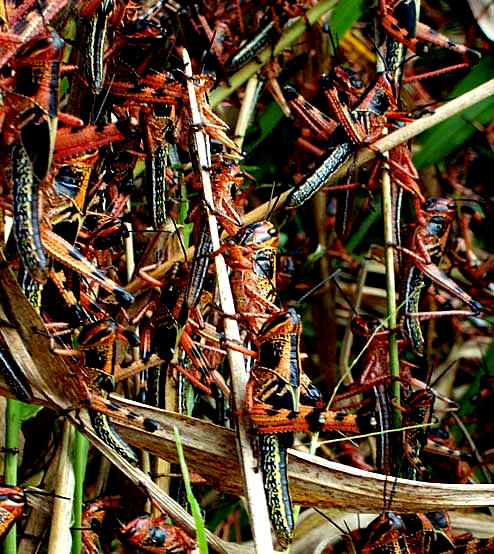
Long-time readers may recall my December 5th, 2004 Newsletter when I reported that "a whole black cloud of grasshoppers (in the sky) was moving from east to west, a fast-moving cloud maybe 150 feet thick and a quarter mile wide, a dark river of grasshoppers stretching from horizon to horizon." {That report follows this one.}.
I think that Tuesday I saw what could possibly be the beginning of something like that 2004 cloud of locusts.
In the close-up picture linked to above notice that though the grasshoppers themselves are fairly large their wings are only beginning to develop. The grasshoppers in the picture couldn't fly because their wings were only a third or a fourth as long as they'll eventually grow. In the picture, the wings are black with yellow rims.
Tuesday's mess of grasshoppers extended about 30 feet up the road and maybe ten feet into the grass. Across the road lay another concentration, that one a little longer and maybe 20 feet deep. Beyond these two well defined populations I didn't see a single other grasshopper.
Clearly there weren't enough grasshoppers here to form a cloud of locusts. However, if many other gatherings such as these dot the countryside then in a couple of weeks -- in early December, as in 2004 -- who knows whether or not the dark, sinuous clouds will rise into the sky again?
from the December 5, 2004 Newsletter issued from near Dzemul, northwestern Yucatán, MÉXICO
LOCUSTS!
A little after mid-day on Wednesday I was out on the highway painting a large, flat rock with the words "Bed & Breakfast... in a private nature reserve," trying to stir up some business for Komchen. It was about 87°, the sun glared intensely on the white-painted rock and I sweated profusely. The stiff afternoon wind was all that kept me going. Still, I was so hot that when the sign I was painting started to flicker, I thought I was having a hypoglycemia attack, which usually starts with things flickering.
But the letters weren't dancing, just the white background. Then I realized that fast-moving, ill- defined, jiggly shadows were animating the white space. I looked up and saw grasshoppers falling from the sky, lots of them. Then I looked higher and a whole black cloud of grasshoppers was moving from east to west, a fast-moving cloud maybe 150 feet thick and a quarter mile wide, a dark river of grasshoppers stretching from horizon to horizon.
I was sitting on a gravelly spot so I lay back and looked straight up. It was like the time on the Kentucky farm back in the 50s or early 60s when early one winter morning huge snowflakes began falling from a single dark cloud above, and sunlight slanted in beneath the cloud absolutely exploding inside the big flakes. But here sunlight detonated in grasshopper wing-flutter, and it was something to see all that brilliant wing-flutter haloing the sun in blue sky.
Well, when there are so many grasshoppers as this, they're called locusts.
I got up to go see what an individual locust looked like. As grasshoppers usually go, these were large ones, about 2.5 inches long, and unusually pretty, the base color being a rich chestnut, darkening to a deep mahogany, boldly striped with yellow, with some to a lot of red. Around the head area they were striped like zebras.
At first I thought there wasn't many on the ground, but then I scanned the weeds with my binoculars and got a sinking feeling in my stomach when I saw that in some places the weed patches showed more locust surface area than plant. I couldn't understand why they weren't eating, but when I took a step closer and they launched into the air like popcorn popping, I realized that they'd not been eating because they were watching me, trying to figure out what I was up to. The insight that the locusts weren't behaving like mindless automatons on an instinctual rampage, but that each of the millions of little beings around me was acutely alert and taking care of its own business gave me a chill.
Now the sky-river of flowing locusts got dark and some parts of the river were darker than others. The sky- river moved like a snake. Sometimes it flowed right overhead, sometimes it shifted to the south or north. When a particularly dark smudge of them passed directly overhead I could hear them, a soft, wet sound a little like an enormous swarm of bees, but without the buzz, like an infinity of softly rustling cellophane.
I've always wondered how giant locust clouds flew so high and so far, because no grasshopper I've ever seen could fly more than a stone's throw away. Now I could see that the locusts around me didn't seem much better at flying than normal grasshoppers. I think I have it figured out that when a grasshopper on the ground flies up and catches the wind, he can fly a long way and be part of a locust cloud, but, if the wind dies on him, he just falls back like a regular grasshopper.
The river of locusts streamed past for between 2.5 and three hours, gradually changing from flowing east to west, to north to south. Some older people I talked to said they'd seen many locust clouds, but never any this big, while others said they'd seen even larger clouds.
As for me, my whole sense of what is possible in nature has been challenged. How can any ecosystem support such huge numbers of hungry grasshoppers? The enormity of what I saw on Wednesday is something my sense of propriety simply cannot digest.
The FAO "Locust Hub" provides information, maps and resources about the state of the locust upsurge and the UN's ongoing response efforts at https://locust-hub-hqfao.hub.arcgis.com/.
from the January 12, 2009 Newsletter issued from near Telchac Pueblo, northwestern Yucatán, MÉXICO
A SKY-RIVER OF LOCUSTS
Yesterday afternoon, Sunday, as I was finishing up this Newsletter I stepped outside to shake the stiffness from my legs and saw what's shown at the top of this page.
Locusts, millions and millions of them streaming southwestward in a vast, sinuous, constantly form-changing sky-river, causing a deep ommmmmmmmmm in the sky, absolutely breathtaking. The picture doesn't capture the power in their irrepressible movement but at least it hints at the numbers. I ran onto my hut's flat concrete roof and saw that the river stretched from horizon to horizon, that it parted and merged here and there, and it twisted and bent like an endless, squirming snake.
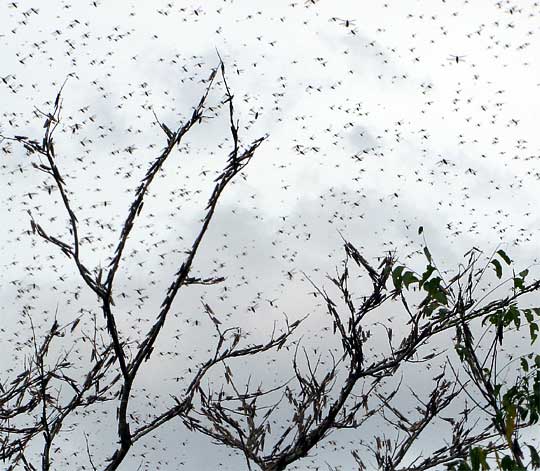
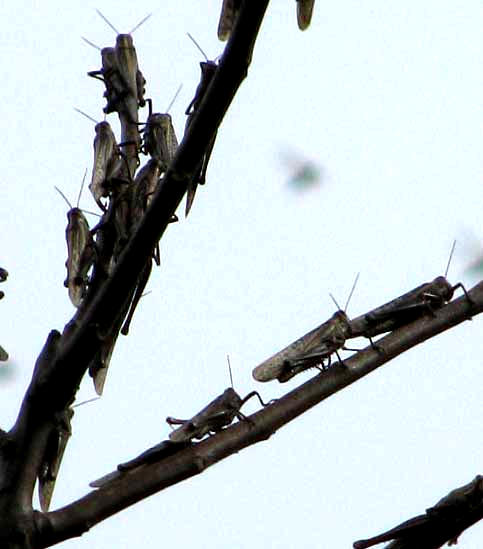
At first it seemed that no locusts were on the ground around me but then I passed beneath a palm and thousands exploded from the fronds above me and swirled upward to join their brethren in the sky. Most trees here are leafless now because of the dry season but suddenly I realized that tree branches were heavy with untold numbers of silent, unmoving locusts, shown below:
I wanted to photograph an individual locust, which looks like a normal grasshopper, but unlike during other outbreaks I've experienced Sunday's insects were jumpy and wouldn't let me come near. It was very hot and windy so maybe the heat gave them extra energy or set their nerves on edge. I never did get a good picture of a single individual, for every one of them was in a high state of alert, and simply flew off as I drew close. For those of you needing an ID, the shot shown below may help a little.
The vast sky-river of locusts passed overhead for about 45 minutes, but who knows how long they'd been passing before I saw them?
from the June 20, 2010 Newsletter issued from Hacienda Chichen Resort beside Chichén Itzá Ruins, central Yucatán, MÉXICO; limestone bedrock, elevation ~39m (~128ft), ~N20.676°, ~W88.569°
A WANDERING SMUDGE OF LOCUST NYMPHS
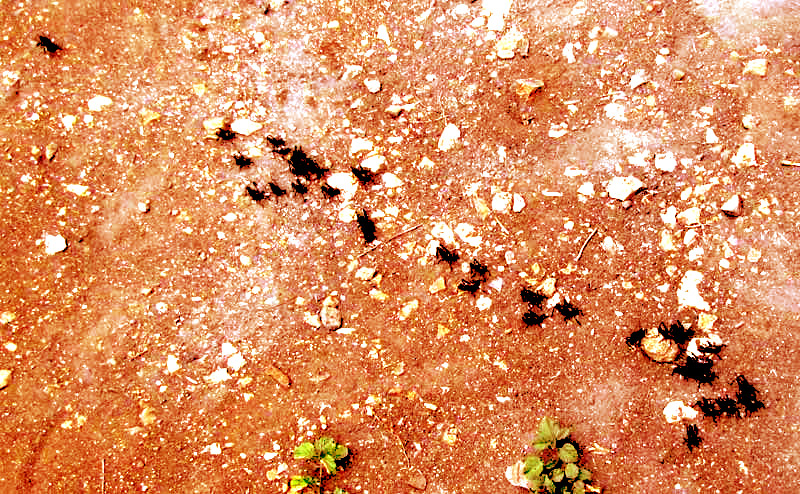
Late Monday afternoon I was reading beside the hut door when my peripheral vision caught movement beyond the book's page. When I looked up it took a few seconds to figure out what I was seeing. It was a black smudge of grasshoppers advancing like a platoon of soldiers across the ground toward my potted basil. You can see them, 35-40 of them walking and hopping, below:
You can see two of them advancing in their rather clumsy-seeming manner, their oversized back legs keeping them from achieving a smooth stride, below:
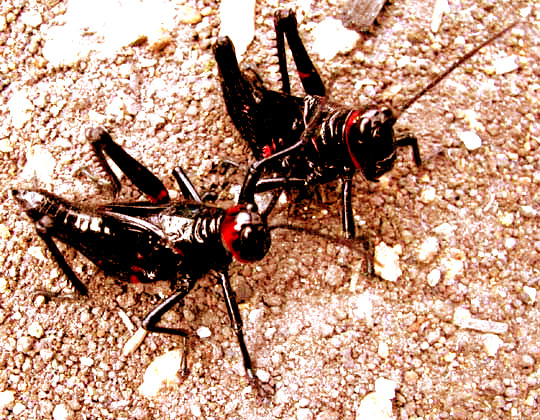
Actually I'm not sure whether to call these grasshoppers or locusts. Basically, locusts are just grasshoppers in large numbers. Hormonal and physical changes occur when typical solitary grasshoppers become locusts. Often one change is that the locust becomes more brightly colored than the grasshopper. But I'm not sure whether 35-40 grasshoppers moving en masse qualify as locusts. Because of their definite group movement toward my potted basil, and their bright colors, I'm calling these locusts until someone corrects me.
I'd been growing those pots of basil a long time so I got up and moved them. However, also I wanted to see what the locusts would do when they found a plant. Some climbed the Chaya plant next to my hut -- recently defoliated during a caterpillar outbreak -- and you can see two of them nibbling new Chaya leaves below:
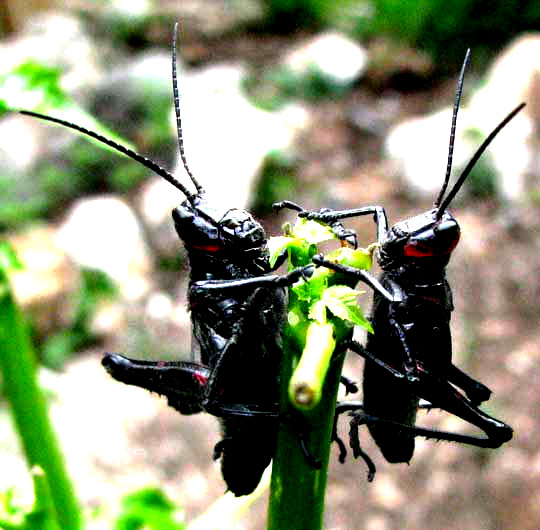
In that picture notice that the insects' wings are only about a third developed. These are not mature grasshoppers or locusts, but rather nymphs. Grasshoppers undergo incomplete metamorphosis so there's no caterpillar or pupa stage between the egg and adult. A tiny edition of the adult emerges from the egg, then undergoes a series of molts, enlarging after each molt, until the adult is formed. Younger, smaller nymphs have no wings, but with each molt the wings more fully develop. So, these are late-edition nymphs with wings, but the wings are too small for flying.
I picked up a nymph and you can see its head below:
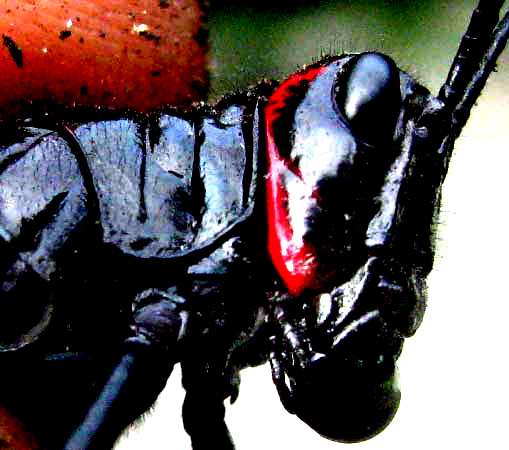
As soon as I disturbed that individual it began disgorging a bubble of plant juice, so apparently it had already fed.
Earlier, when I'd approached the smudge, individuals had hopped in all directions, most eventually finding some kind of plant to chew on. After about ten minutes, though, each seemed to lose interest, crawled back onto the ground, and then from all directions individual grasshoppers/locusts began leaving my general area. Three or four in a tight, dark cluster were heading toward the Hacienda Office, and all others appeared to be half-walking, half-hopping in their general direction, slowly enlarging the group as they went.
from the January 11, 2015 Newsletter issued from Río Lagartos, on the Yucatan Peninsula's northern coast (~N21.60°, ~W88.16°), Yucatán state, MÉXICO
CATTLE EGRETS & LOCUSTS
In extreme northeastern Yucatán State this week our truck passed through a small flight of them as late afternoon sunlight caught in their silvery wings, surrounding us with fluttering, drifting globes of radiance. There must have been more of them out in the savanna beside the road, for that's where a flock of Cattle Egrets was busily gobbling up what could be caught, the flock keeping up with the locusts' general southerly movement. Below, you can see some of the egrets at work:
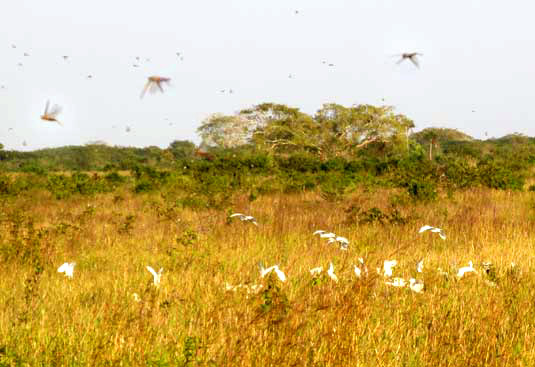
Cattle Egrets are well known for this kind of behavior. Often they follow farmers' plows collecting earthworms. Though they favor insects, especially grasshoppers and other small arthropods, they also catch frogs, fish, lizards, small birds and rodents. In areas where people set grassland ablaze thinking it improves grass production, as here, Cattle Egrets follow along beside the fire, preying on small creatures trying to escape the flames.