PLANTS | ANIMALS | ECOLOGY | FUNGI | GEOLOGY | GARDENING | TOOLS
MEXICAN PLANTS & ANIMALS HOME

Excerpts from Jim Conrad's
Naturalist Newsletter
from the December 8, 2008 Newsletter issued from Mayan Beach Garden Resort 20 kms north of Mahahual; Caribbean coastal beach and mangroves, ~N18.89°, ~W87.64°, Quintana Roo state, MÉXICO
LAUGHING FALCON
The other day I was sitting behind the workers' hut stringing sea-beans and bamboo sections to form a kind of curtain when behind me, out in the hurricane-mangled mangroves, I heard a loud, nasal WAH WAH WAH. A white raptor perched conspicuously on a snag jutting above the mangroves and stayed there until I got my camera. You can see the resulting picture of a truly handsome bird below:
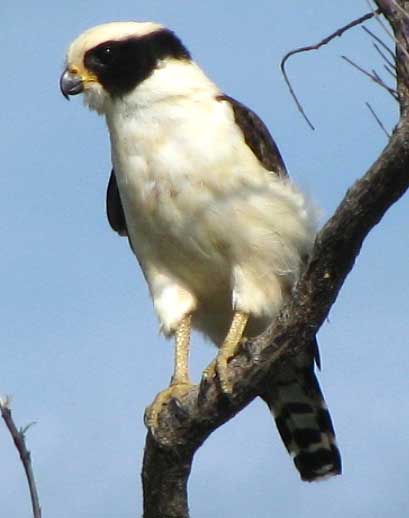
That's a Laughing Falcon, HERPETOTHERES CACHINNANS, and you'll understand why it has that name if your computer can digest WAV audio files, and you point your browser to http://www.naturesongs.com/lafa3.wav.
If you can't do that, imagine a big crow mimicking a fat, jovial man breaking into unrestrained belly- laughter, and that's it. Howell refers to it in A Guide to the Birds of Mexico and Northern Central America, as maniacal laughter.
Some raptor species are hard to distinguish from others, but Laughing Falcons are distinctive and unmistakable. Also, they're fairly common in a variety of habitats ranging from forests to savannas, and they're distributed from Mexico to Argentina, so this is another of those species "emblematic" of the American tropics.
from the April 18, 2010 Newsletter issued from Hacienda Chichen Resort beside Chichén Itzá Ruins, central Yucatán, MÉXICO; limestone bedrock, elevation ~39m (~128ft), ~N20.676°, ~W88.569°
A LAUGHING FALCON'S WELCOME
On my first morning at the new hut I'd prepared breakfast stew over the inside fire, smoke was filtering through the thatch (Maya homes don't have chimneys), and I was sitting behind the house looking up into the big trees when I heard it: ha!-ha!-ha!-ha!...
The Laughing Falcon glided overhead just above the treetops, looking down exactly at me, passed over the house and landed in the big Piich tree out front. You can see him with his distinctive erect posture, whitish underparts and dark brown mask side lighted by the rising sun below:
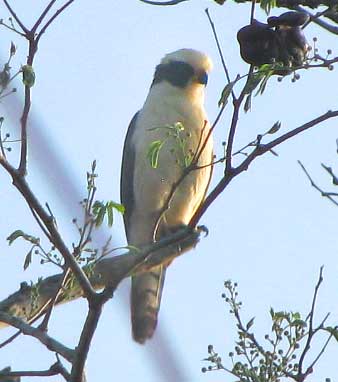
Laughing Falcons are about twice the size of the North's American Kestrel and my experience is that they're far more often heard than seen. When I first arrived here I thought the hotel across the road was keeping a Peacock penned up that called all through the night but it turned out that it was a Laughing Falcon, and the calling has continued these last six months, sometimes day and night. It comes and goes and shifts around, and if you try to track it down you find that the call is uncommonly far-carrying, for the bird is always much farther away than you'd thought.
The actual laugh call, which anyone would say is laughlike, is heard fairly rarely -- mostly as he sails overhead. What you usually hear is the single somewhat nasal wah! repeated about once each two seconds. If two are calling to one another throughout most of a day, it can be trying.
Laughing Falcons are distributed from the humid Mexican lowlands south to Peru and northern Argentina and they're found in many habitats, from forests to open areas with scattered trees, to palm groves. They're not really rare birds, but also not common. Even if you've gotten tired of hearing them, they're always a treat to see.
from the June 12, 2011 Newsletter issued from Mayan Beach Garden Resort 20 kms north of Mahahual; Caribbean coastal beach and mangroves, ~N18.89°, ~W87.64°, Quintana Roo state, MÉXICO
MOBBED BY MOCKINGBIRDS
Possibly the most common bird along the road up our little sand ridge between the sea and the mangrove swamp is the Tropical Mockingbird, which is similar to Northern Mockingbirds and sings almost identically. Possibly our Tropicals are a little more aggressive than the Northern species. At least they are prolific mobbers. By mob I mean that in small groups they harass other birds, especially predator species. You can see a couple dealing with a Laughing Falcon below:
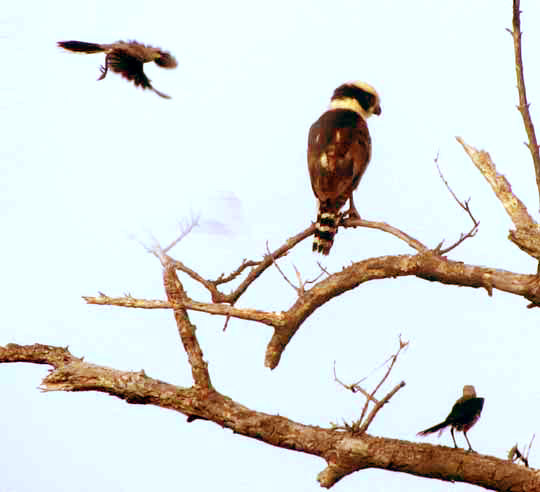
You'd be surprised how much thinking has been done about how and why the mobbing impulse arose during the course of evolution. Among the explanations are: To advertise the mobber's physical fitness and hence uncatchability; to distract predators from finding their offspring; to warn their offspring; to lure the predator away; to teach the offspring to recognize the predator species; to possibly injure the predator, and; to attract a predator of the predator itself. Wikipedia's excellent page on the matter is found at https://en.wikipedia.org/wiki/Mobbing_(animal_behavior).
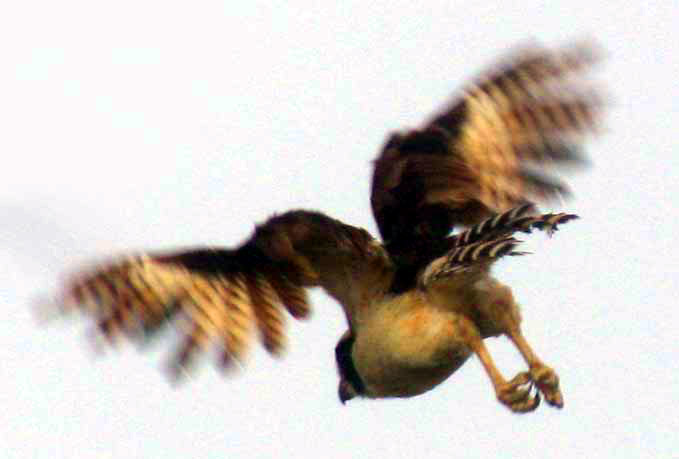
When the above Laughing Falcon finally was driven away I got an interesting shot showing how, just before its wing's downbeats, it brings its wings -- which are shorter and more rounded than those of most falcons -- high over its back. Apparently this enables a more powerful purchase on the air. The picture can be seen below: