PLANTS | ANIMALS | ECOLOGY | FUNGI | GEOLOGY | GARDENING | TOOLS
MEXICAN PLANTS & ANIMALS HOME

Excerpts from Jim Conrad's
Naturalist Newsletter
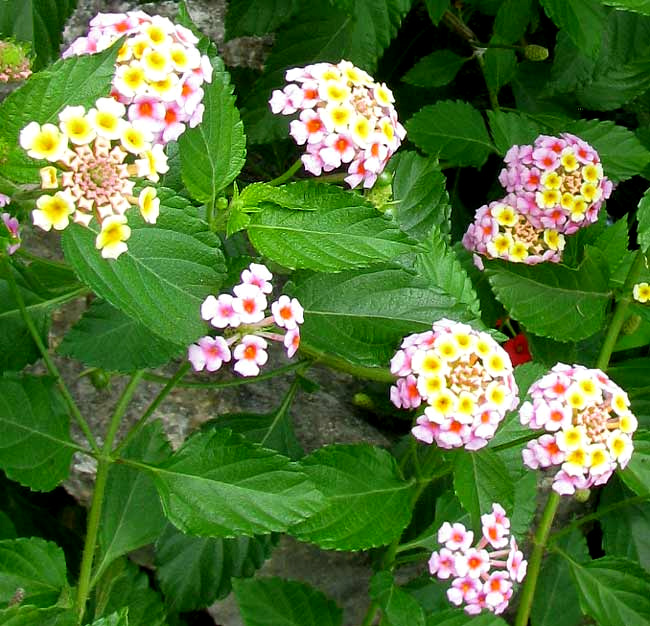
from the September 26, 2010 Newsletter issued from Hacienda Chichen Resort beside Chichén Itzá Ruins, central Yucatán, MÉXICO; limestone bedrock, elevation ~39m (~128ft), ~N18.52°, ~W95.15°
LANTANA BESIDE THE WALL
Above you can see one of the prettiest shrubs flowering in Pisté these days, one with its flower-laden branches tumbling over a stone fence beside a thatch-roofed hut. That's one of the most commonly planted ornamental shrubs in the world's tropical and subtropical zones. It goes by many English names, such as Spanish Flag, West Indian Lantana, Wild Sage, Red Sage, Yellow Sage and a host of other names. It's LANTANA CAMARA, and despite so frequently being referred to as a kind of sage, which belongs to the Mint Family, this pretty, six-ft-tall shrub (1.8 m) belongs to the Verbena Family, the Verbenaceae. An eye-pleasing close-up highlighting a multicolor flowering head is shown below:
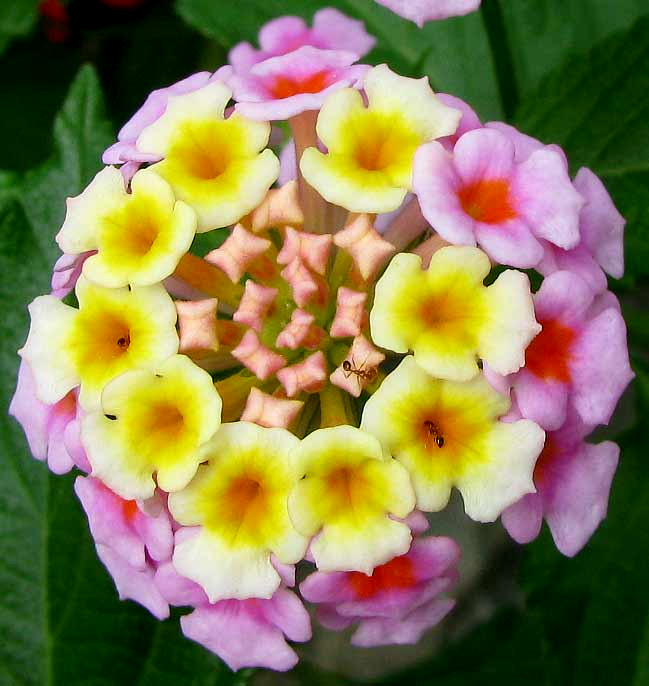
You might recognize a strong similarity between these dog-faced little lantana flowers and those of verbenas, which belong to the genus Verbena. The big difference between the two genera is that Verbena's ovaries are four-celled and develop into four discrete sections, or nutlets, while Lantana's ovaries are two-celled and develop into two separate nutlets. Back in Chiapas in 2007 we ran into fruiting Lantana heads, which looked so much like blackberries that I plopped some into my mouth before realizing what I was doing. They were bitter! You can see those fruits at www.backyardnature.net/chiapas/lantanaf.htm.
Many cultivars of Lantana camara have been developed, including "flava" with sulfur-yellow flowers changing to saffron, the dwarf "hybrida" with yellow flowers, "nivea" with white flowers, and "mista" with yellowish outer flowers changing to saffron and brick-red, and yellow inner flowers.
This pretty species is native to Mexico, Central America, the West Indies and northern South America. Unfortunately, in warm countries where it's been introduced as an ornamental it tends to escape into the wild -- including the US Gulf Coastal Plain. It's listed as a Category One Invasive Toxic Species in Florida. The species is especially common in India, Australia and much of Africa. This is bad news for livestock growers since the herbage is poisonous. Livestock losses have been reported from the US, South Africa, India, Mexico, and Australia.
Still, Maximino Martinez's Las Plantas Medicinales de Mexico reports that the cooked leaves are used against "rheumatism" and for making a stomach tonic. In Sinaloa a cataplasm of its cooked leaves has been used for snakebite.
from the March 31, 2007 Newsletter issued from Sierra Gorda Biosphere Reserve headquarters in Jalpan Querétaro, MÉXICO
SHRUB VERBANA/LANTANA
I've never found it easy to distinguish between Lantanas and Verbenas without seeing the fruits. Up North where you have only a handful of species the differences among flowers look pretty obvious but when you start meeting the many other often-tropical species, things get less clear. With the fruits, however, it's more clear-cut: A Verbena ovary separates into four nutlets, while Lantana ovaries produce fruits with two bony nutlets.
Therefore, the Shrub Verbena that's been flowering here ever since I arrived is clearly really a Lantana, since its ovary matures into into a fleshy fruit with two bony nutlets. You can see the flowers of our very common, very pretty Lantana species below:
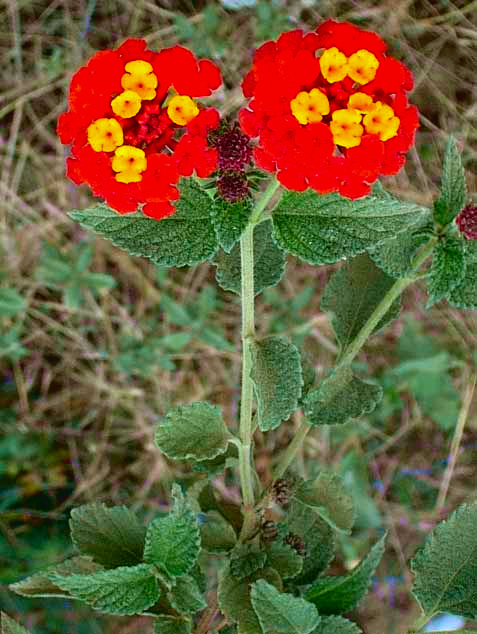
From what I find on the web, Lantana camara and Lantana urticoides are often confused, and both grow here. Both are long-flowering shrubs with strong-smelling herbage, and both have horticultural variations with different-colored flowers. I read that urticoides leaves are normally ovate (egg-shaped) to round with margins bearing a few teeth 2-5mm high, while camera leaves may have their bases forming broad lobes that extend backwards (cordate) or be triangular in shape, and leaf margins bear many teeth that are only 0.5-1.5mm high. According to those criteria, here we have LANTANA CAMARA.
from the February 22, 2015 Newsletter issued from Río Lagartos, on the Yucatan Peninsula's northern coast (~N21.60°, ~W88.16°), Yucatán state, MÉXICO
YELLOW-FLOWERED WILD SAGE
We've run into LANTANA CAMARA, sometimes called Wild Sage, several times in the US and Mexico. We've seen it as a weed, as a wild-growing invasive and as a treasured garden ornamental, and always it's been a challenge to make sure of its identity. That's because the species is so remarkably variable, especially in its flower color. Nowadays Wild Sage grows as a knee-high, weedy shrub along the coastal road, producing striking yellow flowers, as shown below:
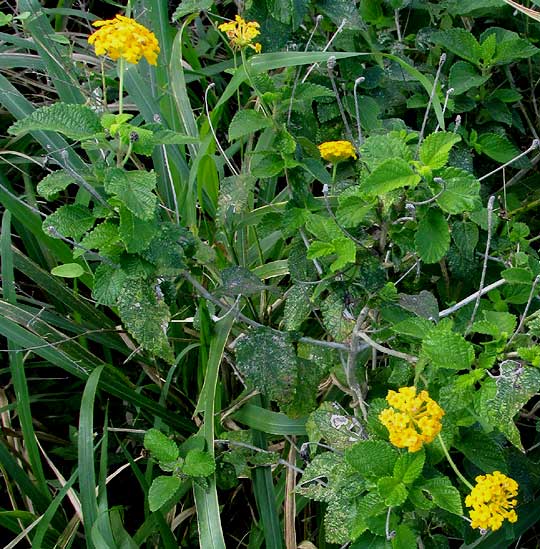
Most Wild Sage flowering heads we've encountered bear blossoms of two or more colors, the individual flowers in the heads usually yellow, red or pink though other colors are possible. The flowering heads on our plants here are just yellow. A close-up of a flowering head from below, showing the bilaterally symmetrical flowers' curved corolla tubes and the leafy bracts subtending the lower flowers is shown below:
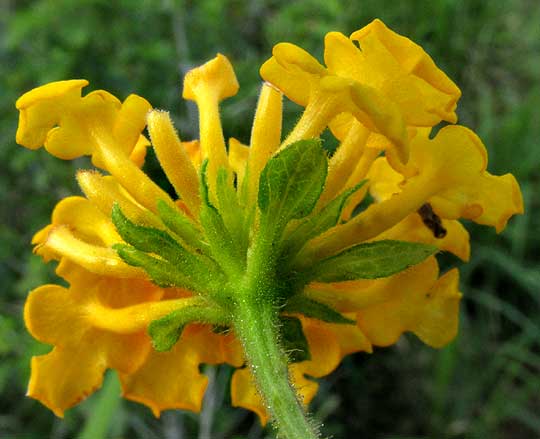
A closer look at the face of one corolla is shown below:
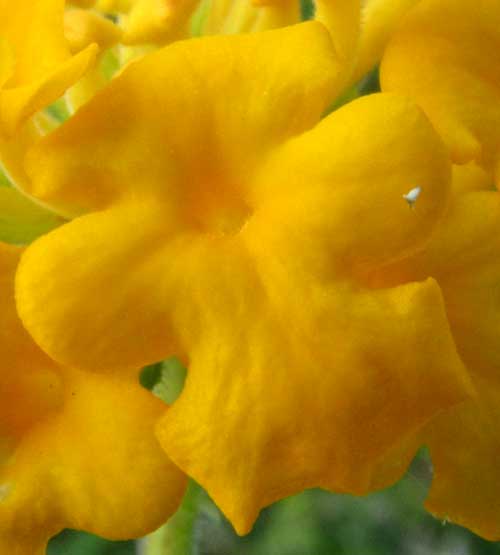
A look at the shrub's mint-like leaves -- despite their belonging to the Verbena Family, not the Mint -- is shown below:
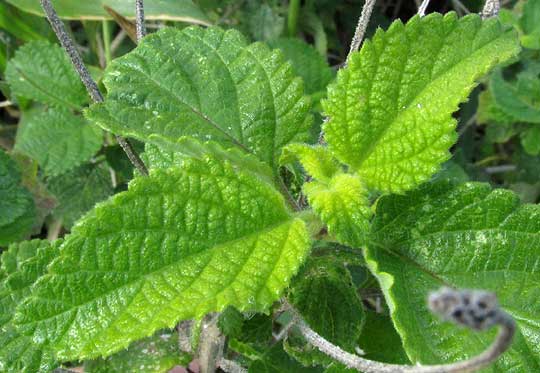
Our yellow-flowered Wild Sages usually are designated as the variety "flava," the word "flava" being Latin for yellow. Several varieties are known.
The bush's crushed leaves produce a strong smell, not necessarily bad but also not minty-sweet. Green Deane at his EatTheWeeds.com website says of the Wild Sage that "Unripe berries have killed children and the foliage has killed livestock," but he says he nibbles on the mature fruits, though never many. I've nibbled on them, too, with no problem, especially because they were so bitter that having more than a nibble was out of the question.
As you might expect from any common, odoriferous plant, Lantana camara traditionally has been used medicinally. The online "Atlas de las Plantas de la Medicina Tradicional Mexican" reports that in Mexico teas have been brewed from the leaves, stems and roots to deal with many kinds of internal problems, such as stomach ache, liver ailment, colic and "rheumatism," but also several female troubles including childbirth issues, and a host of other ailments.
Lantana camara is a common, conspicuous and interesting plant, and it's worth the effort to learn its many flower color variations.
from the November 19, 2007 Newsletter issued from Yerba Buena Clinic just outside Pueblo Nuevo Solistahuacan, Chiapas, MÉXICO
ALMOST BLACKBERRIES
The other day as I descended the slope on a weedy trail I spotted some big, glossy-black blackberries that looked so succulently sweet and inviting that without thinking much about it I reached down as I passed by, pulled a few off, and threw them into my mouth.
Bitter!
I returned to the bush, looked closer and saw what's shown below:
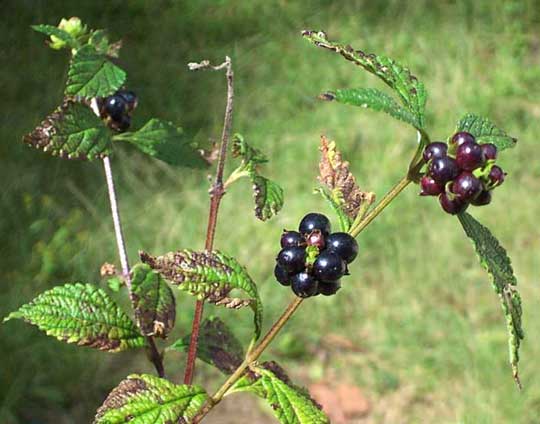
Clearly that's no blackberry, though the plant had been growing up through some leafy blackberry canes, so at least my mistake hadn't been entirely reckless. Typical blackberry leaves are "digitally compound," with leaflets arising from atop a petiole like a hand's "digits," but this plant bears simple, or undivided, leaves. In fact, the leaf shape and the leaves' crinkly surfaces ("rugose" in botanist terms) made me think of weedy Lantanas.
In fact, it is a Lantana, but I'm not sure which one since the flowers have long since fallen away as the fruits enlarged and matured.
from the December 20, 2015 Newsletter issued from Hacienda Chichen Resort beside Chichén Itzá Ruins, central Yucatán, MÉXICO
SHRUB LANTANA AS A PRETTY INVASIVE
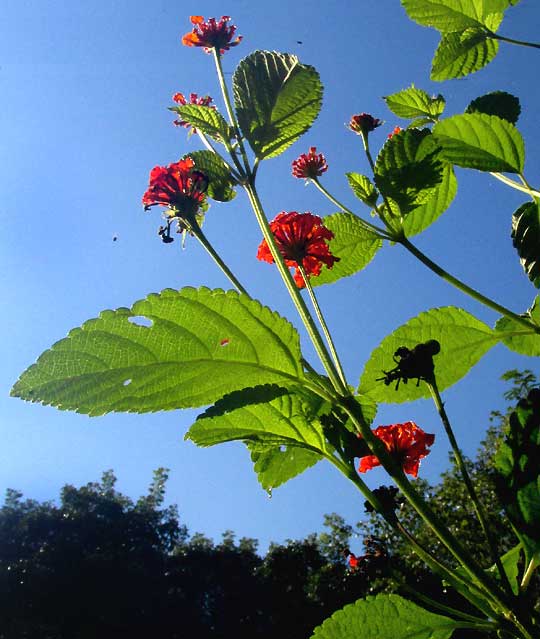
Not far from the hut, next to a revegetating abandoned field, a semi-woody shrub about ten feet tall (3m), turned up on a cool, dewy early morning extending its handsome, green, powerfully odoriferous leaves and clusters of orangish-red flowers into the blue sky, positively radiant in the early morning, low-slanting sunlight, exactly as shown below:
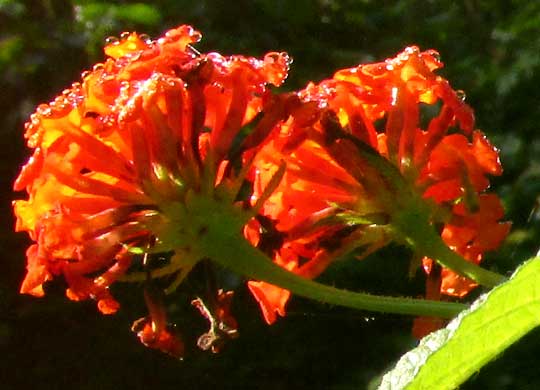
Below you can see a close-up of its dew-covered flower clusters:
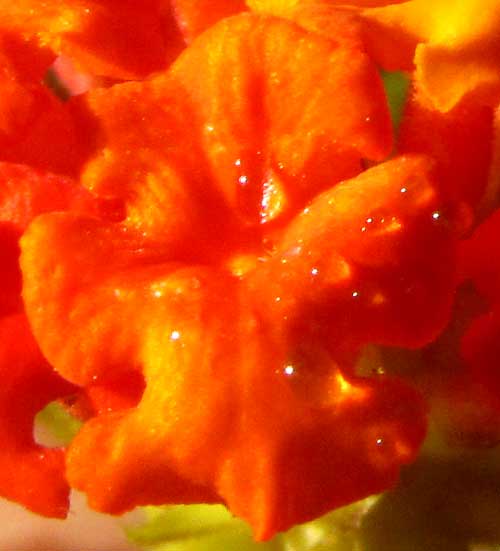
And a view of a single flower's dew-wet face is below:
We've seen this before, and there's plenty of information about it in those earlier Newsletters {see above}. With all that coverage, why return to it?
First, I've never seen such a tall one. Usually they are at most chest high, but this one was practically a small tree, so I felt compelled to double-check the identification and make sure it wasn't a species I didn't know about. And in double-checking it, I found a page of the online Global Invasive Species Database with information new to me:
"It is an artificial hybrid species that has been subject to intense horticultural improvement in Europe since the sixteenth century and now exists in many different forms or varieties throughout the world," the page reports. Also, "there are some 650 varieties in over 60 countries. It is established and expanding in many regions of the world, often as a result of clearing of forest for timber or agriculture." In other words, Shrub Lantana isn't a natural species, is something man-made, and now is running amok in the world creating havoc and causing despair among those trying to protect native environments. It's a kind of patched-together plant Frankenstein with appealing aspects, but which is very disruptive nonetheless.
Among the many uses reported on the Global Invasive Species Database page are that extracts derived from the plant are used in folk medicine for the treatment of cancers, chicken pox, measles, asthma, ulcers, swellings, eczema, tumors, high blood pressure, bilious fevers, catarrhal infections, tetanus, rheumatism, malaria, and more. Shrub Lantana makes decent firewood and mulch. Its stems, treated by the sulfate process, can be used to produce pulp for paper suitable for writing and printing. Bearing short spines, it's planted as a hedge to contain or keep out livestock. Water into which its powerful chemicals have been leached can be used to kill aquatic Water Hyacinth, which in some places chokes tropical rivers and canals. Sometimes Shrub Lantana makes large thickets that provide shelter and winter food for many native birds.
On the other hand, when land is deforested, Shrub Lantana can invade the landscape so completely that the natural succession of plants leading to forest regeneration can't take place. Infestations of the species can completely stall the regeneration of rainforest for at least three decades. Shrub Lantana produces "allelopathic" compounds that retard the growth of other species around it. Land covered with Shrub Lantana thickets protects the soil from water erosion less than if grass covered it, so it contributes to the deterioration of soil structure. Cattle, buffalo, sheep and goats have been poisoned eating its herbage. Disease-causing Malarial mosquitoes in India and tsetse flies in Rwanda, Tanzania, Uganda and Kenya shelter in Shrub Lantana thickets.
When on a dewy morning a lovely being comes along invitingly radiating freshness and vitality, you just never know what you're getting into until you check into her background.