PLANTS | ANIMALS | ECOLOGY | FUNGI | GEOLOGY | GARDENING | TOOLS
MEXICAN PLANTS & ANIMALS HOME

Excerpts from Jim Conrad's
Naturalist Newsletter
from the April 4, 2010 Newsletter issued from Hacienda Chichen Resort beside Chichén Itzá Ruins, central Yucatán, MÉXICO; limestone bedrock, elevation ~39m (~128ft), ~N20.676°, ~W88.569°
MORNING GLORIES & NECTAR ROBBERS
Not long after I began issuing these Newsletters from my hermit camp in Mississippi in 2001 I described how Large Carpenter Bees, genus Xylocopa, were robbing nectar from the red-flowered, ferny-leafed Cypress Vines twining on my garden's deer-fence. Cypress Vines are members of the Morning Glory Family. I wrote:
"Thing is, this bee was not pollinating the flowers. It paid no attention to the blossoms' openings. Instead, it went to the outside base of each flower, thrust its 'tongue' down between the corolla and the calyx... this bee was actually slitting each blossom's corolla so it could get at the nectar inside, completely bypassing the flower's sexual parts. I examined the corollas after the bee visited them and could clearly see the slit. It was violent robbery pure and simple."
I remembered that observation this week when out in the forest I ran into a dead, dried-up morning glory vine bearing the seed-filled capsules shown below:
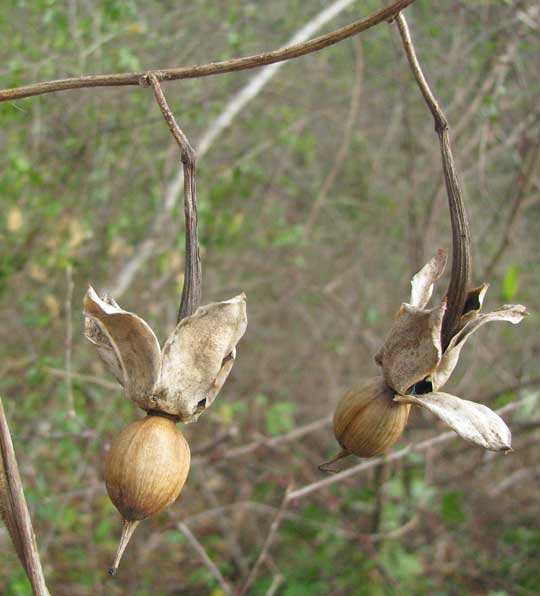
In that picture the spherical items at the bottom are the dry fruit capsules ready to split open to release four seeds. The seeds are exceptionally large, brown-fuzzy, caterpillar-like affairs. The long hairs help the seeds disperse on the wind. You can see the seeds below:
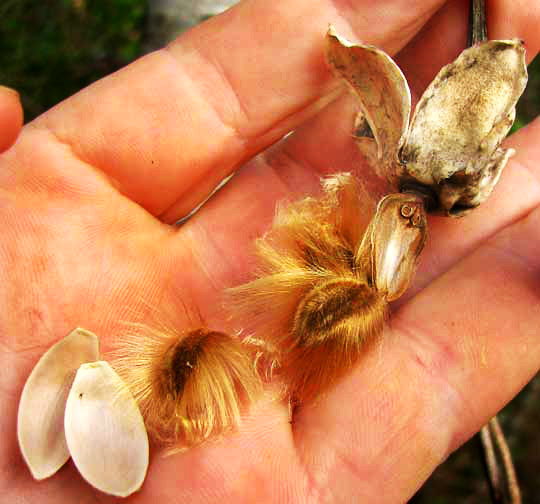
In that picture the grayish, leathery items bent back from the opened capsule are the old sepals -- the lobes of the calyx which on most flowers subtend the corolla. It's easy to imagine why the sepals would need to bend back: It's so they don't keep the wind from carrying away the capsule's fuzzy seeds.
So, what does all this have to do with nectar robbery? The connection is the oversized, leathery sepals.
For, those exceptionally large, tough sepals evolved as a response to a fundamental weakness in the basic morning-glory flower design. That weakness, as my Cypress Vines showed, is the flowers' vulnerability to nectar robbery. The sepals' large size and thickness keeps nectar robbers from slashing their way to the nectar at the corolla tube's base.
Last December I happened to photograph the flowers of the very vine in the above pictures. You can see one below:
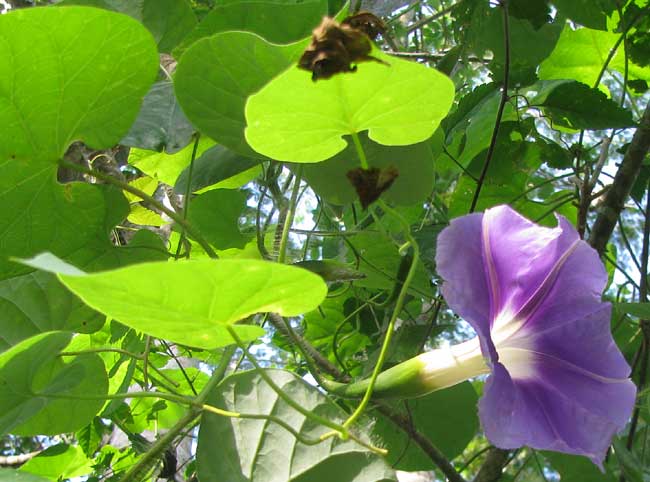
Note that the flower's calyx, instead of being topped by five tooth-like sepals, form a thick, greenish cylinder around the corolla's base.
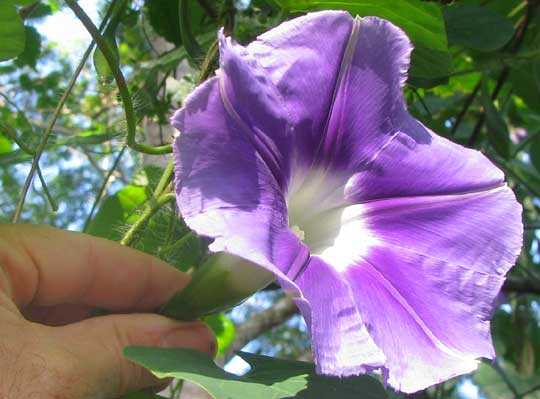
I'm fairly sure this morning glory is IPOMOEA CLAVATA, found from Mexico to northern South America. The flower's large size relative to my hand can be seen below: