PLANTS | ANIMALS | ECOLOGY | FUNGI | GEOLOGY | GARDENING | TOOLS
MEXICAN PLANTS & ANIMALS HOME

Excerpts from Jim Conrad's
Naturalist Newsletter
from the October 27, 2008 Newsletter issued from Yokdzenot, Yucatán, MÉXICO
HUANO PALM
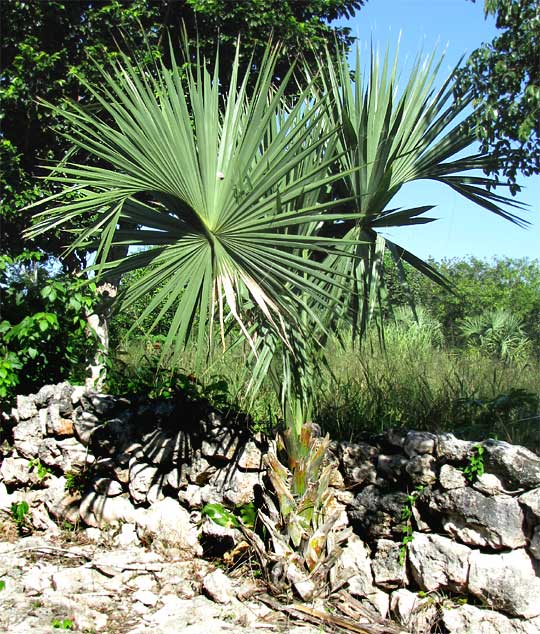
Above you see an eight-ft-tall palm common around here, SABAL YAPA. Sabal species are recognized by North Americans as the palmetto palms so typical of the US Deep South. Here the Maya refer to Sabal yapa as Huano (WAN-oh). Most of the palm's fronds in the picture have been removed because people here use them for thatching roofs.
When identifying palms a point to keep in mind is that the vast majority of palm species fall neatly into one of two broad groups: the fan palms, whose leaf segments radiate from the top of the leaf stem, or petiole, forming a ± circular blade, and; the feather-leaved or pinnate palms, such as the Coconut Palm, whose leaf segments arise from a rachis passing through the center of a long leaf blade, like pinnae arising from the rachis of a feather
Palmettos are regarded as fan palms, even though their blades don't fit the fan-palm pattern exactly.
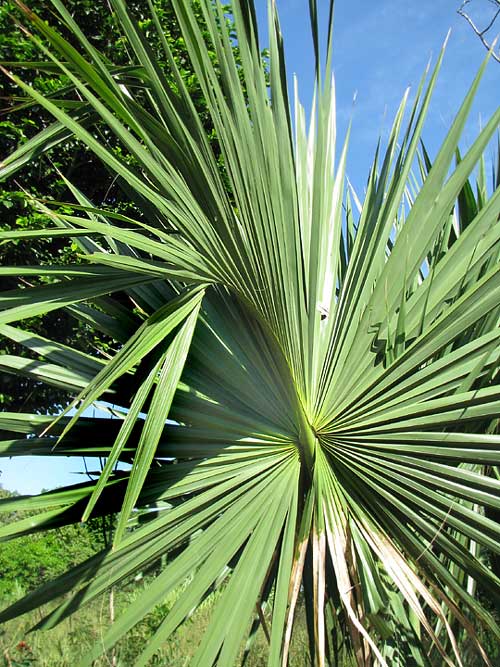
Above you can see how the Huano's petiole, shooting up from the lower right, continues a bit up through the blade, but grows narrow fast, and soon piddles into a little droop, resulting in the frond being ± circular in outline but with an asymmetrical crease in the middle. Palmetto blades suggest a transition phase between fan palms and feather-leaved palms. Palm blades exhibiting this curious midrib behavior are said to be "costapalmate," and this costapalmateness makes palmettos easy to distinguish from other fan palms in the field. Palmettos are also distinguished from other fan palms by their blade stems, or petioles, NOT bearing spines.
Don't confuse smooth-petioled palmettos in the genus Sabal with saw-toothed-petioled SAW Palmettos of the genus Serenoa, often forming dense, leg-chewing thickets along the US Coastal Plain from South Carolina to Mississippi. Palmettos and Saw Palmettos are two different things.
Huano can grow into a tall, slender-trunked tree, as the following picture showing three Huanos in different stages of development shows::
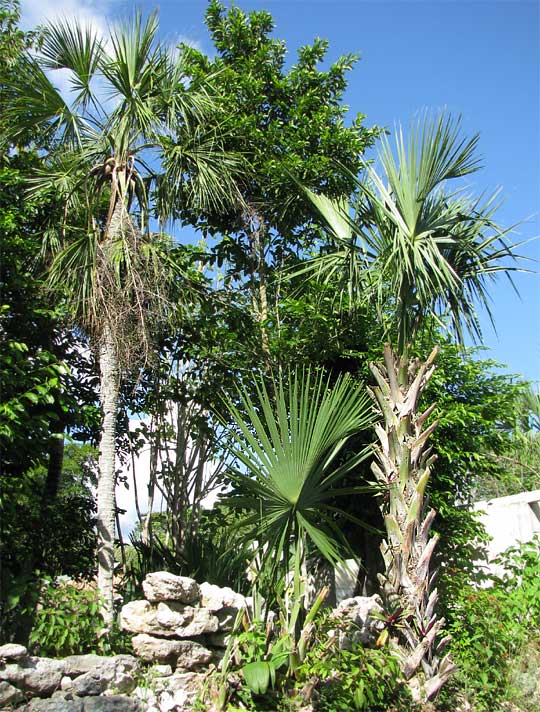
Embracing about 190 genera and 2000 species, the Palm Family, the Arecaceae, is big and varied. Sixteen species are recognized in the Huano's genus Sabal, and most Sabal species cluster around the Caribbean Sea.
from the February 7, 2010 Newsletter issued from Hacienda Chichen Resort beside Chichén Itzá Ruins, central Yucatán, MÉXICO; limestone bedrock, elevation ~39m (~128ft), ~N20.676°, ~W88.569°
THATCHING THE MAYA HOUSE'S ROOF
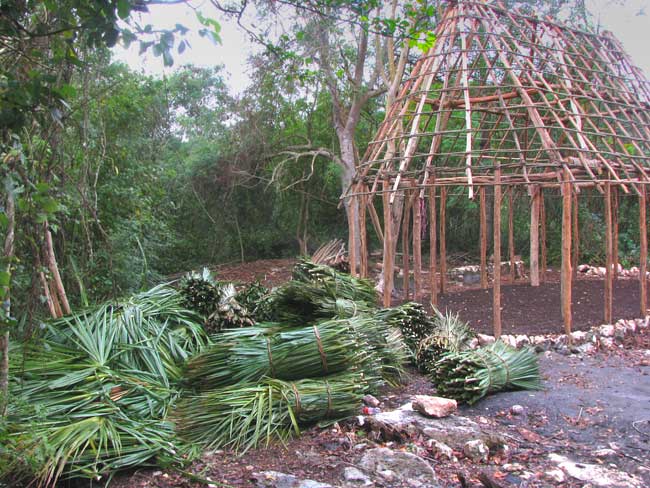
Work on Hacienda Chichen's traditional Maya house continues. This week Paulino and Santos have been thatching the roof with Huano Palm fronds. Last weekend a truck arrived carrying big bundles of Huano fronds tied together with the ropy stems of "Tropical Grapevine," Cissus sicyoides, as shown below:
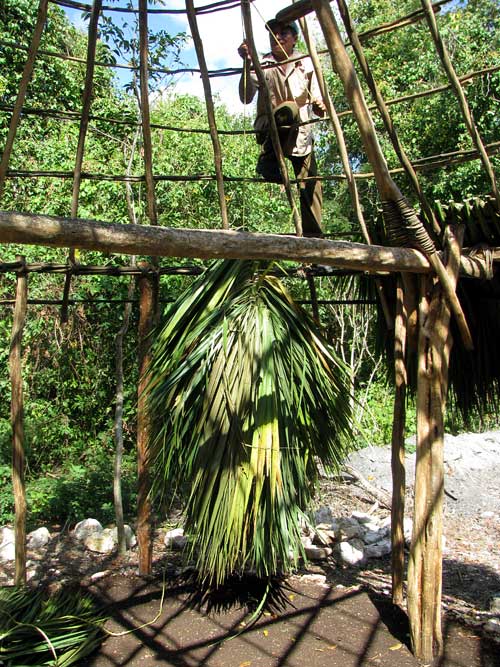
After chopping off each of the frond's stems, or petioles, so they'd be the same length, the men tied together bunches of them so they could be risen to their working spot on the roof, by rope, as shown below:
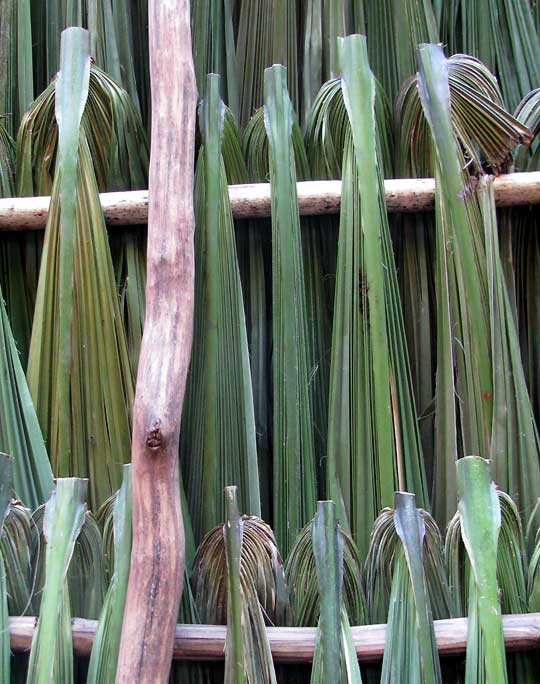
One reason the Huano Palm's fronds are favored over other palm species is that the fronds' petioles extend like a midrib into the fannlike blade. The fronds are affixed to the wooden pole below them by inserting the petiole extension and the leaflets arising from it BELOW the pole, while all the rest of the leaflets go ABOVE the pole. This way the frond hooks onto the pole very securely. You can see how this looks from below below:
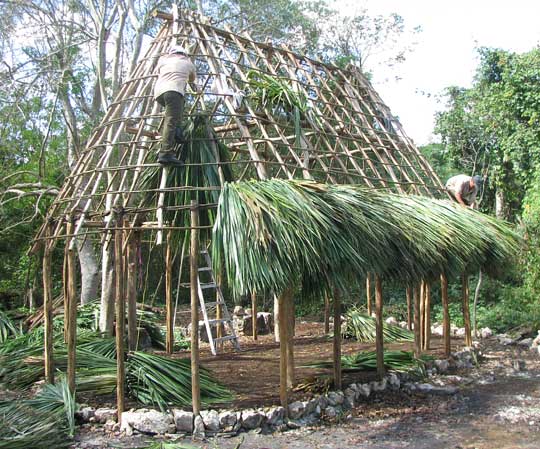
You can see what the house looked like after the first hour of thatching below:
from the January 11, 2015 Newsletter issued from Río Lagartos, on the Yucatan Peninsula's northern coast (~N21.60°, ~W88.16°), Yucatán state, MÉXICO
HUANO PALMS, TALL & SKINNY
In extreme northeastern Yucatán State at El Zapotal, an isolated protected area administered by the Mexican environmental group Pronatura, there were lots of tall, slender-trunked palms like the one shown below.
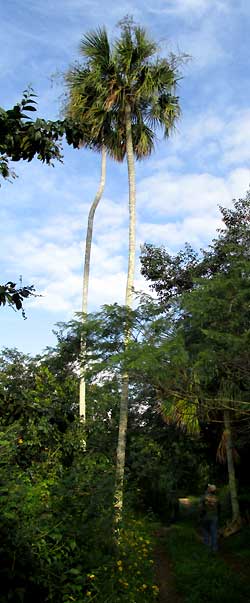
That looks a lot like the famous Huano Palm, Sabal yapa, we've met so often in recent years. Huano Palms are common in northern and eastern Yucatan, and that's the species that provided thatch for my hut roof at Hacienda Chichén.
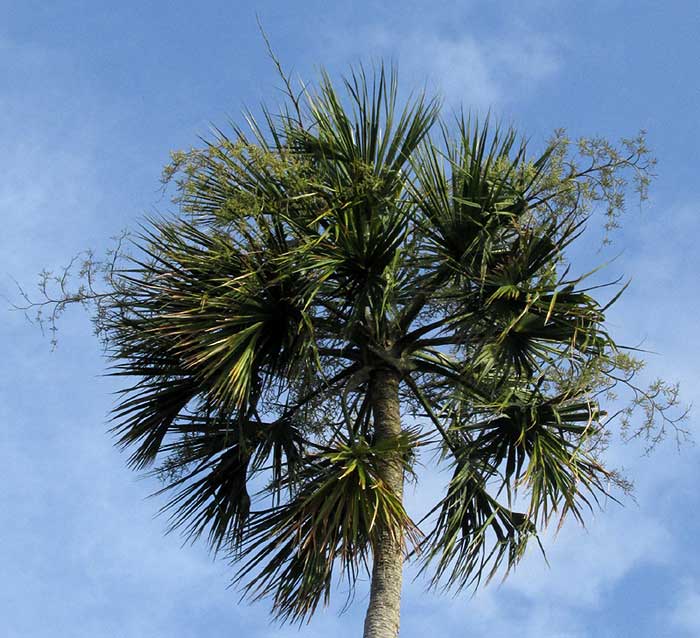
But, the palms in our picture from El Zapotal are taller than those normally seen elsewhere. In the picture, notice my friend Willy below them at the bottom right. Are these regular Huanos who in this protected area have grown larger than the harassed and abused ones normally encountered, or something else? I'd heard of a close relative, the endangered Sabal gretheriae, endemic to just a small part of northeastern Yucatan and described for the first time only in 1991, so could this be that? "Doing the botany" to find out, I began with a closer look at the palm's spherical crown with its inflorescences full of tiny, bee-buzzed flowers, shown below:
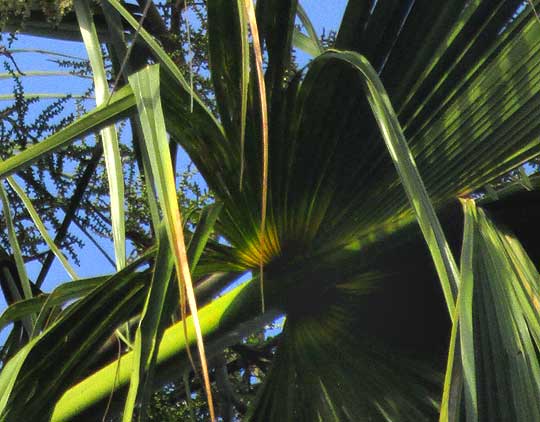
An important field mark for members of the genus Sabal is that at the bottom of their fan-shaped fronds the stiff petiole, instead of abruptly stopping at the point of attachment, continues on up into the fan, gradually diminishing in width and ultimately curving a bit, imparting a certain twistiness to the frond. Fan palm fronds with such intruding petioles are said to be costapalmate, and below you can see that this palm's fronds are indeed costapalmate:
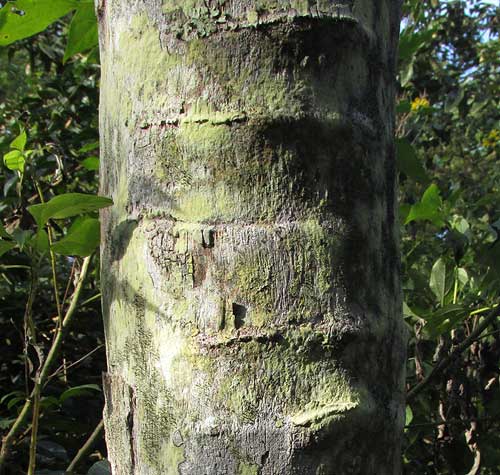
The trunk's petiole scars from fronds lost long ago give the trunks a segmented look, as shown below:
Well, the short story is that these tall, spindly fan palms are indeed our old friend the Huano, just that by being protected by the good folks of Pronatura they've been allowed to express their mature natures. In other places we are left dealing with the robust and landscape-enhancing but nonetheless not very graceful or dignified forms of mere juveniles.