PLANTS | ANIMALS | ECOLOGY | FUNGI | GEOLOGY | GARDENING | TOOLS
MEXICAN PLANTS & ANIMALS HOME

Excerpts from Jim Conrad's
Naturalist Newsletter
from the December 15, 2005 Newsletter written at Hacienda San Juan Lizarraga one kilometer east of Telchac Pueblo, Yucatán, MÉXICO
and issued from Hotel Reef Yucatan 13 kms to the north
HORSESHOE CRABS
Each week the beach is different from every other week. Often I find washed-up, dead organisms that I am completely at a loss to identify -- sometimes don't even know whether they are plants or animals. It's clear that just offshore there's an ecosystem as diverse and beautiful as any I've known, but it's beyond my reach. Still, I'm savoring the process of slowly discovering what I can about this mysterious, potent place.
This week's beach was different from all previous ones in that there were more shells -- extensive accumulations of them in mint condition -- washed up than ever before. Also, for some reason, strewn randomly along the beach, there were about a dozen dead, wave-deposited Horseshoe Crabs, LIMULUS POLYPHEMUS. Usually I find only one or two of them.
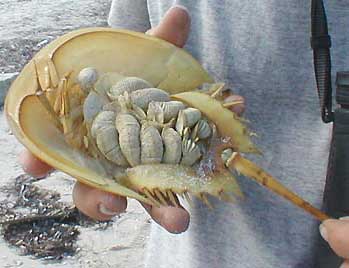
Crabs feed on clams, worms and other invertebrates, but if you look at Karen's picture you're likely to wonder where the mouth is. It's on the shell's underside in the center where the legs come together. Tiny projections at the legs' bases help grind larger itmes so they can enter the mouth. More info on Horseshoe Crab anatomy and many other topics relating to them is available at the Horseshoe Crab Website at http://www.horseshoecrab.org.
In the spring adults move onto sandy beaches and mate. Females lay over 80,000 egs each. When young hatch they go into the water and spend about a week swimming, then settle to the bottom. As the animal grows, it sheds its exoskeleton -- 16 or 17 molts over 9 to 12 years to reach sexual maturity. Then breeding adults live for 2 to 6 more years. Adults feed mainly on marine worms and shellfish.
If you are familiar with the leggy, fast-moving, claw-flaunting crabs along most beaches you might guess that Horseshoe Crabs aren't crabs at all, but rather their own kind of thing. In fact, they're a very ancient creation more related to spiders than to crabs. They're closely related to trilobites, which often show up as fossils in older geologic strata. At one time trilobites were among the most conspicuous of Earth's life forms. During the massive extinction at the end of the Paleozoic Era (when 50% of all the Earth's animal families and 95% of all marine species disappeared for reasons still not clear) trilobites went extinct but their relatives the horseshoe crabs did not.
Anatomically, Horseshoe Crabs haven't changed much for the last 350-400 million years -- since well before the supercontinent Pangea began breaking into the continents we recognize today, even before the first amphibians arose from early reptiles. Horseshoe crabs are living fossils and when I find them along the beach I get a feeling like the one that comes in museums when I see fastidiously wrought but rather klutzy looking knight armor from the Middle Ages.
from the November 27, 2006 Newsletter issued from Diego Nuñez's office above Restaurante "Isla Contoy," Río Lagartos, Yucatán, MÉXICO
A HORSESHOE CRAB'S UNDERSIDE
Usually the horseshoe crabs I find washed up on beaches are shattered, incomplete wrecks of the former organism. However the other day I came upon a very recently dead one in good shape, so I studied his parts closely, and photographed him. That's the picture below.
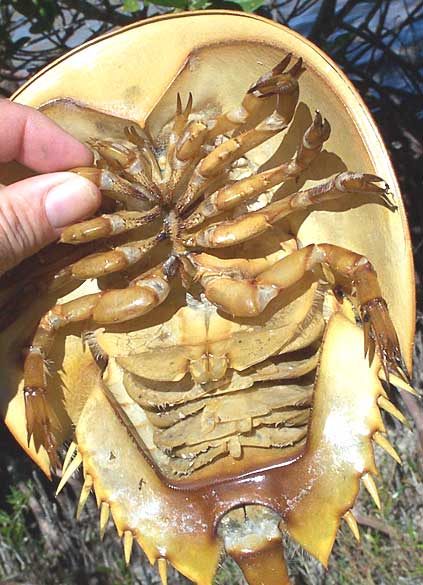
In the picture I'm holding onto the crab by one of its 12 appendages. The ten large ones, called pedipalps, are for walking but the two small ones at the top, called chelicerae, are used for manipulating food into the mouth. Notice that the lowest, largest pair of legs each end in brush-like structures. These are used for stirring up and pushing aside sediment when the crab burrows into the seafloor.
In the creature's center, at the base of the leg I'm holding, you can make out a hole. That's the mouth. If you look closely you can see that the base of each leg arising around the mouth is equipped with small, brown spines called gnathobases pointing downward toward the mouth. These keep food from moving in any direction other than toward the mouth. As food works toward the mouth the spiny leg bases grind it. It's all a very simple system for a simple, primitive organism.
The five pairs of wafer-like items covering the shell's bottom half are gills. You can't see them in the picture but from each gill arise about 150 leaf-like membranes called lamellae. The moving gills keep oxygen-rich water flowing over the lamellae, which absorb the oxygen. The gills also function as paddles for propelling juvenile horseshoe crabs through the water.
from the June 7, 2015 Newsletter issued from Río Lagartos, on the Yucatan Peninsula's northern coast (~N21.60°, ~W88.16°), Yucatán state, MÉXICO
UPSIDE-DOWN SWIMMING HORSESHOE CRABS
As the front of the boat nosed into an indentation of the mangrove's green wall at the estuary's edge, Paco was showing a couple of Tasmanians what a Boat-billed Heron looked like. I've seen lots of Boat-billeds, so I was vacantly watching the estuary's high-tide waters flow in . And then into my field of vision swam the thing shown below:
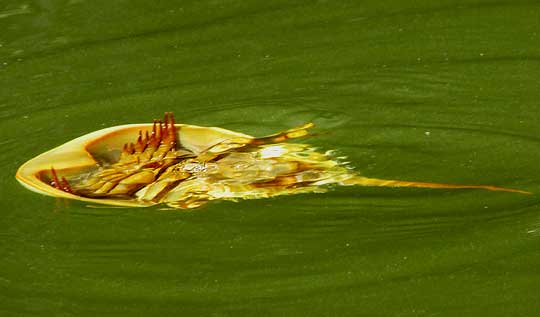
I'd heard about horseshoe crabs swimming upside-down at the water's surface, but seeing it for the first time was a surprise. It was even more surprising when later I learned that horseshoe crabs NORMALLY swim upside-down, inclined at about 30° to the horizontal. A few minutes later another horseshoe crab drifted by swimming completely submerged so, below, you can see the crab's normal swimming position (tilted ±30° upward):
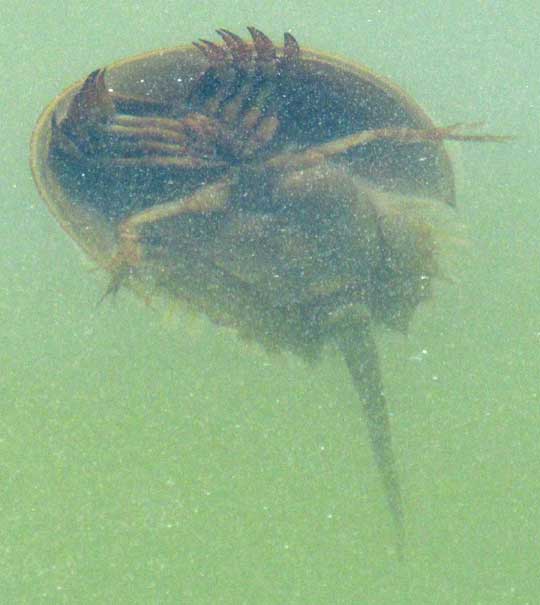
So, I've seen about a jillion living horseshoe crabs, but these were my first upside-down ones. The deal is that normally I spot them on the estuary's muddy floor foraging right-side-up, or else disappearing into a cloud of churned-up mud as they escape from the boat's encroachment, right-side-up. These were just my first peacefully swimming ones.
The one shown above swam so close to the boat that I reached over the gunwale and brought him up, to give the Tasmanians a closer look, especially at the eyes. Guides here differ on how many eyes horseshoe crabs have, and they say that eyes are present on the creature's bottom next to the mouth in the body's center, and I wanted to look for those, too. Below, you can see the eye situation:
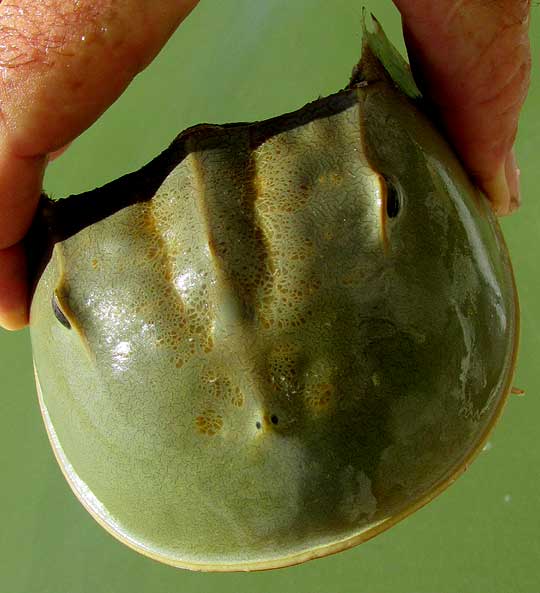
The spots that look like eyes with bony ridges as eyebrows are "compound lateral eyes," each composed of about a thousand lenses, or "ommatidia." These eyes are equipped with rods and cones that qualify as the largest to be found in the eyes of any known animal -- about 100 times the size of a human eyes' rods and cones.
On the one in our photograph, the spots that look like they should be nostrils are "median eyes," which can detect both visible and ultraviolet light. The HorseshoeCrab.Org website also assures us that there is one "endoparietal eye" between and a little above the median eyes, and two rudimentary lateral eyes, each close behind the compound laterals, but I can't see these on our animal.
There's also mention of a pair of "ventral eyes" on the crustaceans bottom surface, beside the mouth, as well as of a cluster of photoreceptors on the "telson," better known as the tail. These tail photoreceptors are said to keep the horseshoe crab's brain synchronized with cycles of light and dark. On our individual lifted from the water, not even scrutiny with a handlens could spot anything looking like an eye near the mouth or along the tail's length.
A variety of horseshoe-crab-vision matters are discussed at http://www.horseshoecrab.org/anat/vision.html.
Anyway, now I understood why the area's guides and the experts they get their information from so disagree on how many eyes a horseshoe crab has. It's a matter of defining what an eye is. Do these "photosensitive spots" scattered across the horseshoe crab's brittle body, especially the tail, qualify as eyes? Is each of the thousand or so lenses in each compound eye an eye?
Despite having such huge rods and cones, and so many spots and regions that gather light, horseshoe crabs are considered to enjoy relatively poor eyesight.
Some guides say that horseshoe crabs swim upside-down as a courtship behavior but I can't confirm that from any authoritative source.
from the June 7, 2015 Newsletter issued from Río Lagartos, on the Yucatan Peninsula's northern coast (~N21.60°, ~W88.16°), Yucatán state, MÉXICO
INNUMERABLE HORSESHOE CRAB SHELLS
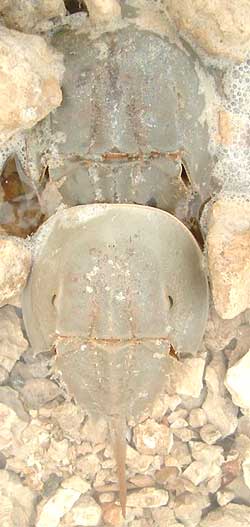
A visitor clambered ashore to find the beach strewn for as far as the eye could see with horseshoe crab shells, a small part of which is shown below:
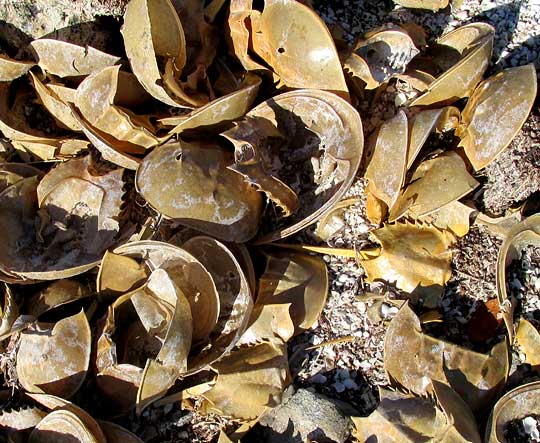
"What could have killed so many horseshoe crabs," the visitor asked.
"Nothing killed them," was the reply. "These are old exoskeletons discarded when the horseshoe crabs needed to grow larger and 'molted.' The old shell splits along its front edge and the animal crawls out, leaving the old shell behind. The new shell is relatively soft and flexible, and the animal increases in size by 25-30% during the hours before the new shell hardens."
Horseshoe crabs molt several times during their first year, during which they reach a width of about half an inch (12mm). After the first year they usually molt once a year until they reach adult size in 10-15 years.