PLANTS | ANIMALS | ECOLOGY | FUNGI | GEOLOGY | GARDENING | TOOLS
MEXICAN PLANTS & ANIMALS HOME

Excerpts from Jim Conrad's
Naturalist Newsletter
from the March 21, 2010 Newsletter issued from Hacienda Chichen Resort beside Chichén Itzá Ruins, central Yucatán, MÉXICO; limestone bedrock, elevation ~39m (~128ft), ~N20.676°, ~W88.569°
HOODED ORIOLE AT THE HALTÚN WATERING HOLE
With the dry season bearing down hard now, every day I fill the haltunes, or natural watering holes in limestone rock, and all day long, every day, there's a continual parade of birds who arrive, land in branches above the haltunes, look around and look some more, then finally descend to drink their fill. Despite the heat often I throw an old, brown poncho over myself for camouflage and sit with my camera about 20 feet away, and wait.
I've mentioned how hard it can be to identify orioles in their immature plumages, so when a challenging one arrives at a haltún I snap its picture, get its image onto my computer screen, bring out Howell's big A Guide to The Birds of Mexico and Northern Central America, and go to work. For example, who's that below:
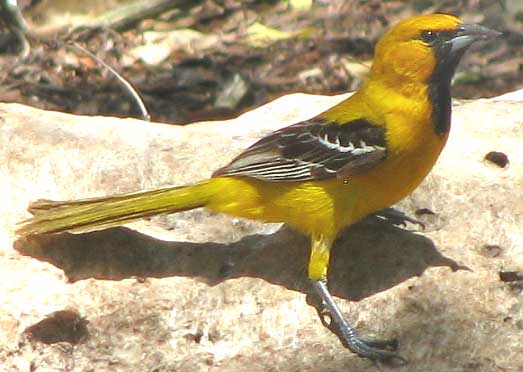
Our most common oriole here is the Altamira, but even the immature Altamira has a yellow wing stripe, which this one doesn't. Of the eight or so oriole species found in the Chichén Itzá area, two species have yellow (as opposed to orange) juvenile plumages with black bibs and white wing stripes -- the Hooded and the Orange.
Though the male adults of these two species are easily separable, I doubt I could differentiate the immature males, but for one feature: The Hooded's upper beak, or culmen, is slightly curved, while the Orange's culmen is straight-topped. The culmen in the picture looks more curved to me than straight, so I'm calling the bird a Hooded Oriole, ICTERUS CUCULLATUS. Some mature adult male Hoodeds were actually in the neighborhood that day so that adds to my confidence. In most of Mexico Hooded Orioles are only winter or summer visitors, or strictly transient, but in the Yucatán the species is present year round, except in the deep interior, where it's absent.
from the August 25, 2008 Newsletter written in Sabacché, l Yucatán, MÉXICO
HOODED ORIOLES NESTING
Here at Sabacché we can expect to see eight oriole species, though one of those, the Baltimore or Northern Oriole, visits only during migration, and the Orchard Oriole only overwinters here.
Here our most common oriole is the Hooded Oriole. Last Saturday when I camped overnight at one of the cenotes I got a good look at the species because a pair had built a nest among the down-hanging blades of thatch at the edge of the palapa (thatch roof on four poles) beneath which I'd set up my tent. You can see that nest, which is only about eight feet off the ground, and make out at least one sleepy-eyed nestling with its bright-yellow, down-turned mouth-corner below:
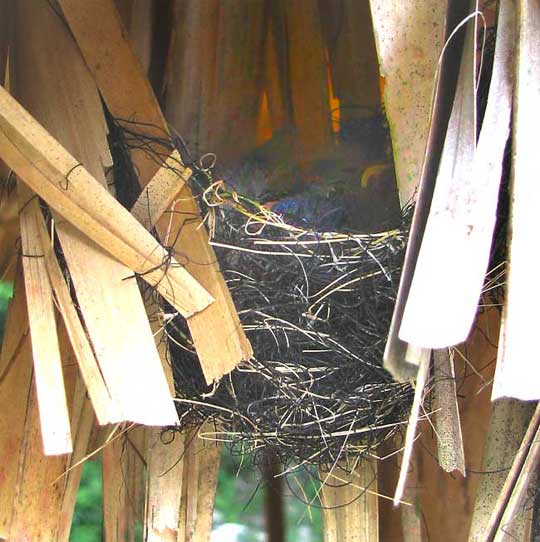
Most oriole species for their nests weave pendulous cups or pouches with plant fibers slung under branches or leaves. Some pouches are quite deep; the Altamira Oriole's bag-nest can be 26 inches deep (65 cm). Obviously the Hooded's little cup is much shallower.
A brightly orange-and-black male and a yellow-and- black immature male were very actively feeding the palapa-nest's inhabitants, always flying together. Actually the "immature male" conceivably could have been a female, for instead of having the black bib shown in the field guides it bore only a black spot on the chest. Anyway, these two birds always flew together, though usually it appeared that only one of the birds returned to the nest with food. Sometimes the adult male brought the food, sometimes it was the other bird
Was this an immature male learning from the adult male how to feed nestlings? Without being positive about it, that's my guess.
from the February 18, 2006 Newsletter written at Hacienda San Juan Lizárraga one kilometer east of Telchac Pueblo, Yucatán, MÉXICO
HOODED WARBLERS & AMAPOLA
Let me tell you what I saw at the tree the locals call Amapola. It's BOMBAX ELLIPTICUM, and it's a member of the tropical Bombax Family, so it's related to the kapok-producing Ceiba.
Visiting the Amapola not long after dawn as the day's first sunlight slanted in from the east, the tree's unopened flowers looked like long, slender, brown, cigars. The brownness was contributed by the flowers' long, slender petals, which were brown on the outside and slightly connected to one another along their margins. Instead of the petals separating from another from their tips, first they would buckle outward at their bases and slits would appear between the petals around the base of the "brown cigar."
Thus as I arrived two overwintering Hooded Orioles, gorgeously orange and black against the dark blue sky, were busily flitting from opening flowering to opening flower sticking their bills into the vertical slits at the flowers' bases, sipping nectar.
And those birds must have been rewarded with copious nectar, for I could see how vigorously their throat muscles worked as their bills poked through the slits. I also saw how glistening beads of nectar clung to the birds' withdrawn beaks, and how the birds themselves peed as frequently as sapsuckers at sap-rising time up North.
As time passed the flower petals split from one another irregularly, with some remaining joined to their adjacent petals and others coming undone completely, but eventually every flower had its tuft of stamens and style completely unsheathed.
The open blossoms attracted not only Hooded Orioles but also honeybees, but the bees seemed to be mostly or entirely interested not in the nectar at the base of the many long stamens but in the pollen at the tips of the stamens. It was nothing to see an oriole probing deeply into the stamen tuft while six to ten bees worked the same flower's stamen tips.
All these sweet, lush bouquets in a brown, dry-season- parched landscape attracted beetles, flies, gnats and more. Sometimes the orioles would catch an insect and gobble it down while hardly missing a beat rushing from opening flower to flower. Nor were orioles the only birds. A Least Flycatcher was kept busy and I could hear his tiny beak snapping sharply upon insects too small to show through my binoculars. Even an uncommon, endemic Yucatan Woodpecker passed through, though he seemed more interested in peripherally participating in the communal commotion than in accepting anything the Amapola directly offered.