PLANTS | ANIMALS | ECOLOGY | FUNGI | GEOLOGY | GARDENING | TOOLS
MEXICAN PLANTS & ANIMALS HOME

Excerpts from Jim Conrad's
Naturalist Newsletter
from the October 26, 2014 Newsletter issued from Río Lagartos, on the Yucatan Peninsula's northern coast (~N21.60°, ~W88.16°), Yucatán state, MÉXICO
ZONE-TAILED HAWK
My first duty upon arriving at Río Lagartos was to accompany several local guides on a birding trip during which I helped them learn to say such things as "Look in that short bush with dark green leaves at the left of the big agave with its spike of white flowers."
This first outing was to a savanna next to a marsh, so it was where two very different ecosystems met. It was a wonderful place for small seed-eating birds, and the raptors who preyed on the birds and rodents who fed on grass seeds and hid inside the grass.
One of the raptors circling us, peering down into the grass that day, was the bird shown below:
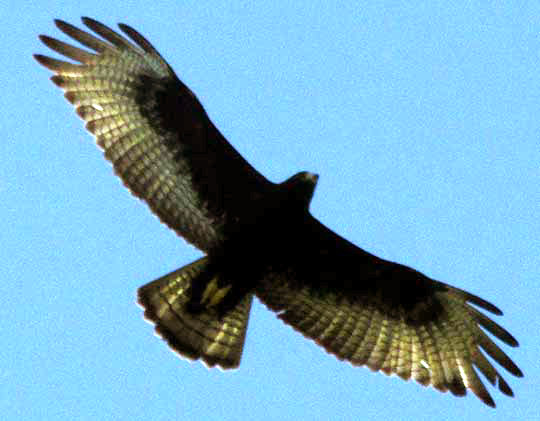
But, raptors are birds of prey, mainly hawks and falcons, but with the blackish color, separate "fingers" at the ends of the wings, and its circling manner, what could this be other than a vulture? Yet, the head doesn't have a vulture's skinny neck, and vultures don't have banded tails like this bird. In fact, this is a hawk masquerading a vulture, the idea being that birds and rodents on the ground who might hide from a hawk or falcon may not scurry for cover when a harmless vulture passes overhead.
Our picture shows an immature Zone-tailed Hawk, BUTEO ALBONOTATUS, a species distributed from the southwestern US throughout Mexico and Central America, clear to southern Brazil. In Mexico it's a summer breeder in the north-central uplands, but here in the Yucatan it occurs only as a winter visitor.
And Zone-tailed Hawks are famous for mimicking vultures. They even soar with real vultures to add to the confusion.
Not far from where we saw the Zone-tail, we also saw a Crane Hawk, which similarly can be confused with vultures, though its long, bright-orange-red legs make it easier to recognize. Still, it's clear that out on the savanna if you look like a vulture you have a better chance to catch prey than if you're obviously a hawk. We also saw a Peregrine Falcon that day, who looks nothing like a vulture, but when you're as fast and powerful as a Peregrine you don't need to resort to subterfuge.