PLANTS | ANIMALS | ECOLOGY | FUNGI | GEOLOGY | GARDENING | TOOLS
MEXICAN PLANTS & ANIMALS HOME

Excerpts from Jim Conrad's
Naturalist Newsletter
from the February 13, 2011 Newsletter issued from Hacienda Chichen Resort beside Chichén Itzá Ruins, central Yucatán, MÉXICO; limestone bedrock, elevation ~39m (~128ft), ~N18.52°, ~W95.15°
GYMNOPODIUM
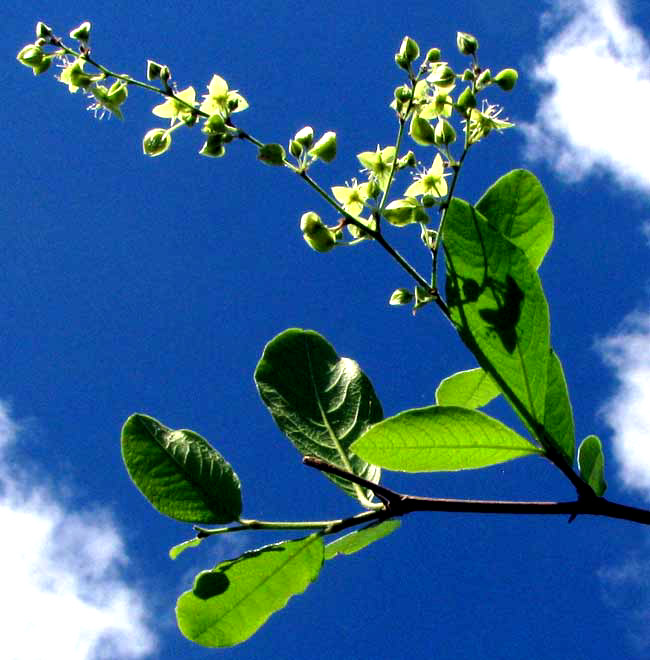
Nowadays out in the woods you'll be walking along a hot, sunny, dusty-feeling trail, then all of a sudden you'll enter a pool of penetratingly sweet fragrance, like honey, but almost too much of it. If in searching for the scent's source you look up you may see what's shown above.
Those are little flowers, smaller than a thumbnail, and if you're sensitized to how average blossoms on "normal" broadleaved bushes and trees look you'll notice something special about these flowers: They're three-lobed. A close look at a blossom is shown below:
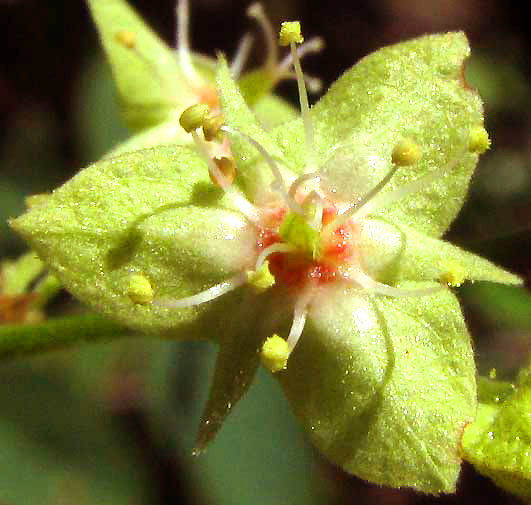
On that flower you see nine stamens and six perianth segments, "perianth" being the term used when the calyx and corolla aren't clearly differentiated. Also the little green ovary in the flower's center has three style branches.
You know that flowering plants traditionally have been separated into "dicots" and "monocots." Dicots, like daisies, oaks and buttercups, usually bear net-veined leaves and flowers with parts numbering four or five, or multiples thereof. Monocots, like grasses, lilies and orchids, usually have narrow and parallel-veined leaves and flowers with parts in threes or multiples thereof. Our fragrant bush has net-veined leaves like a dicot, but flowers with part numbers based on three, like a monocot.
Well, Nature is full of exceptions to nearly everything, and this is one of them. Our plant is GYMNOPODIUM FLORIBUNDUM, a member of the dicotyledonous Buckwheat Family, the Polygonaceae. Sometimes that family includes species with flower parts based on the number three.
Northern naturalists mostly know the Buckwheat Family as a home for herbaceous species, such as the smartweeds, knotweeds, docks and sorrels -- the main exception being woody Sea-Grape found along the seashore. Here in the tropics we have lots of woody Buckwheat Family members, and Gymnopodium floribundum is the most common one locally.
The Maya, traditionally being great bee-keepers, know this plant very well, calling it Ts'iits'il Che, and appreciating the fact that not only do the abundant flowers smell like honey, they also produce large amounts of nectar. In fact, as I took the above picture the whole small tree buzzed with bee busyness.
from the March 29, 2015 Newsletter issued from Río Lagartos, on the Yucatan Peninsula's northern coast (~N21.60°, ~W88.16°), Yucatán state, MÉXICO
GYMNOPODIUM FRUITING
Now later in the dry season, our local, dry-season leafless Gymnopodium floribundum trees are producing abundant fruiting clusters that in early morning sunlight cause the whole tree to seem to glow as if it had an interior fire. Its interesting, fingernail-size, three-winged fruiting clusters are shown below:
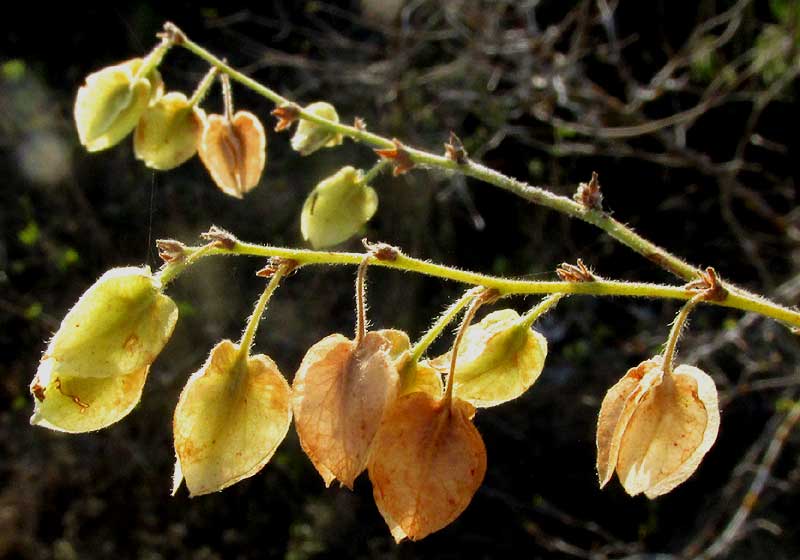
If you're familiar with the edible herb called dock, or the pretty vine called Coralvine -- both members of the Buckwheat Family, the Polygonaceae -- you'll notice similarities between those plants' fruiting heads and the ones on our little tree. That's because Gymnopodium floribundum also belongs to the Buckwheat Family.
Therefore, as with the fruiting heads of dock and Coralvine, each three-winged fruiting head of Gymnopodium floribundum consists of three one-seeded, achene-type fruits bearing a papery wing, which helps disperse the fruit on the wind.
Despite this being such a handsome plant, it simply doesn't seem to have a common name. Of course the Maya know it, calling it ts'iits'ilche' or sak ts'iits'il che'. For us Northerners, the name Gymnopodium probably is easier.
The Maya credit the tree as a good source of nectar for their honeybees, and as worthy of being cut for firewood.
from the February 8, 2019 Newsletter issued from Rancho Regensis north of Valladolid, Yucatán, MÉXICO;
elevation ~40m (~130 ft), N~20.876°, W~88.170°
AN IMPORTANT TREE FOR BEES
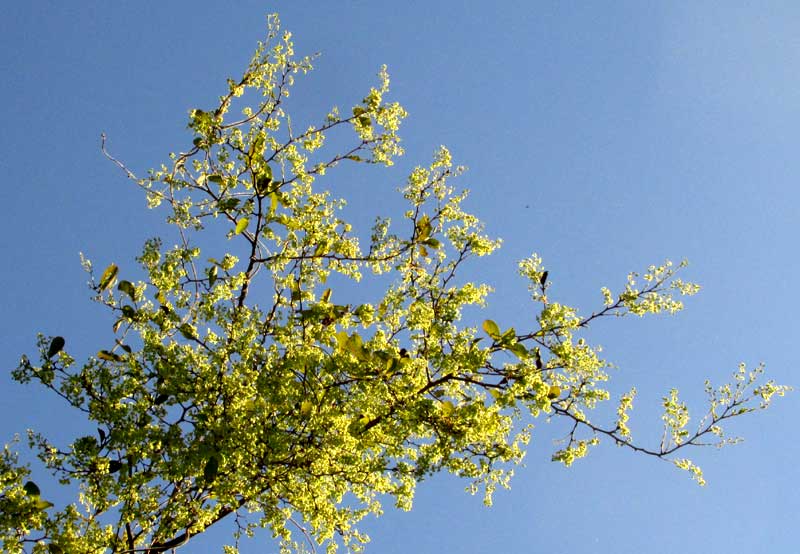
Above you see a commonly occurring, medium-size tree bearing so many small, whitish flowers that from a distance it looks like a big snowball. Up closer the few leaves still on the tree despite the advancing dry season's hot dryness show their shape, but the flowers still are too small to show much, as you can see below:
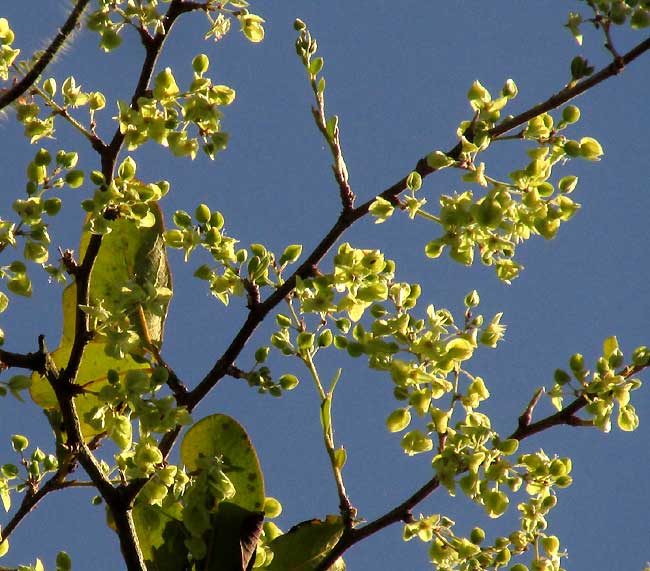
All this tree's flowers were beyond reach, but the camera's telephoto lens provided a closer look at the limbs' triangular, unopened flowers and a few open ones, as seen below:
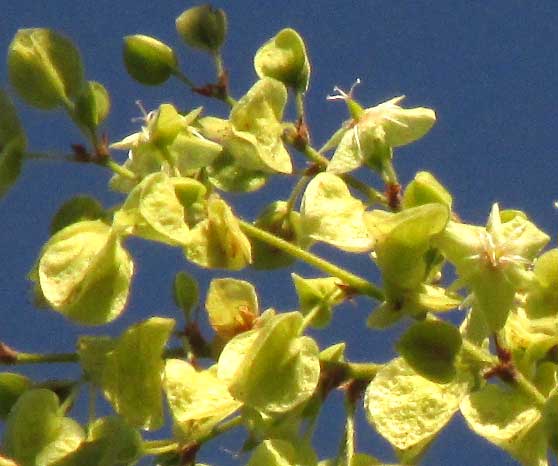
Now it was clear that this really was the Gymnopodium floribundum profiled above. However, when I saw the present tree I hadn't been quite sure of that until seeing the flowers better, because until now I'd seen only smaller trees in shaded places, bearing much fewer flowers -- despite the species name floribundum, "flower-abundance."
So now seeing what a Gymnopodium floribundum is capable of if given enough space and sunlight, I find it easier to believe what at least one online source says about it: That Gymnopodium floribundum is the Yucatan's most important tree for honey-producing bees.