PLANTS | ANIMALS | ECOLOGY | FUNGI | GEOLOGY | GARDENING | TOOLS
MEXICAN PLANTS & ANIMALS HOME

Excerpts from Jim Conrad's
Naturalist Newsletter
from the April 1, 2006 written at Hacienda San Juan Lizárraga one kilometer east of Telchac Pueblo, Yucatán, MÉXICO and issued from Hotel Reef Yucatan 13 kms to the north
PIICH, THE EAR TREE
I've told you about the very anomalous heavy rain we had about a month ago, causing the landscape to burst into greenness well in advance of when it should. It's been interesting to see that the rains have caused certain plants to be released from their dry-season leaflessness and brownness, while other plants weren't fooled by the rains at all. I am guessing that this is because some plants leaf out simply whenever enough water becomes available, while the leafing-out of others is triggered by the relative lengths of days and nights.
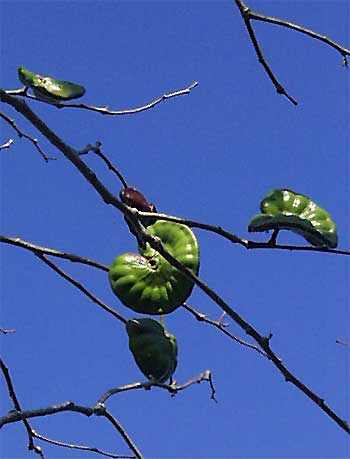
One tree not fooled by our anomalous rain was the great Piich, as it's known in Maya, or Guanacaste, as it's known in other places. It's the potentially huge, widely spreading tree member of the Bean Family, ENTERLOBIUM CYCLOCARPUM. The "cyclocarpum" in its name refers to one of its features accounting for another English name it goes by, at least among tourists requiring an English name for everything, is "Ear Tree." The "ear" comes from coiled (cyclo) fruits (carpum) -- flat legumes curved so that they look like large, green, puffy ears. Right now the Piich is leafless, but very conspicuously adorned with its "ears," which, below, you can see against a very blue sky.
The Piich is one of the most characteristic and best- known trees of the American tropics, occurring from central Mexico through Central America into South America. In earlier times the coiled legume's seeds were toasted and ground for human consumption, as well as for cattle feed and for making soap. Medicinally, the tree's resin has been used for bronchitis, colds and hemorrhoids. In the ancient Maya text "El Ritual de los Bacabes," it's prescribed to place the Piich's flowers over the womb of a woman giving birth. I suspect the idea behind that is that one hopes for the child to grow up as strong and well formed as the majestic Piich.