PLANTS | ANIMALS | ECOLOGY | FUNGI | GEOLOGY | GARDENING | TOOLS
MEXICAN PLANTS & ANIMALS HOME

Excerpts from Jim Conrad's
Naturalist Newsletter
from the March 7, 2010 Newsletter issued from Hacienda Chichen Resort beside Chichén Itzá Ruins, central Yucatán, MÉXICO; limestone bedrock, elevation ~39m (~128ft), ~N20.676°, ~W88.569°
YELLOW-FACED GRASSQUIT
A neat thing about the tropics is that, just when you think you've seen all the local species, something new comes along. Species diversity in the tropics is simply much greater than in the Temperate Zone.
So, early one morning this week on my way to the bar (that's where the wireless signal is strongest) I wasn't surprised when the first Yellow-faced Grassquit, TIARIS OLIVACEA, I've seen on Hacienda Chichen's grounds flitted from the lawn grass onto a spiny-tipped blade of an ornamental agave, as seen below:
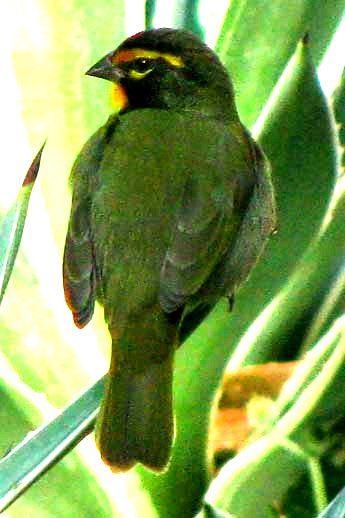
Yellow-faced Grassquits, despite seldom coming onto the grounds, are fairly common in the Yucatán in weeds along roadsides and in abandoned fields. This bird must have been just wandering through. He stayed four or five days, then drifted on.
The orangish-yellow eyebrow, or supercilium, throat and partial eyering just below the eye (the subocular crescent, as Howell calls it) along with the thick, stubby beak make Yellow-faced Grassquits easy to identify. There's just nothing else like it. An important field mark not seen in the above back-shot is the black chest beneath the yellow throat.
You might guess that with such a short, stout beak Yellow-faced Grassquits are classified in the same large subfamily, the Emberizinae, as sparrows, towhees and the like, and that's true. The species occurs from eastern Mexico and the Greater Antilles to northwestern Venezuela.
from the August 1, 2010 Newsletter issued from Hacienda Chichen Resort beside Chichén Itzá Ruins, central Yucatán, MÉXICO; limestone bedrock, elevation ~39m (~128ft), ~N20.676°, ~W88.569°
BIRD TEENAGERS
Nowadays you see lots of half-grown birds, and it's a pleasure to behold. For one thing, they're living proof that next year there'll be a new generation. The more immediate charm, however, is that it's simply grand to be in the presence of a creature who's half baby, half adult. It's the mingling of innocence and what's left after the school of hard knocks that's so captivating.
These bird teenagers fly full of enthusiasm onto a limb and lose their balance because of a reckless landing, and you just have to laugh. Something in them says that the grasshopper might be good to eat, but you can see in their body language that they're scared of it and don't know whether it might sting like a scorpion. Even their plumages are half adult, half nestling. You can see an immature male Yellow-faced Grassquit, his face only incipiently yellow and his chest only beginning to turn black below:
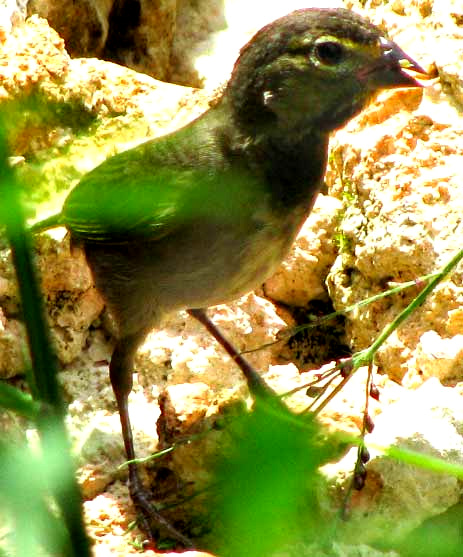
One morning just after dawn a week or so ago that same bird arrived with a parent, landing on a rock near my breakfast chair. Maybe it was just my own anthropomorphic projection, but in the immature's face I seemed to see the question, "What are we doing here?" The father hopped over to a certain grass plant bearing mature grains, grabbed one with his beak and started grinding on it. The light of understanding instantly illuminated the immature's face, and he hopped over and began pulling off grains himself. Since then the couple has returned several times and each time the immature seems more excited about the grass grains. On the day the picture was made the immature came to the grass-pecking rock alone, though the adult male accompanying him perched on another rock about ten feet away.
In my head now there's a tableaux of this young male coming of age, and of that grass plant -- under other circumstances just a weed probably needing to be pulled -- playing an important part in a family's development and survival.
from the May 28, 2017 Newsletter issued from Rancho Regensis north of Valladolid, Yucatán, MÉXICO;
elevation ~40m (~130 ft), N~20.876°, W~88.170°
ANOTHER IMMATURE PLUMAGE
Early one morning this week a certain bird flew onto a branch over the pit next to the hut and was good enough to remain still until my camera got focused and snapped the picture shown below:
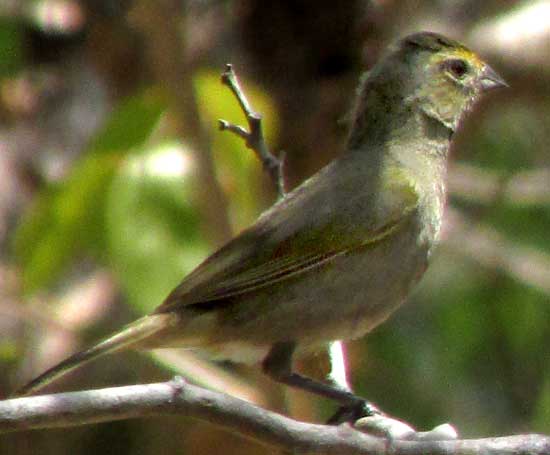
I'd never seen a bird colored like that. However, by eliminating species that don't occur in this area, and paying special attention to the fairly distinct yellow line above the eye -- the yellow "supercilium" -- and the very unusually shaped beak, in the end it was clear that this was a Yellow-faced Grassquit.
The really distinctive feature of this species, no matter what plumage it's displaying, is its straight upper mandible -- its "culmen." Normally a finch-like bird's culmen is at least a little curved, usually very noticeably so.