PLANTS | ANIMALS | ECOLOGY | FUNGI | GEOLOGY | GARDENING | TOOLS
MEXICAN PLANTS & ANIMALS HOME

Excerpts from Jim Conrad's
Naturalist Newsletter
from the December 15, 2008 Newsletter issued from Mayan Beach Garden Inn 20 kms north of Mahahual; Caribbean coastal beach and mangroves, ~N18.89°, ~W87.64°, Quintana Roo state, MÉXICO
GHOST CRABS
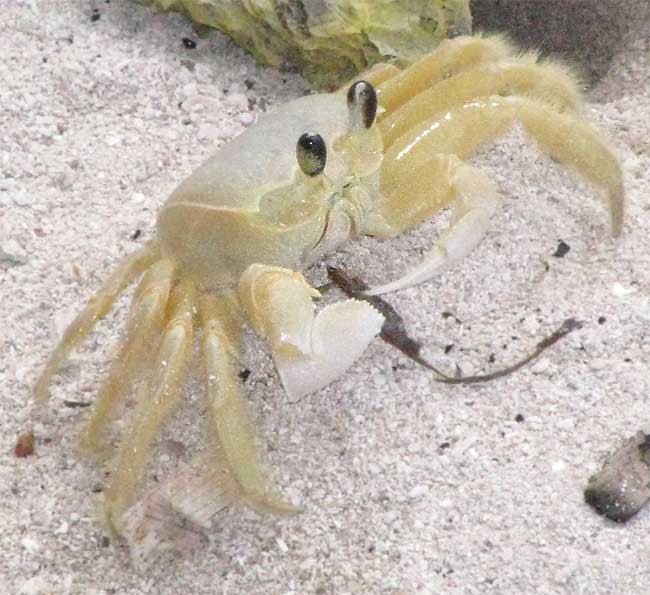
Just about anytime during the day as you're walking along the beach or the scrubby rise between the ocean and the mangroves, but especially at dawn and dusk, you see the white, black-eyed, fuzzy legged crab shown above.
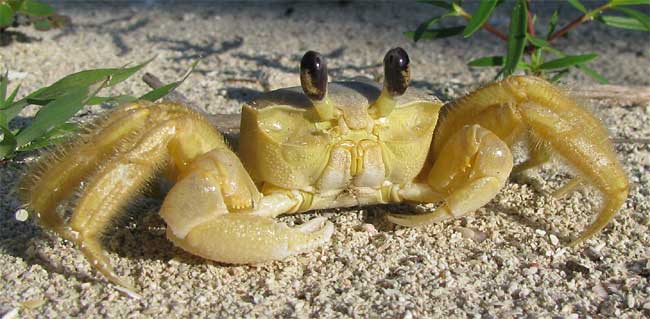
About the size of a saucer, this is the Atlantic Ghost Crab, sometimes referred to as a sand crab, OCYPODE QUADRATA. You can see in the picture that one of this species' claws is larger than the other. This points to the fact that the genus Ocypode resides in the same family as fiddler crabs, the Ocypodidae, famed for having a single claw so large that it looks like the crab is playing a fiddle.
In the short time I've been here I've learned three things about our ghost crabs. First, they dig deep slanting tunnels into moist sand (four-feet deep, at a 45° angle, I read), and if a favorite ornamental plant stands above the tunnel the digging's disturbance may damage or kill the plant.
Second, ghost crabs eat an enormous variety of foods, such as the blackened, brittle, dried leaf the one in the picture is munching on, and; third:
If you're jogging down a road at dawn and come upon a ghost crab, if it figures it can't outrun you, it'll stand its ground and try to face you down, holding its white claws before it like a judo expert keeping his dangerous hands out front. In dim dawn or dusk light, the white claws are very conspicuous, almost seeming to glow. A good-sized dog wanting badly to sniff the critter, seeing the spectral white claws brandished before him, cedes his sniffing rights.
Many crab species are aquatic, but Ocypode quadrata is beautifully adapted for life on land, only occasionally returning to water to wet its gills. Ruppert & Fox in 1988 published a work describing how the species also can moisten its gills by extracting water from damp sand, using fine hairs near the base of its walking legs to wick ground water up onto the gills through capillary action! The species also must be close to water at mating time, for its females release their eggs at the water' edge.
from the October 23, 2011Newsletter issued from Mayan Beach Garden Inn 20 kms north of Mahahual; Caribbean coastal beach and mangroves, ~N18.89°, ~W87.64°, Quintana Roo state, MÉXICO
CRAB TUNNELS
Within a few feet of the water most of the beach in our area is perforated with a few to many holes about right for a golf ball to roll into, as shown below:
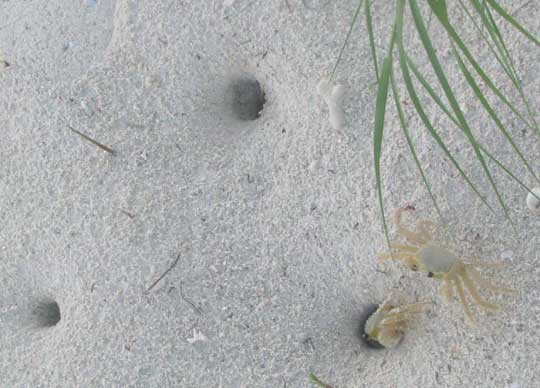
At the picture's lower, right, those are Ghost Crabs, OCYPODE QUADRATA. In that picture the two crabs had emerged from the same hole. Also, the outside crab had exited that hole but then entered another. These observations got me curious about Ghost Crab tunnels.
In Wayne and Martha McAlister's Life on Matagorda Island, an online "Google Book," I learn that Ghost Crab tunnels enter the sand at 45° angles and are directed so that they catch the onshore breeze. Often two tunnels join into a Y, possibly to create a draft through the lair. Other tunnels are simple Ls or Js, the bottoms enlarged so that the crab can rest and turn around during the day when normally it's belowground. The tunnels descend to just above the water table, and usually there's just one crab per tunnel.
Ghost Crab tunnels aerate the sand, but also newly hatched sea turtles tumble down them. Ghost Crabs prey on both turtle eggs and recently hatched turtles.
A study in Malaysia with a different species of ghost crab found that when the crabs tunneled into turtle nests they would break open several eggs. This began a sequence of events normally resulting in the entire clutch being destroyed -- though the crab may actually eat only a few eggs. The crab's tunnel serves as an entry point by other predators, such as ants and fungi, plus diseases affecting the whole nest arise from the broken eggs.