PLANTS | ANIMALS | ECOLOGY | FUNGI | GEOLOGY | GARDENING | TOOLS
MEXICAN PLANTS & ANIMALS HOME

Excerpts from Jim Conrad's
Naturalist Newsletter
from the December 8, 2005 Newsletter issued from Hacienda San Juan near Telchac Pueblo, Yucatán, MÉXICO
HOUSE GECKOS
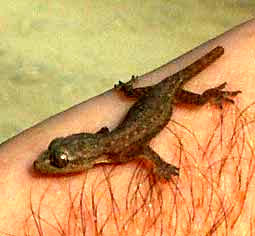 Each night four or five minutes after I turn off the light, in that half-sleep when thinking is on the verge of becoming dreaming, then it comes:
Krrrk krrrk krrrk krrrk krrrk krrrk!
With my bare, high-ceilinged, stuccoed stone walls, the krrrking is loud and shocking. I must begin a whole new cycle of going to sleep and there's a good chance that when I reach the same stage of half-sleep as before precisely the same krrrking will erupt, with the same consequences.
The krrrking critters are cream colored little geckos 2-3 inches long. They climb the walls of all the buildings here and I hear them among Hotel Reef's fancy rooms. However, last year at Komchén I never saw or heard any. I'm guessing that that's because of the several cats there. Here we have fewer cats and more buildings.
For weeks I've been wondering what gecko species I had. Therefore, when this week the long-ago-ordered book AMPHIBIANS AND REPTILES OF NORTHERN GUATEMALA, THE YUCATÁN, AND BELIZE, by Jonathan Campbell, finally arrived, the first thing I did was to open it to the gecko section. Unfortunately, my sleep- disturbing gecko wasn't there. A note in the general info section said that several alien gecko species have been introduced into Mexico, and the book presented only native species.
Back in Hotel Reef's computer room, by using Google's image option and the keywords "gecko, Mexico," I found pictures of my obstreperous roomy. Identification was particularly easy because where the reptile's tail attaches to his body several short, sharp but pliable spines appear. My sleep disturber was the Common House Gecko, HEMIDACTYLUS FRENATUS, shown above.
While Googling up that identification I ran across a page in Spanish listing amphibian and reptile species that have been introduced into Mexico -- Mexico's invasive species. Here I learned that my Common House Gecko is a native of islands in the Pacific Ocean, and that it's found in quite a number of places throughout Mexico. Plus, at least two other introduced gecko species occur here in the Yucatan -- and that's atop three native Yucatec species.
from the November 15, 2009 Newsletter issued from Hacienda Chichen Resort beside Chichén Itzá Ruins, central Yucatán, MÉXICO; limestone bedrock, elevation ~39m (~128ft), ~N20.676°, ~W88.569°
WOLF SPIDER NABS GECKO
Throughout each of the previous nights a certain House Gecko, Hemidactylus frenatus, periodically had been erupting with his somewhat loud, squeaky Krrrk krrrk krrrk krrrk! One afternoon I was glad to see this particular gecko scampering across my tile floor, for I wanted to meet the maker of all that noise. I wasn't really annoyed with him, for once you get used it -- if he doesn't call exactly as you're dozing off -- it's rather nice having such a hut mate, one who minds his own business, being so engaged in his own little life. Therefore, to know this gecko better, I got down on my hands and knees for a better look.
But as I drew near something black streaked in from the left and before my brain could register what was happening a big, blackish wolf spider had taken up position atop the gecko, and apparently at that very moment was digging his fangs into the gecko's body. As the spider began rushing away dragging his prey beneath him I grabbed my camera and shot the image below:
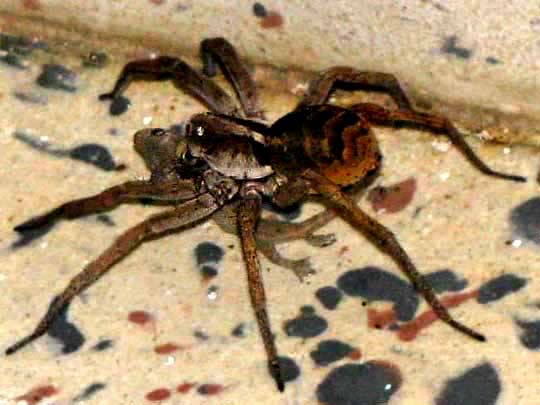
In that picture one of the spider's side eyes is glowing because I used a flash, and spider eyes are very reflective. Back when I led nighttime wildlife- watching walks in Belize, the moment during each walk eliciting the most visitor ooooohs usually came when I'd beam a strong flashlight across the rainforest floor and it'd look as if diamonds were strewn all about, those sparkles being the eyes of large spiders.
Before the spider could get away I jumped around in front of him and shot a close-up of his head, seen below:
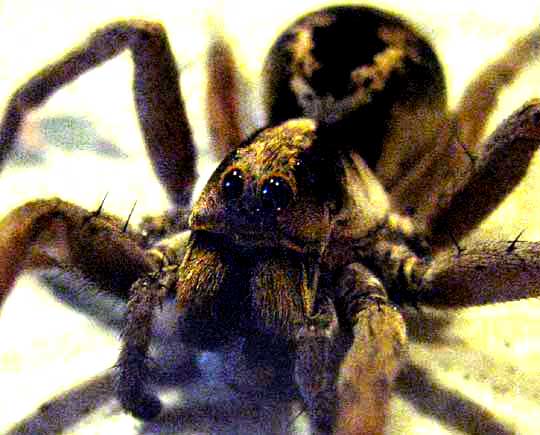
Even in the last picture the spider carries the gecko below, though now the prey has been shifted back and isn't to be seen from the front.