PLANTS | ANIMALS | ECOLOGY | FUNGI | GEOLOGY | GARDENING | TOOLS
MEXICAN PLANTS & ANIMALS HOME

Excerpts from Jim Conrad's
Naturalist Newsletter
from the January 12, 2009 written at Hacienda San Juan Lizárraga one kilometer east of Telchac Pueblo, Yucatán, MÉXICO
A GREAT HORNED OWL WELCOME
On my first morning at this new location, just before it got light enough to jog, a homey hoo hoo-hoo, hoo eased through the still, predawn, balmy air. I lay in my mosquito net feeling welcomed by this friendly call of the Great Horned Owl, BUBO VIRGINIANUS, the same species found in North America, as the species name virginianus indicates.
I've been wanting to test my digital camera in very limited lighting so this was a good time for that. Hardly able to see the ground I worked my way toward the hooting until the big owl's silhouette appeared against the fast-lighting sky. It was about 20 feet up and 40 feet away on a crossbeam projecting from the side of a very tall stone chimney next to an old hurricane-collapsed henequen mill. Below, you can see the results of this low-light picture-taking experiment.
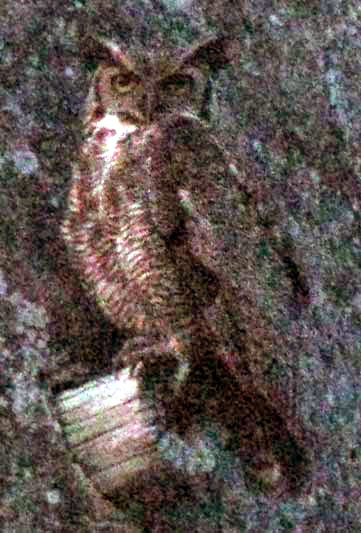
When I first downloaded the above picture into my computer it showed up as nearly solid black. However, with PhotoShop I coaxed the owl's very grainy, colorless but early-dawn-evoking image into existence, reconfirming my general suspicion that most good photos are less the results of artful camera use than artful use of a darkroom or a good image program.
The property owner tells me that Great Horned Owls have nested at this same spot for many years producing generation after generation of young. An adjoining plot of scrub forest was purchased largely with the intent of providing a secure hunting ground for them.
from the March 11, 2006 Newsletter written at Hacienda San Juan Lizárraga one kilometer east of Telchac Pueblo, Yucatán, MÉXICO and issued from Hotel Reef Yucatan 13 kms to the north
GREAT HORNED OWL NESTLINGS
Atop a topless wall jutting into free space at the side of the hurricane-ravaged, old henequen mill next to my lodging, during each of the last several years a pair of Great Horned Owls has produced two offspring. It's not clear whether the parents are the same owls each year, but we like to think that they are.
For the last few weeks I've ended my tours of the hacienda by taking folks to see the mother patiently sitting on her nest, visible as two ear-tufts rising from a mat of brown grass that's established itself atop the ruined wall. Always two or more large Black Iguanas encircled her, facing the nest, and it sure looked as if those iguanas were waiting for the right moment for an egg or nestling meal. Remember that at Komchén last year we had problems with Black Iguanas eating eggs in the hen house.
About a week ago one morning the mother appeared to be off her nest, showing herself from the chest up. I guessed then that the nestlings had hatched and that now they were large enough to displace the mother. This Wednesday two fuzzy little heads appeared next to the mother, the iguanas were gone, and the father was flying around carrying in his talons the gut-dangling remains of what was probably a rat, but could have been an iguana. The nestlings were surprisingly unlike one another in their faces. Atop their heads their future "horns" were no more than low, bushy bumps.
The species enjoys an especially large distribution, being found from northern Canada and Alaska to Tierra del Fuego in extreme South America. Its habitats range from arid deserts to humid evergreen and deciduous forests, and dry, hacked-up scrub like ours. During my first months here I heard them every night, but lately they've been quieter.