PLANTS | ANIMALS | ECOLOGY | FUNGI | GEOLOGY | GARDENING | TOOLS
MEXICAN PLANTS & ANIMALS HOME

Excerpts from Jim Conrad's
Naturalist Newsletter
from the January 24, 2010 Newsletter issued from Hacienda Chichen Resort beside Chichén Itzá Ruins, central Yucatán, MÉXICO; limestone bedrock, elevation ~39m (~128ft), ~N20.676°, ~W88.569°
FLAMING KATYS
Another commonly potted houseplant up North planted outside here and now flowering very prettily is a red-flowered succulent going by such inspired names as Flaming Katy, Madagascar Widow's-thrill, Christmas Kalanchoe and Florist Kalanchoe. It's KALANCHOE BLOSSFELDIANA, a native of Madagascar, shown below:
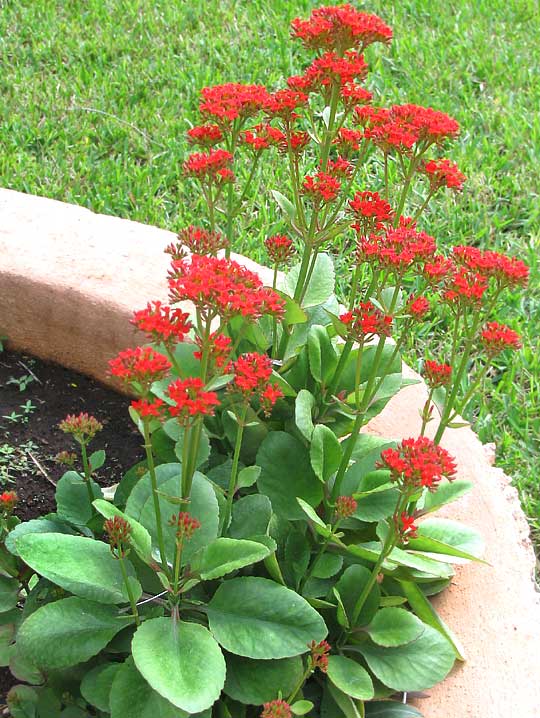
Flaming Katys are members of the Stonecrop Family, the Crassulaceae. For admirers of "succulents" -- plants with fleshy parts well adapted for preserving water --the Stonecrop Family is important, for it embraces many potted plants as well as plants used in rock gardens that receive little or very intermittent watering.
An interesting feature of the Stonecrop Family is that its 25 or so genera fall neatly into two groups: Those whose stamen number equals the number of corolla lobes or petals, and those whose stamens are twice the number. Kalenchoe falls into the group with stamens twice as many as the petals, as you can see yourself below:
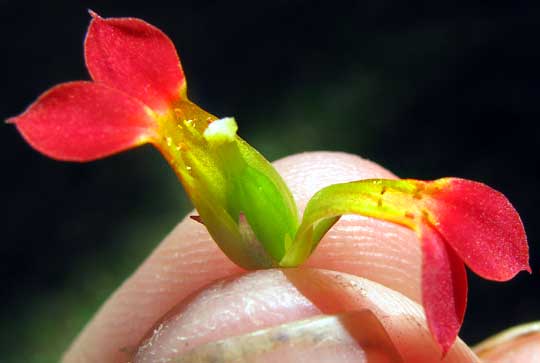
In that picture's center the white-topped, green with a neck appears to be a normal flower's pistil consisting of a white stigma, a neck-like style, and an ovary. However, if you look closely you can see that what appears to be the ovary is shallowly furrowed along its length. In fact, what appears to be one pistil with one ovary are several pistils, each with its own white stigma, neck-style and plump ovary. This is a feature of the entire Stonecrop Family, something to look for if you think you've run into a member. Also, in this flower the eight stamens arise at two different levels on the corolla tube, most easily seen on the flower's left side.
Flaming Katys are rated as requiring temperatures of at least 50ºF (10ºC), though they can stand brief periods of lower temperatures, as indicated by the fact that in southernmost Florida they've been noted as escaping from cultivation.