PLANTS | ANIMALS | ECOLOGY | FUNGI | GEOLOGY | GARDENING | TOOLS
MEXICAN PLANTS & ANIMALS HOME

Excerpts from Jim Conrad's
Naturalist Newsletter
from the July 31, 2011 Newsletter issued from Mayan Beach Garden Inn 20 kms north of Mahahual; Caribbean coastal beach and mangroves, ~N18.89°, ~W87.64°, Quintana Roo state, MÉXICO
A SOFT, GREEN SPURGE
On this low, windswept, sun-drenched sand rise paralleling the beach between the Caribbean and big coastal mangrove swamps, one grows accustomed to plants showing adaptations to the harsh environment -- toughness, succulence, silvery-wooly hairiness, etc. However, out behind the employee's dorm where rainwater runs off a tin roof, out of the wind and shaded for part of the day, a small community of normal weeds has taken root. Sometimes I stand looking at their trusting softness and innocent, simple greenness just for a break from the environmental harshness elsewhere.
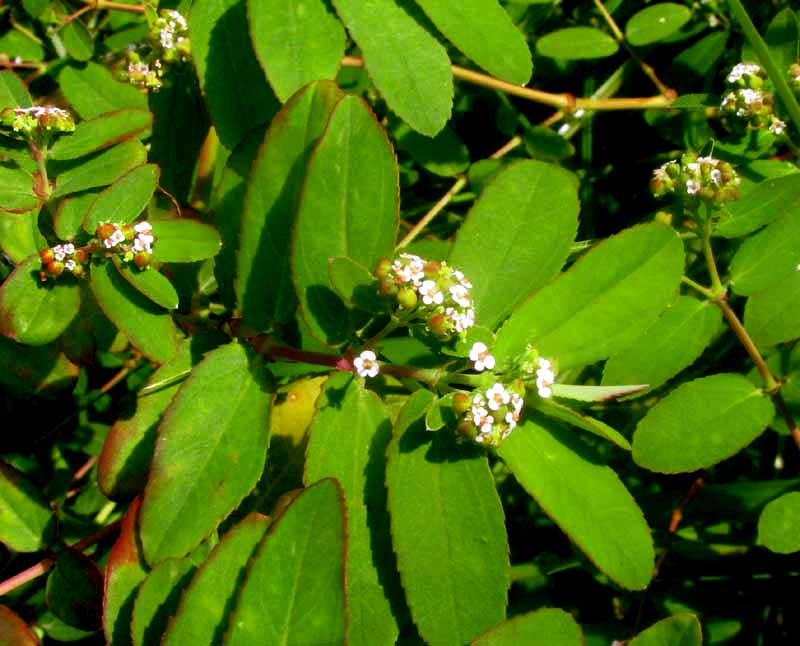
One if those moisture-loving, shade-thriving species is EUPHORBIA HYSSOPIFOLIA, a weedy native of the tropical and warm-tending Americas, and invasive in most of the rest of the world where there's enough moisture and heat for it. In the US it's found in the southernmost tier of states. You can see a sprig of our plant with inch-long leaves and tiny white flowers at the top of this page.
A close-up of flowers showing the amazing Euphorbia feature of the oval ovary on a bent stem dangling outside the main flower body is shown below:
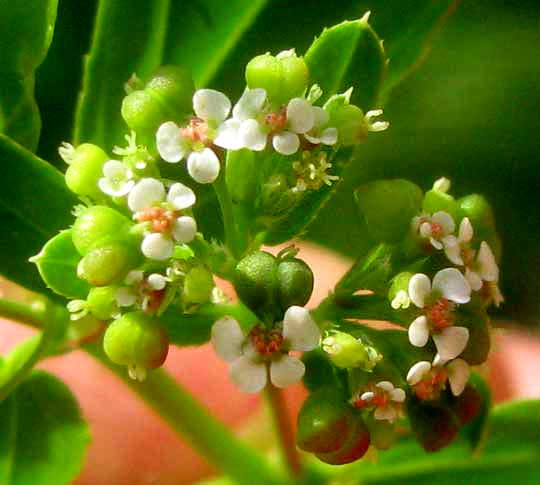
In that picture, the almost heart-shaped item in the center is an ovary, or future fruit. It dangles from the flower just below it. Each flower seems to bear four white petals, but in fact the white things are petal-like appendages of nectar secreting glands.
Found in so many English-speaking lands, Euphorbia hyssopifolia goes by lots of English names. The USDA seems to have settled on the name Hyssopleaf Sandmat, but others sometimes call it Leafy Spurge. Traditionally many members of the huge genus Euphorbia (over 2000 species as currently delimited) are known as spurges.
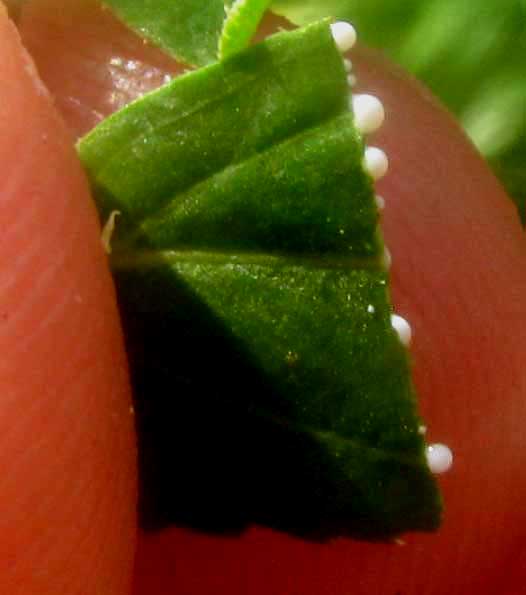
That word "spurge" has good roots, deriving from the Middle English/Old French "espurge," meaning "to purge." That name refers to the fact that the plants produce a white sap often regarded as purgative -- if taken internally, you vomit. In fact the milky juice exuding from spurge leaves is rich in alkaloids that can be toxic or medicinal, depending on dosage. Some Maya use the sap for "tired eyes," putting the juice into the eyes. You can see a torn leaf exuding milk below: