PLANTS | ANIMALS | ECOLOGY | FUNGI | GEOLOGY | GARDENING | TOOLS
MEXICAN PLANTS & ANIMALS HOME

Excerpts from Jim Conrad's
Naturalist Newsletter
from the November 8, 2009 Newsletter, issued from Hacienda Chichen Resort beside Chichén Itzá Ruins, central Yucatán, MÉXICO; limestone bedrock, elevation ~39m (~128ft), ~N20.676°, ~W88.569°
TREE CYCAD, OR BLUE DIOON
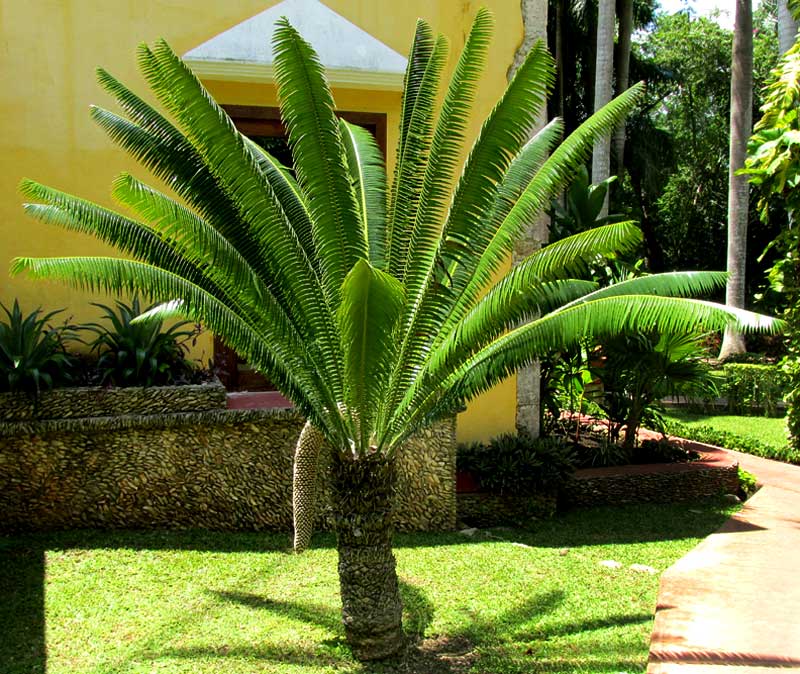
Even before I'd introduced myself to the Hacienda staff I got sidetracked at the office's entrance, admiring the handsome being shown below:
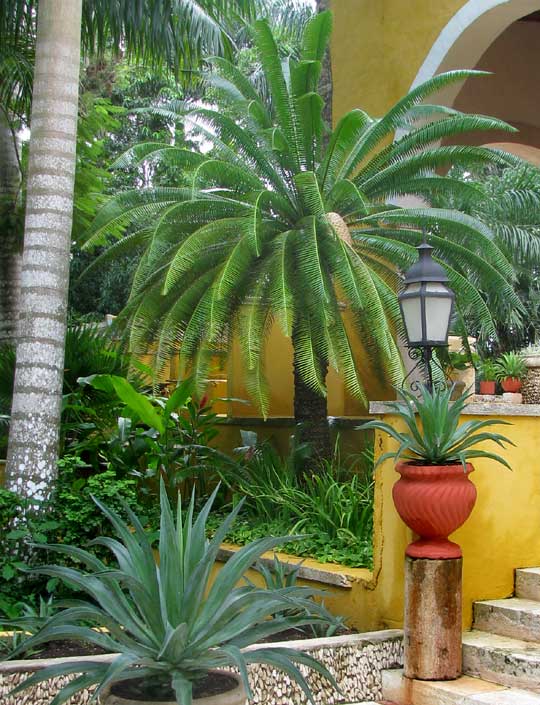
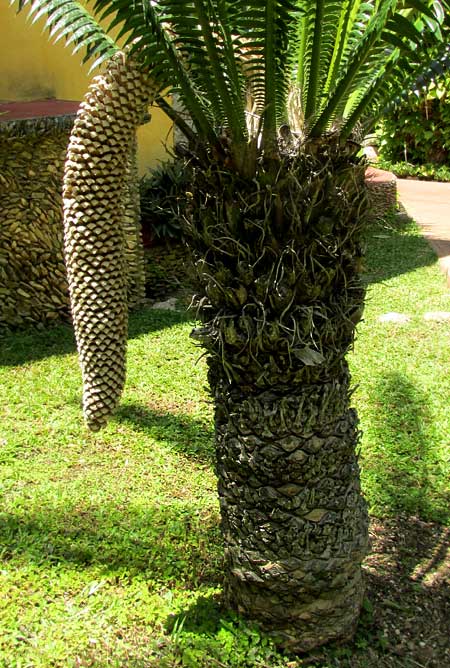
"What on Earth kind of palm is that?" I heard myself almost say, before noticing the 21-inch-long (53 cm), pale-tan-colored item emerging among the fronds at the trunk's top. In fact, there were two of them, and you can see a close-up of the one on the tree's other side below:
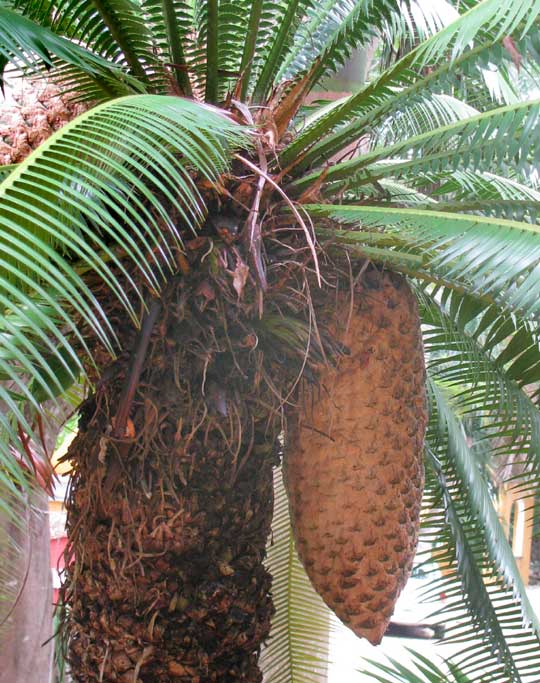
Palms don't produce fruits like that. Typical palm fruits are like small coconuts, for coconuts are indeed palm fruits. What's in the picture is some kind of cone. When finally I'd noticed all this I realized I had a cycad, one of those "living fossils" it's always nice to encounter. Cycads are gymnosperms and thus most closely related to plants such as ginkgos and yews, but really their closest relatives went extinct millions of years ago, so now cycads as a group occupy a rather isolated branch of the evolutionary Tree of Life.
We've run into a native Mexican cycad before, Dioon edule, back in Querétaro. You can see that smaller species at www.backyardnature.net/q/cycad.htm.
Cycads can be hard to identify to species level if you don't have the seeds, and I don't, but my best guess is that what's in the picture is a close relative to our Querétaro discovery, DIOON SPINULOSA, sometimes called the Tree Cycad or Blue Dioon. It's endemic to a small part of Veracruz State, and is endangered, but is being planted widely because it's such a wonderful tree. It's really a distinction to have such a large one living here.
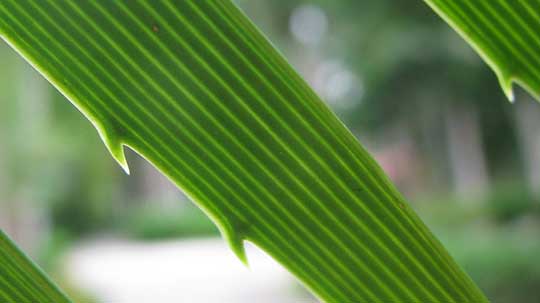
A good field mark for cycads of the genus Dioon is that the frond sections, or pinnae, bear several parallel veins -- there's no outstanding mid-vein or reticulation. Also, each pinna bears small, sharp, stiff "teeth" along its margins. All this is below:
The local folks call the tree "Piña de Brasil," or "Brazilian Pineapple." The pineapple part is understandable, but everyone should be clear that this is a very special Mexican native, not something from Brazil
from the January 31, 2010 Newsletter issued from Hacienda Chichen Resort beside Chichén Itzá Ruins, central Yucatán, MÉXICO; limestone bedrock, elevation ~39m (~128ft), ~N20.676°, ~W88.569°
A RIPE CYCAD FRUIT
Upon my arrival at Hacienda Chichen last November the very first plant profiled in this Newsletter was the amazing Tree Cycad, Dioon spinulosa, standing so handsomely next to the Office's entrance, as seen above.
The second picture from the top of this page shows a 21-inch- long (53 cm) cone, or fruit, suspended from the cycad's crown. This week that same cone reached maturity and broke apart in a very spectacular manner. You can what it looked like Monday morning below:
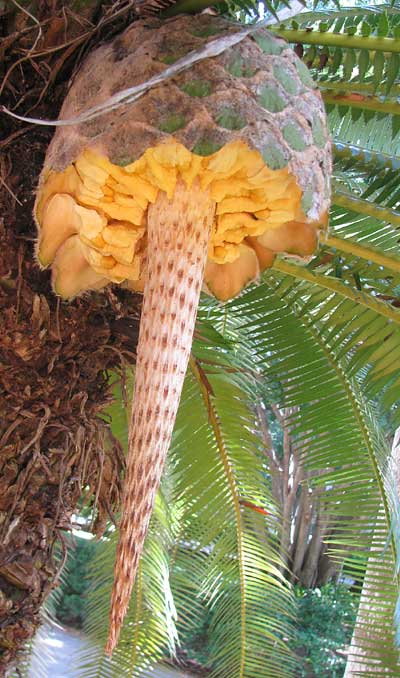
Most of the cone had disintegrated into pieces, which lay heaped beneath the cycad. Anyone who has ever dissected a pinecone, or seen them shattered on the road where they'd been run over by cars, can see that the cycad's cone is structured similarly; numerous seed-bearing scales are attached spirally around a central axis. Among pines, the scales are somewhat dry and woody, but these scales are different. You can see a single scale in the palm of my hand below:
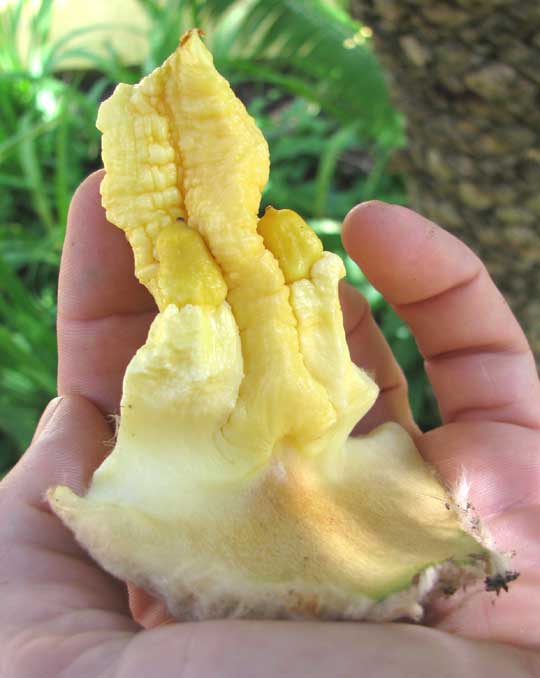
In that picture notice the two yellow, oval seeds held at about the level of my little finger's tip. Here we can really see the "gymnos" in "Gymnosperm." For, "gymnos" is classical Greek for "naked," so "Gymnosperms" are plants with "naked seeds." And those two seeds on their scale perches are about as naked as they can be. Remember that in Angiosperm fruits the seeds are covered. Cherry seeds are embedded in sweet flesh; a maple's fruit has its seed surrounded by a dry husk that enlarges on one side into a papery wing. In a sense, the gymnosperms' naked seeds recall a moment in evolutionary history when plants hadn't yet figured out the advantages to embedding their seeds in various coverings.
This cycad species is so rare and beautiful that it would be the star in any garden. Therefore, why not plant the seeds and sell the seedlings at a hefty price? I collected all the fallen scales with their seeds ready to do just that. However, I had a certain doubt: My books say that the main cycad genus Cycas is "dioecious" -- plants either male or female. I have no information about this genus, Dioon, but if it's also dioecious we may be in trouble because I know of no male tree hereabouts. Before harvesting all the seeds from their scales I cut across many seeds and every one of them showed the disheartening situation shown below:
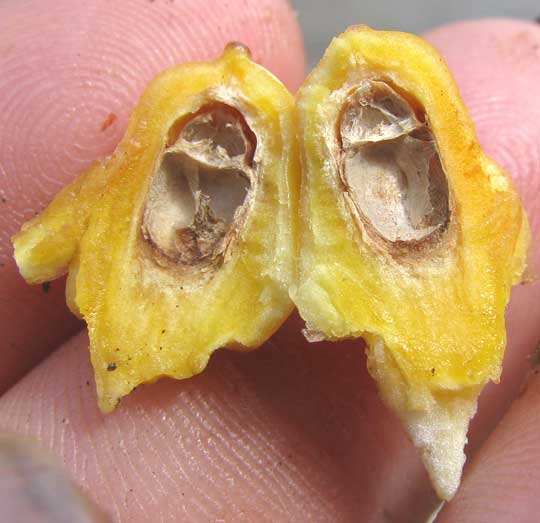
The part of the seed supposed to hold the genetic information is empty. This looks like a spectacular case of "false pregnancy." Apparently fruits and seeds are produced whether fertilization takes place or not. This explains why all the older seeds were rotting. On the Internet I find a page entitled "Cycads From Seed" stating that inside the seed there should be "... a fine coiled filament and attached to the end of that a small object which is the embryo. If the hollow inside the seed is quite empty, the seed is no good." It also says that some cycads produce well formed seeds even when no pollination has taken place.
In Querétaro we ran into a much smaller cycad with edible cones. Literature I have access to is mute on the edibility of Dioon spinulosa cones, so I ate most of the scale in my hand. The darker yellow part had the texture of raw winter squash, which it slightly tasted like, in the sense that it didn't have much taste at all, though there was a hint of sweetness. The paler yellow part was too hard to bite into. Still, that cone provided a lot of eating for anyone just needing calories. I can imagine that cooked it might be good eating.
from the July 10, 2016 Newsletter issued from Hacienda Chichen Resort beside Chichén Itzá Ruins, central Yucatán MÉXICO
TREE CYCAD ISSUING A CONE
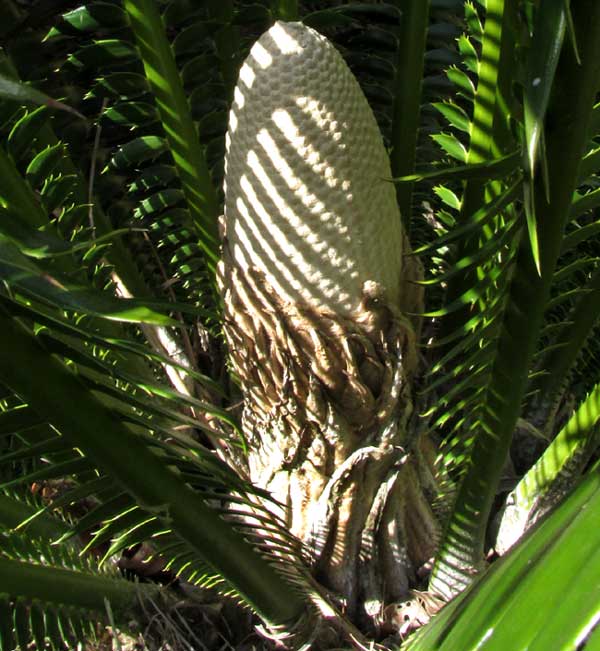
One of the Hacienda's younger tree cycads is turning up issuing an immature, American-football-sized and -shaped cone pushing up between the bases of its crown leaves, shown below:
A close-up showing the white-hairy future cone scales packed tightly next to one another is shown below:
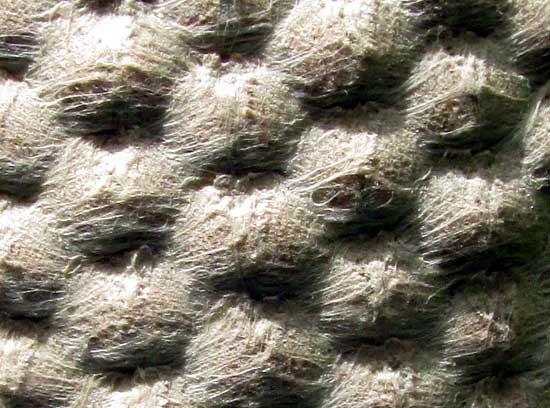
Cycads come in either male or female plants, and at least during their early stages of development the cones are fairly similar. I think that the cone in our picture is a female, but I find pictures on the Internet with cones looking just like this labeled as male. I'm just going to wait and see which sex this cone turns out to be. If it happens to be male, that'll be great news because it opens the possibility of pollinating the big female featured on our Tree Cycad page. That big female does produce seeds, but the seeds are empty and sterile, as shown toward the bottom of our page.
By the way, in 2010 when I wrote about the big female on our Tree Cycad page, I mentioned that the fleshy tissue around the seeds was succulent and not bad tasting. Since then I've read that at least the tree's foliage and seeds contain toxins. However, I also read in the "Flora de Veracruz" that natives in the tiny area of Veracruz State where this species grows naturally eat the seeds in tamales. Also, the species has suffered from their leaves being gathered for religious celebrations. The Flora says that, as ornamental plants, in 1967 the trees were sold in lots of up to 30,000 individuals, for a price of 6 pesos for each plant.
from the August 28, 2016 Newsletter issued from Hacienda Chichen Resort beside Chichén Itzá Ruins, central Yucatán MÉXICO
A MALE CONE
In July, it looked as if the tree profiled above were giving birth to a fuzzy, pale American football, exiting from the exact center of the trunk's top. Weeks passed and eventually the entire cone emerged, standing upright amid the fronds' bases. It was so similar in size, shape, color and wooliness to the female cone that for the last year has dangled from the big Tree Cycad in front of the main building that I was so convinced that we had another female that I stopped paying attention. I'd wanted a male, so I could gather pollen to scatter on receptive female cones, to produce seeds we might later germinate.
Therefore, I was very surprised this week when I saw what's shown below:
I've looked hard for pictures or a good description of the male cone of this species, without any luck. I'd had the impression that if our cycad turned out to be a male, it would produce several pollen-producing cones much smaller than the female cone, but that's not what we got. A closer look is provided below:
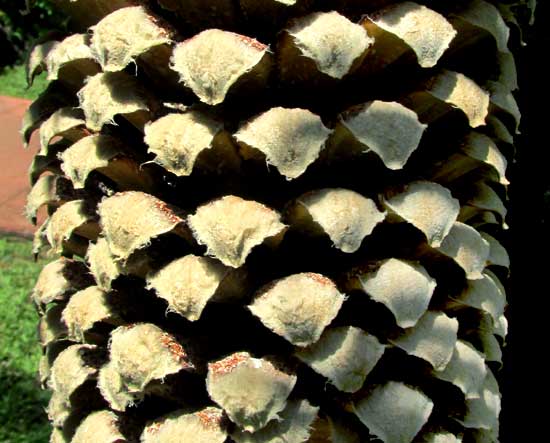
Up closer still, the cone's scales look much like those of a pine cone, which isn't too surprising since cycads are gymnosperms and conifers just like pines. A scale close-up is shown below:
I was particularly curious about what our cycad's pollen-producing structures, its stamens, might look like. Assuming that they'd be affixed to the bracts' bottom surfaces, so that pollen could tumble from them, at first I was confused because the bracts' undersurfaces proved to be smooth, bearing only warty clumps of pale pollen. But then I forced some bracts apart, and saw what's shown below:
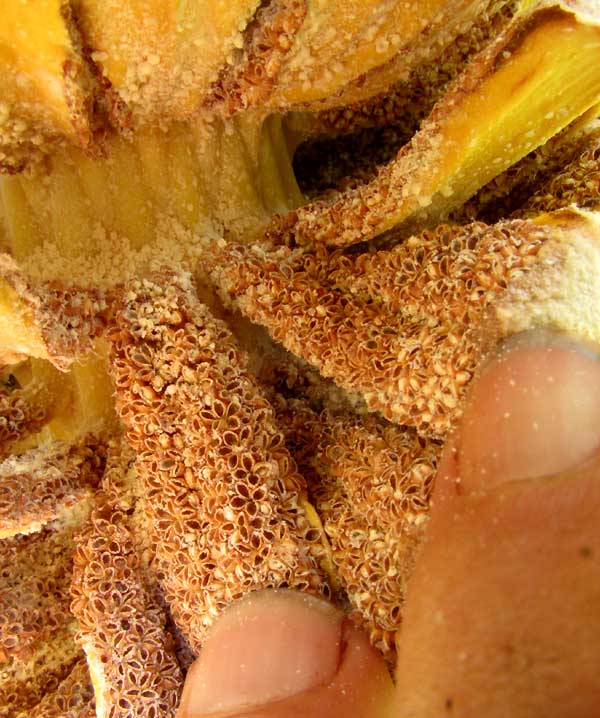
Open, pollen-shedding anthers crowd the bracts' tops -- which would be bottoms if the cone had remained erect. These are things I've never seen. It's like going to Mars, finding a field of wildflowers, and discovering whole new concepts on how to get things done, like produce pollen.
Because the female cone on the big cycad in front of the Main Building has been hanging there pretty much unchanged in appearance for the last year, I'm assuming that the time has passed when her female flowers could be pollinated. However, maybe there are processes I'm unfamiliar with, so to be sure that our male cone's pollen wasn't wasted because of my ignorance, I patted the cone to make pollen cascade from among the bracts, and watched my hand grow creamy colored with cycad pollen. Then I walked around the building and astonished the staff by caressingly rubbing the big cone all over with pollen.