PLANTS | ANIMALS | ECOLOGY | FUNGI | GEOLOGY | GARDENING | TOOLS
MEXICAN PLANTS & ANIMALS HOME

Excerpts from Jim Conrad's
Naturalist Newsletter
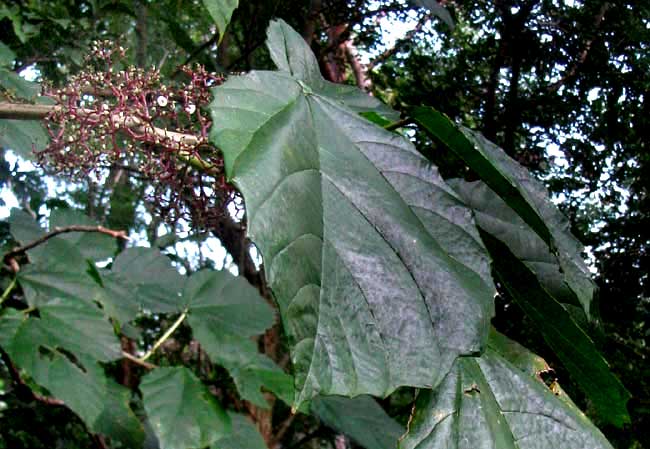
from the December 13, 2009 Newsletter issued from Hacienda Chichen Resort beside Chichén Itzá Ruins, central Yucatán, MÉXICO; limestone bedrock, elevation ~39m (~128ft), ~N20.676°, ~W88.569°
COW-ITCH
Here and there in the forest where it's particularly protected from the sun and wind -- where it's moist and shadowy -- you find shrubs or small trees with thick, brittle branches and broad, veiny, shallowly sawtooth-margined leaves, such as is shown above.
Over in Belize the Creole-English speakers call that Cow-Itch, and if you touch it you'll know why, for the whole plant is covered with stinging hairs. In the Yucatan they often call it Ortiga, which is a name given to all kinds of plants with stinging hairs. It's URERA BACCIFERA, and if you've noticed the diffuse flower cluster like a halo around the thick branch to the left of the leaf in
the picture, and you know your Northern plants, you may have already figured out that Cow-Itch is a member of the Nettle Family, the Urticaceae. The flower cluster with its many branches and rebranches is very much like that of the North's stinging nettles. A close-up of the inflorescence is below:
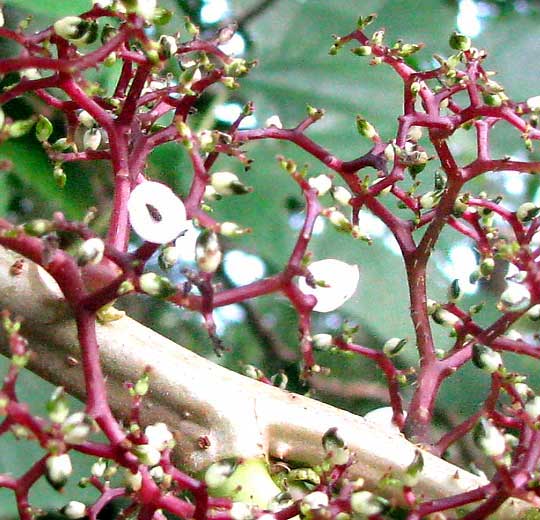
Note the pale, sharp, stinging hairs present even on the inflorescence's purple stems. The white globes are fleshy fruits reminiscent of mistletoe fruits. The tiny flowers at the tips of branches are unisexual, the plants coming in male and female types.
This is a typical plant of the hot, humid American tropics, found from Mexico to Peru and Argentina. In Mexico the Aztecs used to make paper from the inner bark, while in Venezuela indigenous people boiled the root for a tea to eliminate kidney stones.
from the November 29, 2015 Newsletter issued from Hacienda Chichen Resort beside Chichén Itzá Ruins, central Yucatán, MÉXICO
COW-ITCH'S MALE FLOWERS
Cow-Itch is "dioecious," meaning that it comes in all-male and all-female plants. Back in 2009 {above} I didn't notice any male plants, but this year there's one leaning into a trail I walk down almost daily, and its flowers are tiny and elegant, as you can see below:
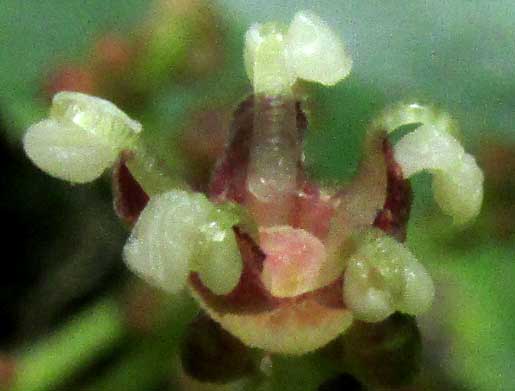
In that picture, the five purple, scoop-shaped items are calyx lobes, or sepals, and each sepal has a stamen rising at its base. Notice how the stamens' filaments are almost transparent, and gracefully curve over the top of sepals' tops. By bending over the calyx the filaments keep pollen from the white anthers from falling inside the calyx-cup, where it would do no good. The flower wants its pollen to be scattered afar.
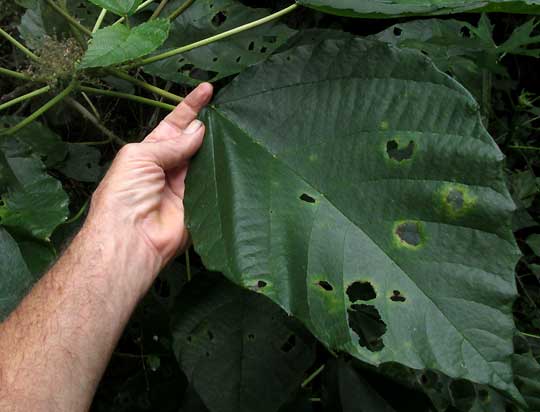
You can see Cow Itch's big, easy-to-recognize leaves below:
One of Cow-Itch's sharp, broad-based, stinging spines is shown below:
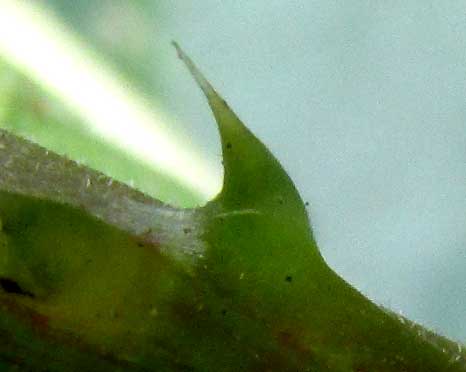
Notice that spine's tip is transparent. Sometimes spine tips are transparent because they're hollow, containing irritating substances that make the spines sting. I'm only guessing that that's the case here.
The plants around the hut grow in a moist, shadowy spot, but I read that normally the species is intolerant of shade and dies back once taller trees grow over it. In fact, I've not seen it in more mature forest. I think that these next to the hut must be relics from when this area was cleared a few years ago, and they may be on the verge of dying back as the forest returns.
Cow-Itch is especially adapted for invading areas disturbed by fire, so it can be thought of as one of "Nature's first responders" after fire damage. Sometimes, I read, large areas of burned land is covered almost exclusively with Cow-Itch, in which case its fruits become an important food for wildlife such as small birds.