PLANTS | ANIMALS | ECOLOGY | FUNGI | GEOLOGY | GARDENING | TOOLS
MEXICAN PLANTS & ANIMALS HOME

Excerpts from Jim Conrad's
Naturalist Newsletter
from the November 7, 2010 Newsletter issued from Hacienda Chichen Resort beside Chichén Itzá Ruins, central Yucatán, MÉXICO; limestone bedrock, elevation ~39m (~128ft), ~N20.676°, ~W88.569°
YELLOW COSMOS
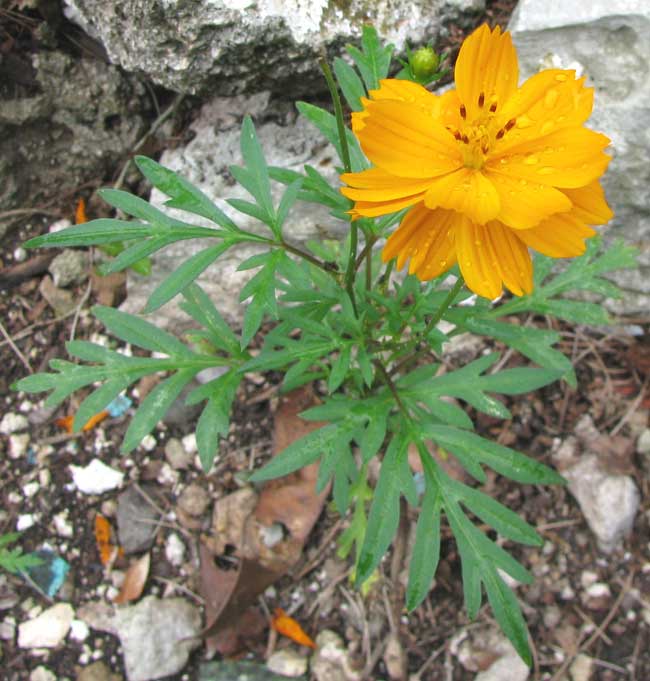
Two or three months ago when I had to visit Mérida several times with my visa problems -- I have an FM3 good until April now -- one day I was walking up the grand boulevard called Paseo de Montejo when I noticed pretty, orangish flowers planted in the green spaces between the two broad, one-way streets. The plants were fruiting so I filled a shirt pocket with some "seeds" -- technically indehiscent, one-seeded fruits called achenes. Back at the Hacienda I sowed them next to my hut, and now the plants are flowering, shown above.
This is the Yellow Cosmos, COSMOS SULPHUREUS, native from Mexico to Brazil but planted worldwide, even in the Temperate Zone, where sometimes it escapes from gardens.
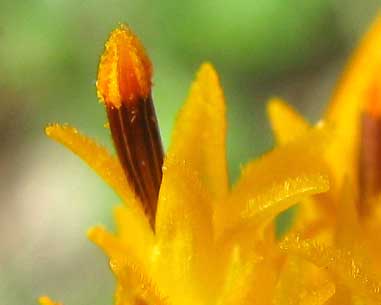
Yellow Cosmos, which grows seven or more feet tall, is distinguished by its yellow-orange flowers and ferny, twice- or thrice-pinnately compound leaves. A further neat little fieldmark is that its pollen-producing anthers -- which are united by their edges to form a cylinder around the style (normal for the Composite or Daisy Family) -- are black with orange tips, as seen below:
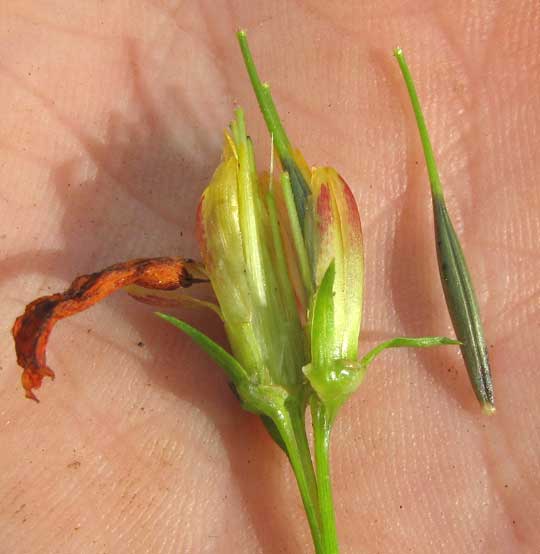
An important fieldmark for the genus Cosmos is that the achene-fruit is topped with a slender neck, or "beak." A broken-open flower with an achene beside it is shown below:
Not long ago we looked at a rosy-pink-flowered Cosmos, Cosmos caudatus, which also was planted at the Hacienda. You might enjoy comparing it, remembering to look at that species' "beaked achenes," at www.backyardnature.net/yucatan/cosmos.htm.
On that page we report that Cosmos caudatus had edible leaves and that in parts of the world it's grown as a salad ingredient -- even though I found the leaves a bit strong. I read that our Yellow Cosmos also has edible leaves, so of course I've nibbled on them to see if they taste any better than the other.
I find the Yellow Cosmos's leaves with a more interesting flavor, not quite as much like eating Marigold leaves as the other, but still a bit too pungent for my taste.
from the May 29, 2016 Newsletter issued from Hacienda Chichen Resort beside Chichén Itzá Ruins, central Yucatán MÉXICO
COSMOS A GOOD FLOWER FOR BUGS
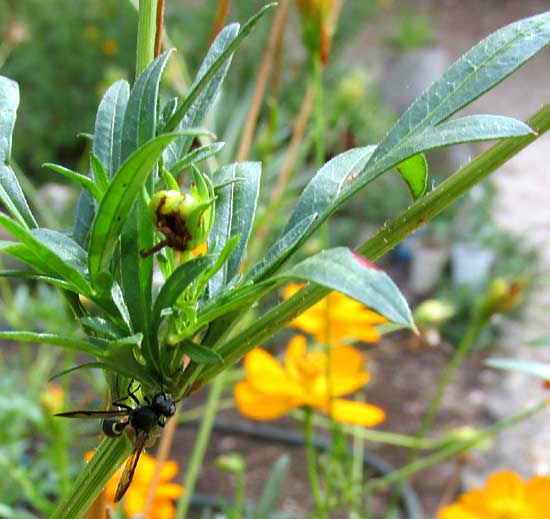
Sometimes as many flying insects are attracted to certain green parts of the Yellow Cosmos's body as they are the flowers. For example, below you can see a small wasp that rushed from one leaf axil to another, completely ignoring the blossoms:
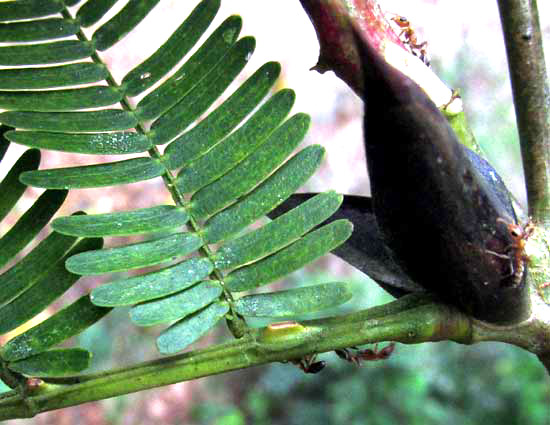
Many plants produce "extrafloral nectaries," which are nectar-producing glands on a plant's body, other than among its flowers. In general, the idea is to attract ants and other insects whose presence on the plant might dissuade herbivores from feeding on the plant. A while back we looked at extrafloral nectaries on an ant-attracting acacia in Chiapas, shown on the petiole of a compound leaf, with ants hovering about, at www.backyardnature.net/n/16/160501ae.jpg
When I looked for extrafloral nectaries on my cosmoses, however, I couldn't find any. I did notice that certain insects were attracted to spots where the plant's stems branched, such at the place shown below:
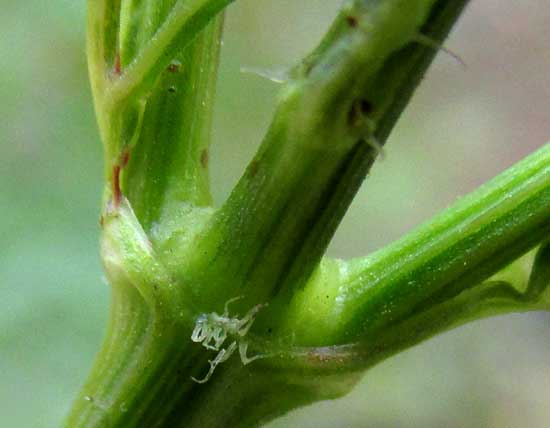
Here, insects would briefly poke about the white tufts of hairs between the branches, and they'd linger about the pale green parts that look a little swollen. I've not seen any insect clearly feeding at these spots, however. They go directly to them, very briefly rummage about, and usually leave, going to a similar spot. Is the plant issuing some kind of sexual pheromone that tricks insects into visiting, but offers nothing in return? Even the wasp in our first picture seemed to be looking for something other than nectar -- maybe a prey insect attracted to the Cosmos -- and after a quick look-about flew away.
I can't find documentation stating that Cosmos species bear extrafloral nectaries, but several web pages describe Cosmos as "good plants for bugs."