PLANTS | ANIMALS | ECOLOGY | FUNGI | GEOLOGY | GARDENING | TOOLS
MEXICAN PLANTS & ANIMALS HOME

Excerpts from Jim Conrad's
Naturalist Newsletter
from the January 19, 2009 Newsletter written near Telchac Pueblo in north-central Yucatán, MÉXICO
NEOTROPIC CORMORANTS
Possibly the most common species at "Flamingo Lake" is the Neotropic Cormorant, PHALACROCORAX BRASILIANUS, what I grew up calling the Olivaceous Cormorant, shown below:
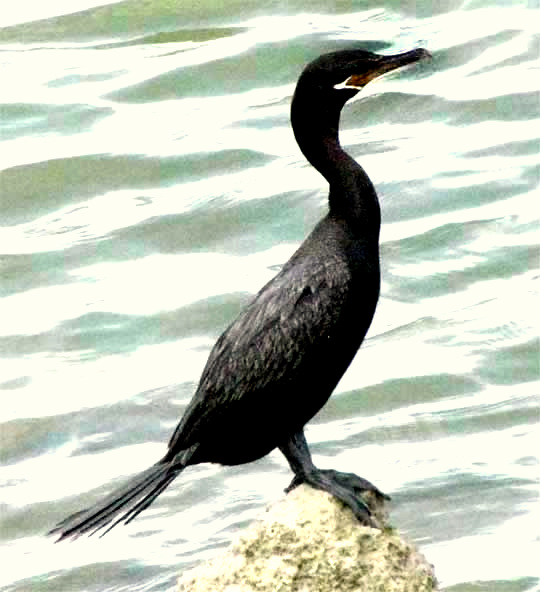
That picture shows one difference between Neotropic Cormorants and North America's other cormorant species -- the white V behind the beak, and the way the beak itself forms a sharp angle inside the V's arms, or, as Howell describes it in "A Guide to The Birds of Mexico and Northern Central America," "posterior edge of gular skin pointed." Other North American cormorants display a whole different rear-beak arrangement. In this area you need to keep these features in mind because occasionally Double-crested Cormorants do show up along the Yucatán coasts, though the Neotropic is always the species to be expected.
Field guides mention the Neotropic Cormorant's green eyes, and it's true that in some lights you see greenness, but most of the time the eyes are exactly as in the picture, hardly visible at all.
Often you see these birds perched on rocks and snags with their wings half open, drying and warming in the sun.
In this same lagoon I've watched several Neotropic Cormorants hunting together. They formed a line with one end lagging the other, and proceeded across the lagoon, each bird's head completely submerged and the body nearly so, and noisily churning up a great deal of water with their passage. I think they were trying to scare up prey that with less rambunctious swimming would have stayed hidden. Typically you see this species working alone, however, making dives of a minute or so, then when they surface they show nothing but their snaky heads and necks sticking from the water. You can see a Neotropic Cormorant swimming his typical low-in-the-water, head-held-high manner below:
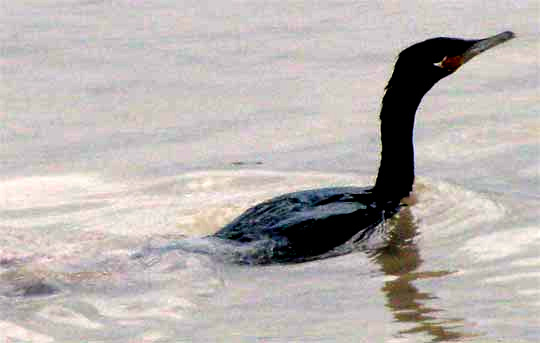
Neotropic Cormorants are distributed from the US's western Gulf Coast south to southern South America.
from the January 26, 2007 Newsletter issued from Sierra Gorda
Biosphere Reserve Headquarters in Jalpan, Querétaro, MÉXICO
SNOWY EGRET & NEOTROPIC CORMORANTS
For the last few weeks I've been seeing at least one Snowy Egret doing something I didn't know an egret could do. When he spots a school of fish near the reservoir's surface he flies into the school's center, lands in the water and while floating like a duck stabs with his long beak all around him. Often I see this bird come up with silvery fish in his beak, so the behavior seems to be working.
The story doesn't stop here. A small flock of Neotropic Cormorants always is fishing nearby and when they see the Snowy Egret plop onto the water's surface anywhere in the lake they all rush to participate in the fishing, knowing that the egret wouldn't have landed on the water if there'd been no school of fish there. The cormorants splash into the water and dive with such fervor, churning up the water something awful, that the heron usually looks a bit confused, then flies away.
However, the strategy works both ways. Sometimes the heron sees that the cormorants have located a school and are feeding nicely, so then the heron flies out into the lake and lands amidst the diving cormorants, who don't seem to notice or care about their visitor's arrival.
from the March 15, 2015 Newsletter issued from Río Lagartos, on the Yucatan Peninsula's northern coast (~N21.60°, ~W88.16°), Yucatán state, MÉXICO
NEOTROPIC & DOUBLE-CRESTED CORMORANTS SIDE BY SIDE
Yet another opportunity for a side-by-side comparison of two similar species was made possible this week with the grouping shown below:
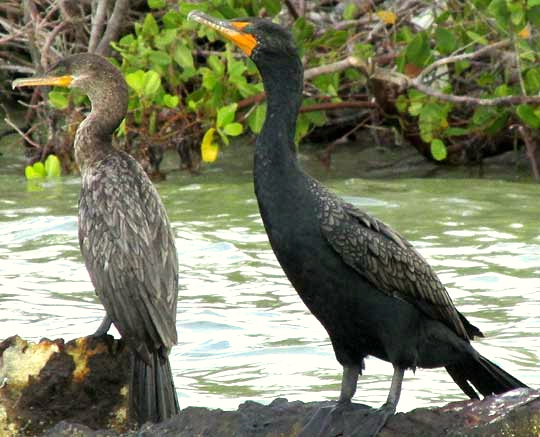
On the left, that's our permanent-resident the Neotropic Cormorant, while on the right there's the Double-crested Cormorant, which along most of the Yucatan Peninsula's coast is a winter visitor, but which nests in certain dispersed breeding colonies along the coast.
Plumage colors are changeable and not dependable. However, the picture reminds us that Neotropic Cormorants are fairly consistently smaller than Double-cresteds. The most decisive difference, however, is seen on the "face." A close-up of the faces side-by-side is shown below:
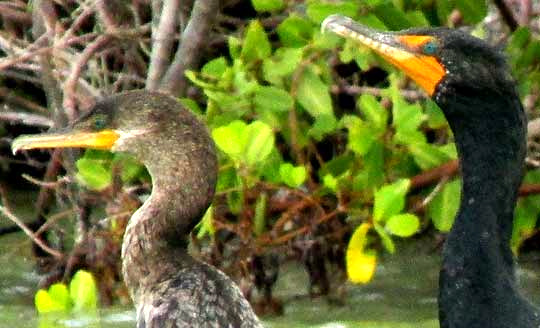
Note that the Neotropic's bill connects with the feathered part of the head forming a kind of V-on-its-side, and that a whitish border is forming at the connection. In contrast, the Double-crested's orangish skin doesn't make such a connection and there's no pale fringe. A more technical way of describing this is that on the Neotropic the "posterior edge of the gular skin is pointed," but that's not the case with the Double-crested. Also, note that the Double-crested has yellow skin above and in front of the eye, but the Neotropic doesn't.