PLANTS | ANIMALS | ECOLOGY | FUNGI | GEOLOGY | GARDENING | TOOLS
MEXICAN PLANTS & ANIMALS HOME

Excerpts from Jim Conrad's Naturalist Newsletter
from the October 20, 2008 Newsletter issued from Yokdzonot, central Yucatán, MÉXICO
CORALVINE IN FULL FLOWER
A common twining vine throughout the Yucatán sometimes cultivated in gardens and sometimes seen growing as a rank weed is putting on a show during these rainy days. It's the Coralvine, called Corallita in Spanish and ANTIGONON LEPTOPUS in Latin, shown on a stone wall below:
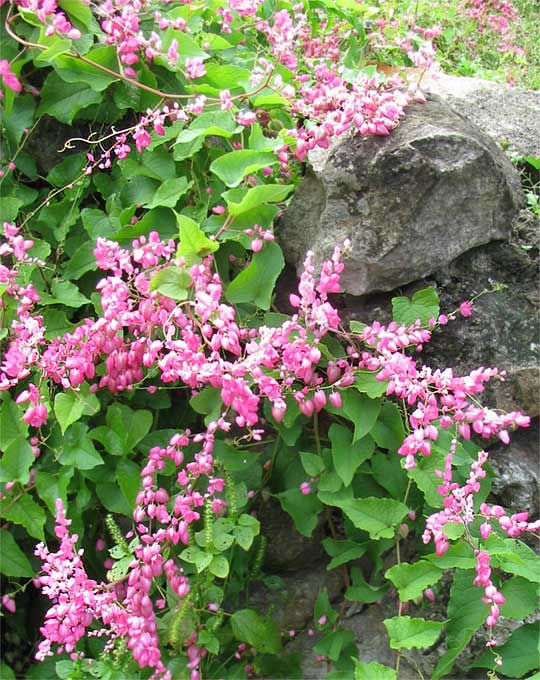
The vine's heart-shaped leaves almost cause it to look like a morning glory vine but its pink, thumbnail-size flowers up close dispel that notion, as can be seen below:
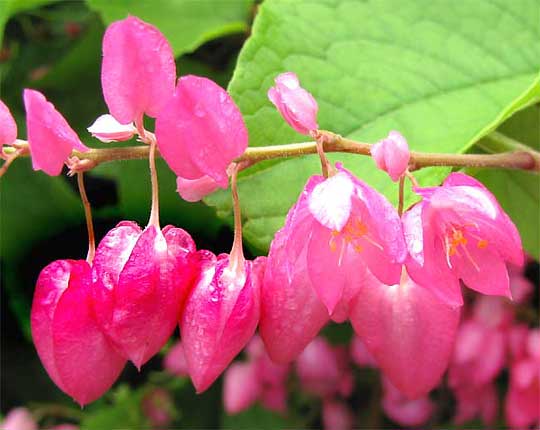
On the right in that picture two open flowers dangle from the horizontal stem, while three flowers not yet open dangle on the left. Can you see that the unopened flowers on the left are three-cornered? That's sort of unusual in the flowering world and when I see it in the field the first plant family to come to mind is the Buckwheat or Smartweed Family, the Polygonaceae, which the Coralvine belongs to.
Flowers in the Buckwheat Family produce no distinct calyx or corolla. Instead, each blossom has a lobed, calyx-like or corolla-like structure referred to as a perianth. Coralvine's flowers produce two kinds of showy perianth lobes. The outer ones, usually numbering three, are shaped so that together they give the unopened blossom a three-cornered, Chinese-lantern look. The inner lobes look like regular petals. Each flower has eight stamens and three styles. The hard, dry, one-seeded fruit, an achene, also is three- angled. The Buckwheat Family just likes having its parts in three, even though that's usually a feature of monocot flowers, like lilies and irises, not of dicots, which this and most plants with conspicuous blossoms are.
Woody, tendril-bearing Coralvine is a native Mexican plant, which explains why you see it in the wild so often. However, its masses of pink flowers are so pretty growing up trellises or scrambling over walls that it's grown worldwide in the tropics -- even in the US Deep South and California, where it also goes by names such as Love-chain, Queen's Jewels and Confederate Vine.
from the March 27, 2011 Newsletter issued from Hacienda Chichen Resort beside Chichén Itzá Ruins, central Yucatán, MÉXICO; limestone bedrock, elevation ~39m (~128ft), ~N20.676°, ~W88.569°
CORALVINE IN THE WILD
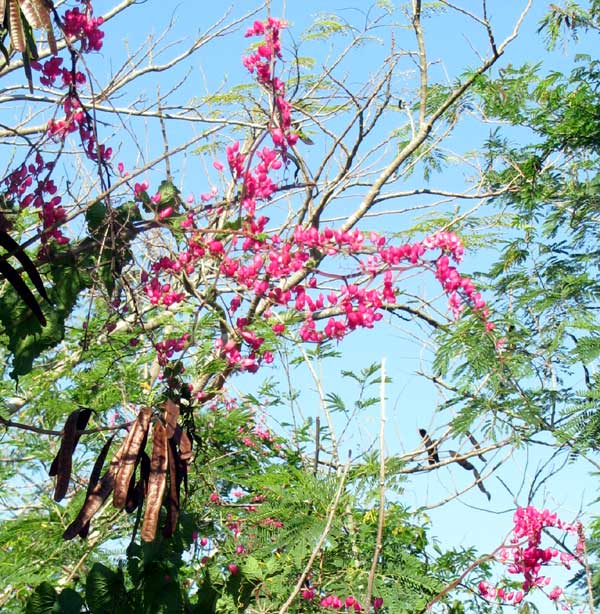
We've already spoken of Coralvine a couple of times. What's new to me now is seeing it out in the woods, not just in weedy areas and in town. The other day when I saw the vine climbing 20 feet into a Uaxhim tree (Leucaena leucocephala) deep in the forest, I thought it was something new. That plant is shown below:
I shouldn't have been surprised finding it in the wild, though, since it's a native Mexican plant. Probably the most surprising thing about it is that it's a native able to compete with the rankest alien weeds in abandoned lots and fields. In fact, in the southern US it's often planted for its prettiness, and frequently escapes into the wild up there.
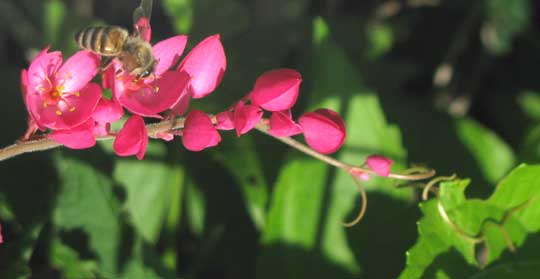
Something interesting about the species is that its branches end in flowering racemes, and the racemes themselves end in tendrils. Usually we think of tendrils as associated with leaves or stems, not flower clusters. You can see a tendril-ending raceme below: