PLANTS | ANIMALS | ECOLOGY | FUNGI | GEOLOGY | GARDENING | TOOLS
MEXICAN PLANTS & ANIMALS HOME

Excerpts from Jim Conrad's
Naturalist Newsletter
from the June 27, 2010 Newsletter issued from Hacienda Chichen Resort beside Chichén Itzá Ruins; limestone bedrock; elevation ~39m (~128ft), N20.675°, W88.569°; central Yucatán state, MÉXICO
VARIEGATED CROTON
I've begun paying more attention to the ornamentals scattered around the Hacienda. A very common one is shown below:
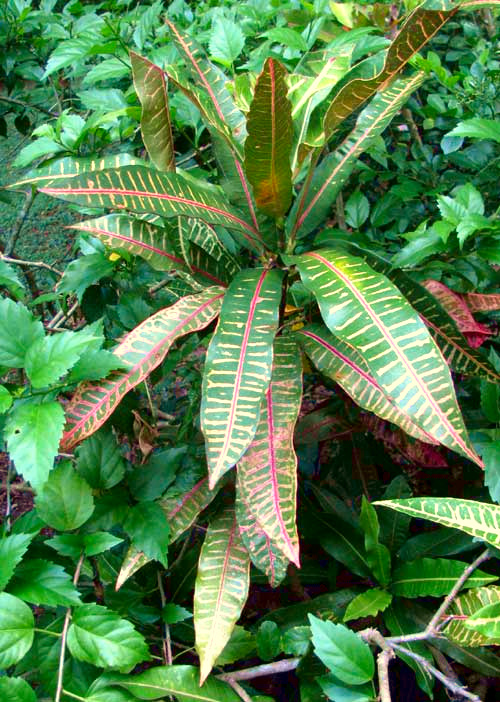
With such pretty leaves it's clear why that species is so frequently planted. It's the Variegated Croton, CODIAEUM VARIEGATUM, a member of the same family as the Poinsettias, Castor Bean and spurges. The species is native to southern India, Sri Lanka, Indonesia, Malaysia and the western Pacific islands. It's grown in tropical settings worldwide, and in colder climes it's kept inside in pots. It's an evergreen shrub growing up to ten feet tall (3 m), though most of ours are only about chest high and the ones up North in pots usually are smaller still.
Horticulturalists have created hundreds of cultivars from the wild species. They've developed kinds with leaves that range from roundish to very narrow, leaves that can be lobed or unlobed, leaves with and without crinkly margins, leaves whose color patterns may follow the veins, margins or appear as random blotches, and the leaves' colors can be green, white, purple, orange, yellow, red, pink -- just about anything.
The name Variegated Croton is a little misleading, since there's a big genus called Croton in this same family, but that's a different plant.
Members in the Variegated Croton's family, the Euphorbiaceae, often "bleed" copious sap when wounded, and often the sap is colored and toxic, even irritating or burning the skin. Variagated Croton's sap can cause skin eczema in some people, and if eaten in fair amounts is toxic. However, small doses of it have been used to treat gastric ulcers.
from the January 15, 2012 Newsletter issued from Hacienda Chichen Resort beside Chichén Itzá Ruins; limestone bedrock; elevation ~39m (~128ft), N20.675°, W88.569°; central Yucatán state, MÉXICO
VARIEGATED CROTON EXTREMES
The picture on that page shows a plant with mostly green leaves with a red midrib and narrow, pale lines perpendicular to the midrib. Now look below:
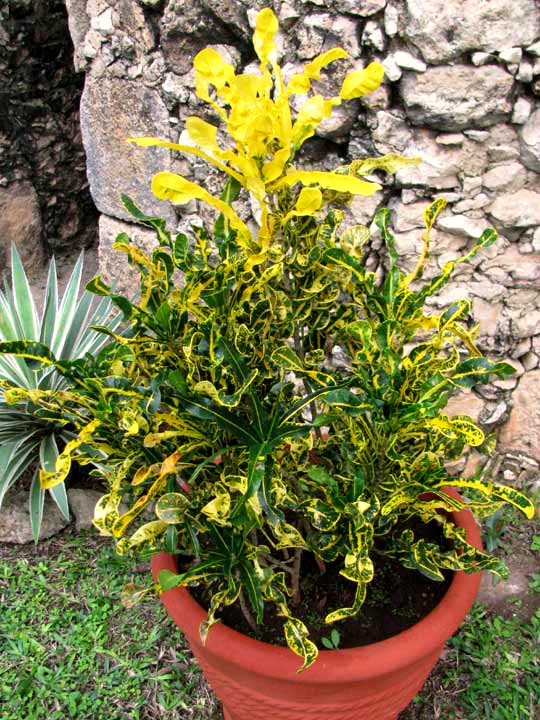
That's also a Variegated Croton -- the very same species -- but a very different-looking cultivar. I'm showing it just to remind ourselves that horticultural cultivars can look enormously different from one another. Several hundred cultivars are recognized for this species. In fact, you might enjoy browsing the many "variations on the Variegated Croton theme" shown here.
from the March 6, 2016 Newsletter issued from Hacienda Chichen Resort beside Chichén Itzá Ruins; limestone bedrock; elevation ~39m (~128ft), N20.675°, W88.569°; central Yucatán state, MÉXICO
VARIAGATED CROTON WITH MALE FLOWERS
Though until now I've never noticed a Variegated Croton bearing flowers, this week an especially gaudy, potted one doing service outside the bathroom where lots of folks can see it did have flowers. Maybe you can spot them, small as they are, on our colorful picture shown below:
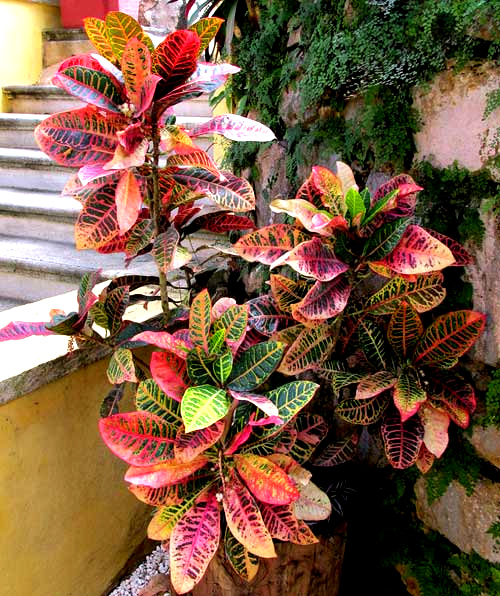
The flowers are pea-sized, star-burst-like, white ones arranged in long, slender racemes, as seen below:
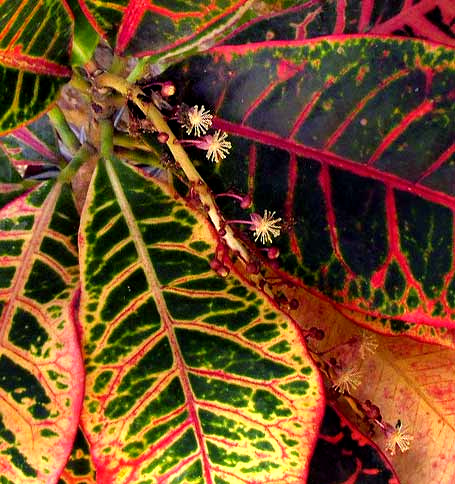
A close-up of a single flower is shown below:
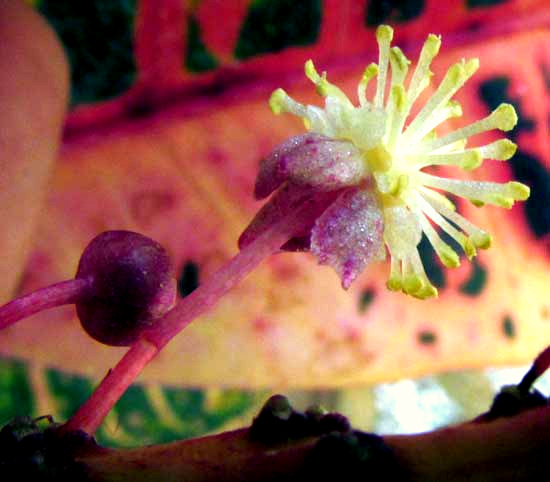
That flower consists of nothing but five purplish, swoop-backed calyx lobes, five very short, whitish, almost indiscernible petals, and numerous matchstick-like stamens tipped with bulging, yellowish, pollen-producing anthers. No female parts are in evidence, but that's not surprising since Variegated Crotons are members of the Euphorbia Family in which unisexual flowers are the norm. Codiaeum species are described as generally bearing unisexual flowers of both sexes on each plant, but on our bathroom plant I found only male ones.
I'm looking for female flowers on other plants, however, just being curious about what they look like. So far, among the dozens I've examined, not one of them even bore more male flowers, much less female ones.