PLANTS | ANIMALS | ECOLOGY | FUNGI | GEOLOGY | GARDENING | TOOLS
MEXICAN PLANTS & ANIMALS HOME

Excerpts from Jim Conrad's
Naturalist Newsletter
from the March 4, 2006 Newsletter written at Hacienda San Juan Lizárraga one kilometer east of Telchac Pueblo, Yucatán, MÉXICO and issued from Hotel Reef Yucatan 13 kms to the north
COCONUT PALM
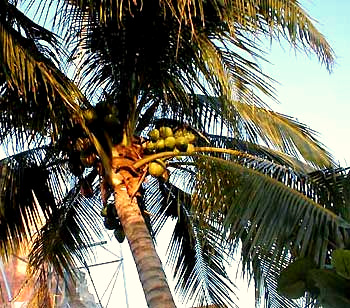
Coconut Palms grow naturally along the Yucatan peninsula's beaches, but visitors are most likely to see planted ones. Many palm species are planted in the Yucatan and several are native. You can distinguish the Coconut Palm from other species by these features:
from the March 4, 2006 Newsletter written at Hacienda San Juan Lizárraga one kilometer east of Telchac Pueblo, Yucatán, MÉXICO
and issued from Hotel Reef Yucatan 13 kms to the north, México
COCONUT PALM FLOWERS & FIBER
These mornings one of the favorite hangouts for orioles is in the flowering Coconut Palms. The brightly orange and black birds foraging among large clusters, or inflorescences, of yellow-green flowers, frequently resting and looking around from among the palm's dark green fronds, are pretty to see. I watch them as my campfire's white smoke lazily drifts skyward, and the orange flame next to me flickers with life. One day this week I decided to take a closer look at the flowers. I set a ladder against a palm's trunk and climbed it, taking along Vladimir's camera. You can see it below:
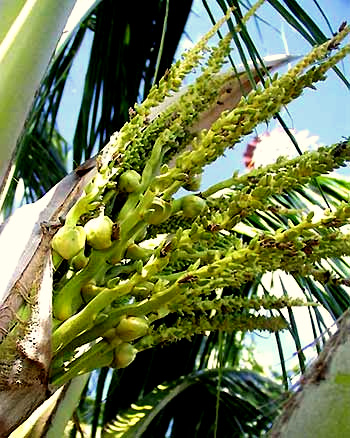
Palms are "monoecious" -- their flowers are unisexual but flowers of both sexes occur on the same tree. In the picture, the many small, greenish items densely arranged along the slender, fingerlike things directed toward the upper, right corner (the rachillas), are male flowers, or what's left of them. Male flowers at their peak bear six pollen-producing stamens above three stiff, triangular scales representing the corolla. The much less numerous and larger, oval items at the rachillas' bases are female flowers, or the female flowers' pistils enlarging as they become coconuts.
Notice how the entire large inflorescence arises from a semi-woody, brownish, scooplike spathe. The spathe surrounds and protects the flowers as they develop before emerging from it. In the picture, the spathe base arises from the bottom, left and its tip reaches the top, right. Spathes remain on the tree until well after the fruits are mature.
Not all Coconut Palms are flowering right now. Some are full of green, enlarging coconuts and some bear old, brown ones. While up the tree I took a close look at the net-like, brown fiber arising from the bases of the tree's leaf stems, or petioles. The fiber material is so thick, tough and regular that it looks machine made. I also photographed this, and you can see it below:
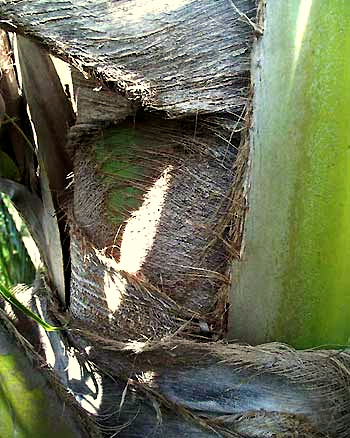
In the picture, the broad green area at the right is the base of a frond's petiole. Notice how its fiber mat wraps around the palm's growing center or terminal bud area. You can imagine how this tough fiber protects the tender growing area from physical injury.
In the old days coconut fiber, called "coir," was famous for being employed for matting, mattress filling, cordage and the like. However, that fiber wasn't what's shown in the picture. The coconut fiber of commerce was derived from the coconut-fruit's husk. My musty old Hand Book of Tropical Plants by H.F. Macmillan proudly reports of coir "...27,250 Tons exported from Ceylon in 1933, valued at about 4s. 6d per cwt."
from the April 17, 2011 Newsletter issued from Hacienda Chichen Resort beside Chichén Itzá Ruins, central Yucatán, MÉXICO; limestone bedrock, elevation ~39m (~128ft), ~N20.676°, ~W88.569°
A COCONUT FLOATS ASHORE
The other day a coconut floated ashore. It's shown drifting amidst uprooted Shoalgrass and trash below:
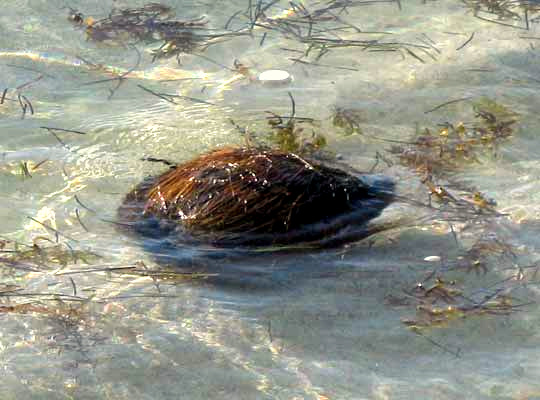
It's possible that that coconut had been dropped into local water earlier that morning, but trash floating with the coconut bore labels identifying points of origin as Venezuela and Trinidad. I'm betting that our coconut fell into the water on the northern coast of South America, or an island of the Lesser Antilles.
Years ago I was taught that Coconut Palms, COCOS NUCIFERA, were native to tropical coastlines worldwide, and thus that they were among the few flowering plants that had no one particular homeland. Now genetic sequencing reveals a different evolutionary history. Most Coconut trees belong to one of two genetically distinct groups. One population arose along the Indian Ocean coastline, the other in the Pacific, from the Malay Peninsula to New Guinea. The species was domesticated in both places, and since then much crossbreeding of the two strains has taken place.
Coconut Palms in Middle America mostly derive from the Pacific domestication while Caribbean palms mostly come from the Indian group. In Mexico it's important to take into account the various genetic groupings because some are much more vulnerable than others to Lethal Yellowing Disease (LYD), which we discuss at www.backyardnature.net/yucatan/lethal.htm.
The problem in the Yucatán is that for decades people have been planting just one genetic type known to quickly produce large, round nuts. Unfortunately, that type is very vulnerable to LYD.
So, that smallish, not perfectly round coconut that floated in the other day probably represented Nature's effort to undo the mess caused by people obsessively planting just one Coconut genotype here. Nature is trying to introduce healthy genetic diversity where humans have created a monoculture vulnerable to diseases.
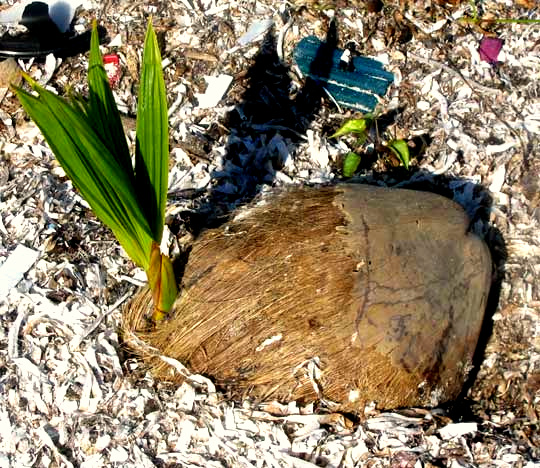
Not up the beach from here a certain coconut that's floated in from who-know-where has germinated in a pile of moist Turtleweed and trash washed up by the waves. You can see it issuing its first fronds below:
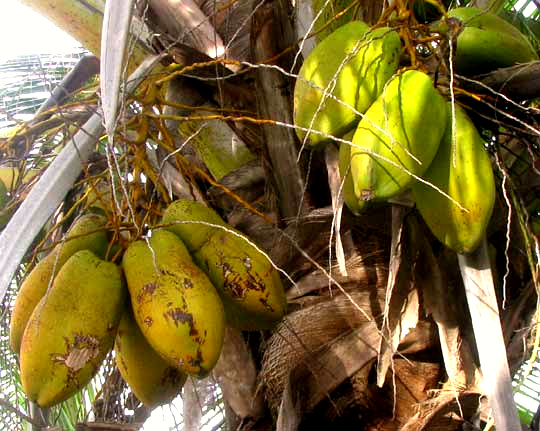
You can see smallish, narrow-type coconuts on a healthy, wild tree -- as opposed to large, spherical coconuts on nearby sick, planted trees -- below:
from the February 6, 2005 Newsletter issued from Issued from Hacienda Komchén de Los Pájaros just outside Dzemul, Yucatán, MÉXICO
GREEN COCONUT
A green, more or less spherical object the size of a canteloupe washed ashore and Karen was surprised when I retrieved the object and began cutting into it with my Buck Knife. My first insertion of the blade produced a a spurt of clear liquid that sparkled in the powerful sunlight. I continued cutting until I removed a conical wedge from one end, at which point I asked Karen to bring out her straws, brought along for just such an occasion, and then we drank some coconut milk.
Karen's concept of a coconut was that they are brown, very hard-shelled, and grapefruit-sized, like the ones sold in grocery stores. Inside such coconuts she was used to finding fairly hard, white "meat." Thus none of what she was seeing now seemed to have anything to do with her idea of how a coconut should be.
Well, a coconut begins its life, like all true fruits produced by flowering plants, as the pistil of a flower. The pistil at first contains three ovules, and therefore three potential coconuts, but two die by abortion, so one female coconut flower produces one coconut.
The mature coconut fruit consists of a very thick, fibrous husk surrounding a single seed, which is the hard, brown item Karen sees at the supermarket. It's like the husk of a walnut. Before the seed matures, it's filled with "milk," not "meat." As the seed matures, the "milk" turns to "meat," which technically is the seed's albumen. Hard, dry coconut "meat" is kown as copra. Thus supermarket coconuts are mature coconut seeds. What washed up that day was an immature coconut fruit with an undeveloped seed inside -- a seed full of "milk."
Coconut "milk" in a seed at the stage of maturity in which the "milk" is starting to convert to "meat" is wonderfully sweet and good to drink. At that early stage of maturation the small amount of "meat" inside is more like jelly than the hard stuff you shred to sprinkle on cake icing. On touristy tropical beaches nearly always there are men wandering around selling green coconuts at this stage of maturity. When they make a sale, with their machetes they whack off enough of one end of the coconut to expose a small hole in the seed just big enough for inserting a straw. Once you've drunk the "milk" the man should offer to cut a sliver from the husk which you then use as a scoop for scraping the gelatinous, half-formed "meat" from the interior walls of the cracked-open nut.
Our washed-ashore coconut was so immature that the "milk" hadn't yet grown particularly sweet. However, it was nutritious, wet and not bad tasting, so we were glad to have it.