
| from the September 19, 2010 Newsletter issued from
Hacienda Chichen Resort beside Chichén Itzá Ruins, central Yucatán, MÉXICO TROPICAL GRAPES FLOWERING Last November in these parts a very common liana, or woody vine, was bearing clusters of grapelike, purple fruits. Our page showing the liana's fruits and leaves, and how its limber stems were used to bind together poles in the hut I'm now living in, is found lower down this page. The lianas in question were members of the genus Cissus, in the Grape Family, the Vitaceae. "Real" grapes are in the genus Vitis, so somewhat arbitrarily I call Cissus species "tropical grapes." With about six species of Cissus listed for this area, and not having flowers to work with, I've been hesitant to say which species we have. Now at least two species are flowering and I find that it's still hard to name them. One species, with hand-sized, red flower clusters, or inflorescences, showing up brightly against dark-green forest backgrounds bears simple (not compound), very variable-shaped leaves. A flowering branch is shown at the top of this page. An interesting close-up of some flowers that already have lost their four petals and four stamens, leaving only developing ovaries submersed beneath shiny droplets of nectar, with slender, stigma-bearing styles poking up through the nectar, is shown below:
From very scant information and limited images on the Internet, I'm guessing that this is CISSUS GOSSYPIIFOLIA, sometimes named C. formosa. A second Cissus species, this one with trifoliate leaves and yellowish inflorescences, is shown below: |
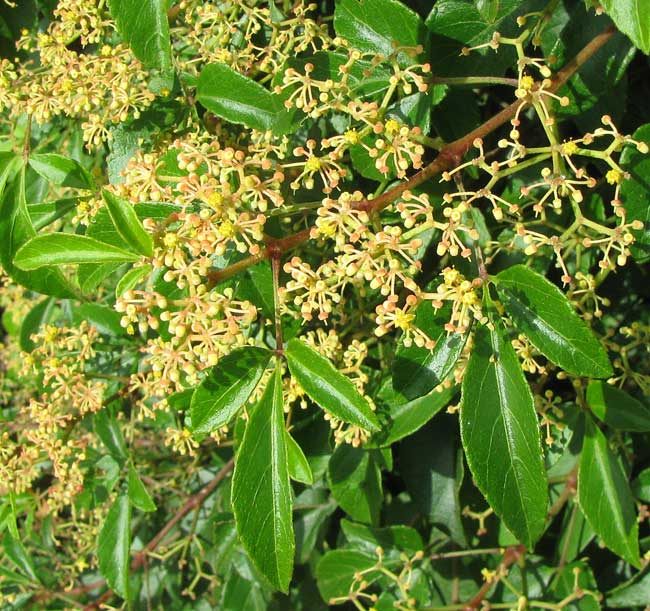
| A close-up of this species' flowers, this time with a blossom bearing four
turned-back, yellow petals and four anther-bearing stamens, with no nectar globule, is
shown below:
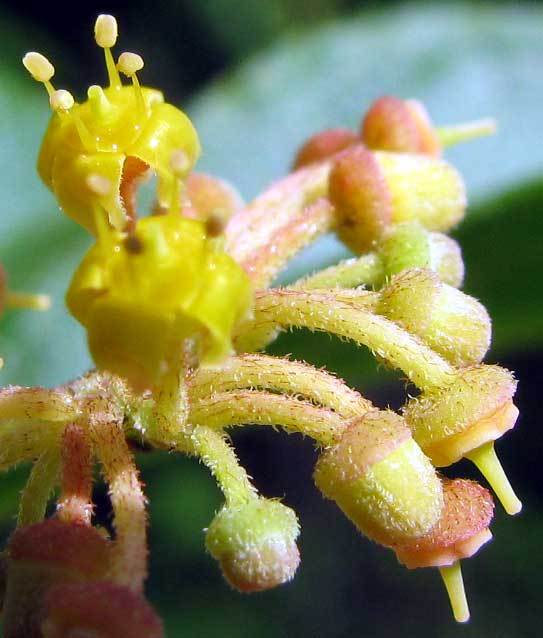
I'm guessing that this is CISSUS ALATA, sometimes listed as C. rhombifolia. Really I hadn't realized that Cissus blossoms are so pretty and interesting. To discover this, first I had to get so blind that I could no longer focus up close or use my hand lens well, and thus had to photograph small things and see them on my laptop screen! from the November 15, 2009 Newsletter issued from
Hacienda Chichen Resort beside Chichén Itzá Ruins, central Yucatán, MÉXICO
This is the genus CISSUS, which I'm calling "Tropical Grape," putting the English name in quotation marks because I can't find an English name, and the fruits seem close enough to "real grapes" to call them that. In fact, the genus Cissus belongs to the Grape Family. "Real grapes" belong to the genus Vitis, however, so plant-name purists might be uncomfortable referring to Cissus fruits as grapes. Several species of Cissus are native to the Yucatán and without flowers I can't be sure which this one is.
Various parts of Cissus vines are medicinal. My Maya friend José says that leaf juice is especially good against "bad winds," "vientos malos," that blow on you and cause your neck to twist and hurt. A technical paper on the Internet looks at the effects of leaf alcohol extracts of Cissus sicyoides on pregnant rats because the vine in Brazil, where it is an invasive from this part of the world, is used extensively as a medicine. Brazilians sometimes call the plant "Insulina Vegetal," or "Vegetable Insulin," the paper says, and use extracts from it not only for diabetes but also as a diuretic, an anti-inflammatory and against epilepsy. Other studies demonstrate a "vasoconstrictor effect on guinea-pig aorta rings." Maximino Martinez's Las Plantas Medicinales de Mexico reports that in Mexico alcohol extracts of it have been used against rheumatism, which I suppose to be arthritis, and for ulcers and bruises. Beating the leaves in water even produces suds you can wash with. Not all news about the health effects of Cissus sicyoides extracts is good, however. One study showed that a tea made of the leaves increased chromosomal damage in bone marrow cells. The study on the Internet I found reports that extracts caused pregnant rats to abort. from the January 10, 2010 Newsletter issued from
Hacienda Chichen Resort beside Chichén Itzá Ruins, central Yucatán, MÉXICO
There the branches of a forked pole are secured because later the pole will bear the roof's weight and if the forks are not bound together downward pressures will force the forks apart, possibly splitting the pole. The Maya workers who do this certainly have no training in physics or engineering. They just know where stresses and strains are in a building, and they know how to deal with them using materials from the forest. Note that I'm referring to the plant's stems, not its aerial roots. I've often read that the dangling aerial roots of this woody vine, or liana, or used for construction, but here the men are using the stems, saying that the roots soon decay and aren't really used for anything. On the ground nearby lay coils of Cissus stems seen below:
Below Don Paulino is using a block of wood to tamp stem coils tighter around the poles.
|
Plants & Animals of
Mexico Homepage
Yucatan Homepage
Backyard Nature Homepage