PLANTS | ANIMALS | ECOLOGY | FUNGI | GEOLOGY | GARDENING | TOOLS
MEXICAN PLANTS & ANIMALS HOME

Excerpts from Jim Conrad's
Naturalist Newsletter
from the January 2, 2005 Newsletter issued from Hacienda Komchen de Los Pájaros
just outside Dzemul, Yucatán, MÉXICO
CENOTES & THE CHICXULUB CRATER
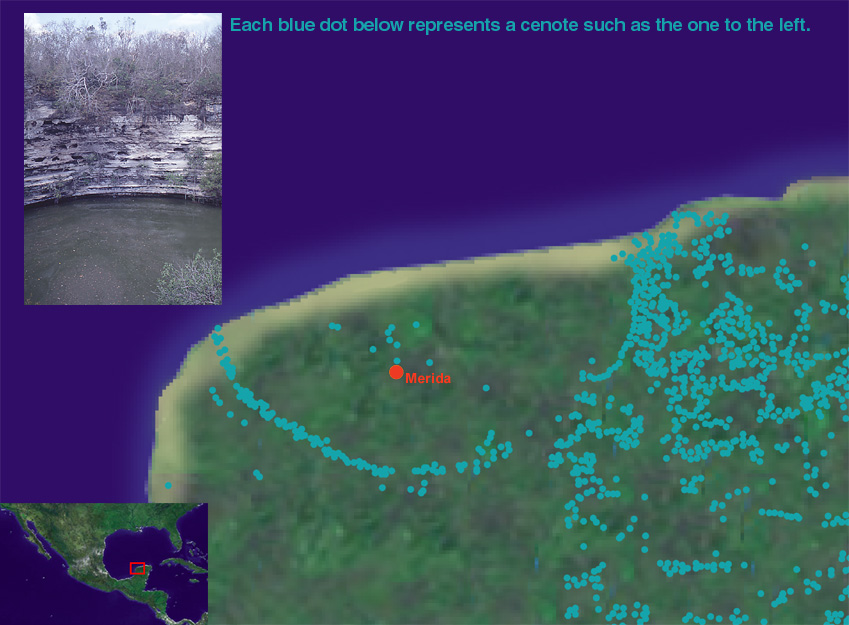
One of the most striking features of the Yucatan's geology is that there are lots of cenotes -- easily seen when you fly over the land. A cenote is a natural hole in limestone bedrock -- a sinkhole -- with water at the bottom of it. Some cenotes are small and shallow but others are very large and deep. A wonderful map showing northwestern Yucatan's identified cenotes is at http://www.lpi.usra.edu/science/kring/epo_web/impact_cratering/Chicxulub/gpcenotes.jpg.
The above map not only shows a lot of cenotes but also a very conspicuous and strange feature that at first glance seems inexplicable: A dense ring of cenotes surrounds the capital city of Merida, and inside the ring few cenotes exist. Well, this feature constitutes important evidence for one of the most important discoveries ever made relating to the evolution of life on Earth. And I am writing to you from inside this ring.
About 65 million years ago a worldwide extinction of many plant and animal species took place. One feature of the extinction was that reptiles, particularly dinosaurs, were largely wiped out. Mammals, which at that time were fairly small, simple, unimportant, rat- like animals, then were able to evolve into niches formerly occupied by reptiles. In other words, if it hadn't been for the extinction disaster, a scaly reptile might be writing these words, not a hairy mammal.
It's now believed that that extinction was caused by an asteroid or comet hitting Earth. The object's impact center is thought to be near where today stands the Yucatec town of Chicxulub, so today science refers to the Chicxulub Crater.
From here inside the impact zone you see no evidence of a crater. That's because when the comet hit, the Yucatan Peninsula lay deep beneath the Gulf of Mexico's waters. Now what remains of the crater is buried beneath thick layers of limestone deposited later.
I'm not clear on how the object's impact came to produce the ring of cenotes around Merida, and why within the zone cenotes are so rare, but I do know that here at Komchén we have two small cenotes. The one I visited was about 15 feet deep and the size of a bathroom. You could climb down into it and float in the cool, clean water. Farther inland where cenotes are deeper, the ancient Maya often regarded them as mystical places and sometimes people were sacrificed to the gods by being thrown into them.