PLANTS | ANIMALS | ECOLOGY | FUNGI | GEOLOGY | GARDENING | TOOLS
MEXICAN PLANTS & ANIMALS HOME

Excerpts from Jim Conrad's
Naturalist Newsletter
issued April 27, 2020 from the forest about 1km west of Tepakán; elevation ~9m (~30 ft), N21.053°, W89.052°; Yucatán, Mexico
CHACHALACA UP CLOSE
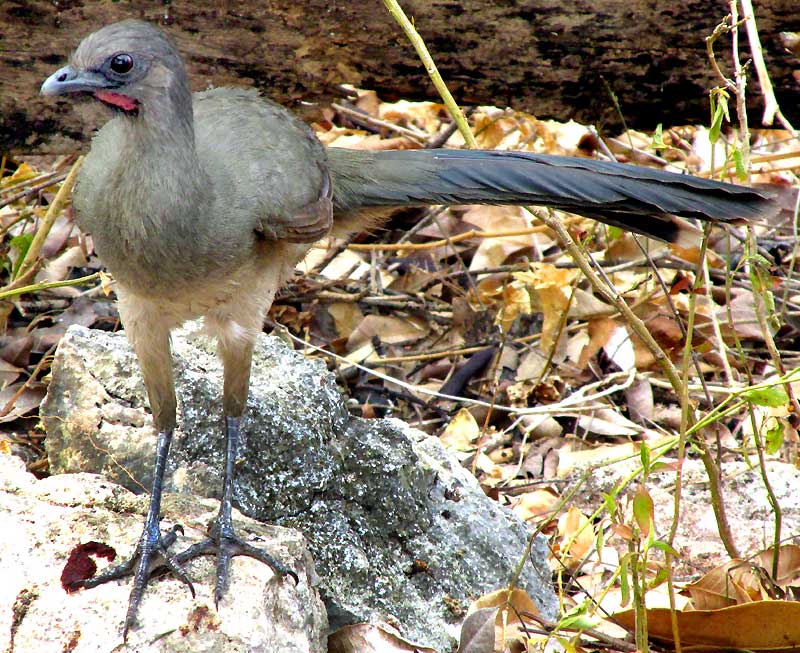
A couple of weeks ago a young chachalaca started paying unusual attention to me. During late-afternoon showers from the tank beneath the windmill, this bird stands and watches, shown above. At first I thought he or she was only interested in the water, but when I'm reading outside, I'll look up and there's the bird perfectly still, looking directly at me through the bushes, or maybe even from a branch of the Ramón above me. Strangely alone, this bird quietly focuses on one thing, me.
In the past I've seen sick individuals behave like this, but this bird seems healthy. Sometimes an adult attacks our bird, so maybe this one is a fledgling being chased from home. Over the years several times I've seen adults of different species violently force their adolescents from home, and it's always hard to see.
from the August 25, 2008 Newsletter issued from Sabacché, western Yucatán, MÉXICO
CHICKEN CHACHALACAS
In late afternoon with the temperature in the upper 90s, the sun's brightness brain-numbing and the village just emerging from siesta I strolled mad-dog- Englishman down the middle of the street. Doña Martha, buried in shadows beneath her Anona tree, almost whispered, but in a way carrying in the afternoon's deadness, "Look at the chachalacas... "
I'm half deaf and these Maya speakers throw Spanish phraseology at me I'm unaccustomed to so I'm always expecting what I think I hear to mean something other than what it seems to mean, but "Look at the chachalacas" was pretty straightforward. The problem was that chachalacas are wary birds. You hear them calling raucously at dawn from out in the scrub but then they're quiet the rest of the day, and in this area where hunting is the main male activity after gathering firewood (people eat chachalacas) typically you can't get very close to them.
With dumb incomprehension I looked at Doña Martha who smilingly pointed across the road where indeed two Plain Chachalacas, ORTALIS VETULA, calmly promenaded atop a neighbor's stone fence.
"I'm going for my camera," I said, and the picture is shown below:
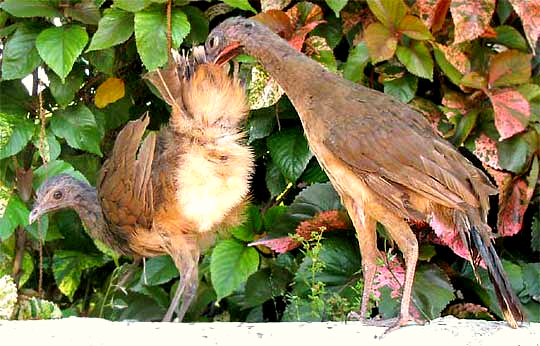
They were young chachalacas with their tails just beginning to develop but they displayed the basic features making them chachalacas. Namely, they were brownish, largish, long-legged, long-necked birds with chicken-like beaks, and with reddish, naked, loose throat skin. On an adult the tail is about as long as the body, minus the neck. The sexes are similar.
Once I understood that they were juveniles already I could guess what their story was: "Someone found a nest out in the scrub, got the eggs and put them under a broody hen," I suggested to Doña Martha, who nodded in affirmation. These birds were thinking that they were chickens, which explained why I had been able to get within five feet of them.
Among the thirty or so taxonomic ORDERS of birds, chachalacas fit with the "Gallinaceous Birds," along with chickens, turkeys, grouse, quail, pheasants and the like. Within this order, chachalacas belong to the Cracid FAMILY, which includes other cracids such as guans and curassows. Howell refers to cracids as "large, primitive, neotropical gamebirds." Plain Chachalacas reach about 22 inches long (56 cm).
Mexico is home to four chachalaca species. Our Plain Chachalaca is distributed from the southernmost tip of Texas south along the Mexican Gulf Coast and the Yucatan to western Nicaragua.
issued March 16, 2020 from Tepakán, Yucatán, Mexico
CHACHALACAS FEEDING ON BULL-HORN ACACIA LEGUMES
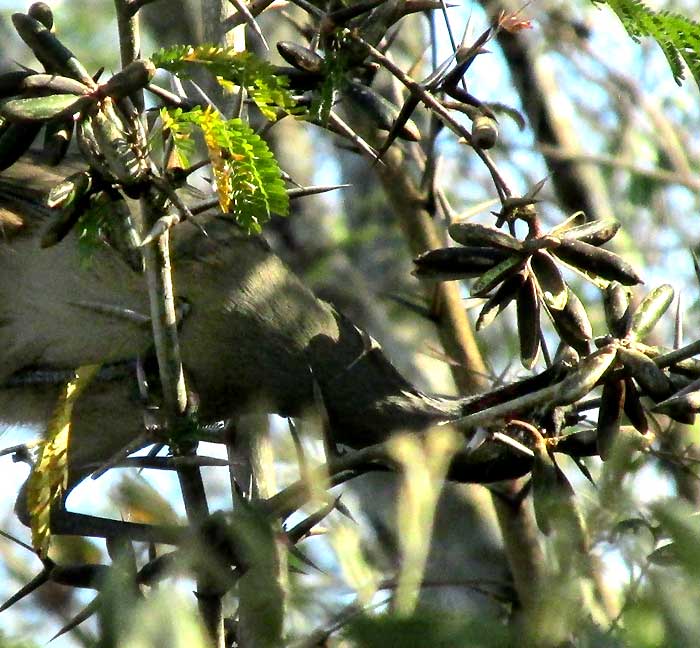
During these hot, dry days with stiff breezes, the Bull-horn Acacia's hard legumes are cracking open, revealing greenish-yellow pulp in which small beans are embedded, and birds come to feed. The first morning arrivals in the trees next to the stone hut are the Pheasant-size Plain Chachalacas, one of which is shown below well camouflaged among the spines and fruits. The front half of the big bird's body enters from the left, the neck curving so that the head comes up from below an open fruit:
from the December 12, 2004 Newsletter issued from Hacienda Komchen de Los Pájaros just outside Dzemul, Yucatán, Mexico
CHACHALACAS AT DAWN
Each morning as I jog along the road leading north to the beach, at a certain moment the chachalacas begin calling. The most vivid memory I have related to chachalacas is one from back in the 80s when one early morning I was sitting quietly just off a trail in lowland San Luis Potosí, watching for birds. A young Nauahatl Indian woman came along on her way to the market, carrying a small child on her back. Just as they passed me the chachalacas burst into an obstreperous uproar.
"Niño," she whispered, "listen to how pretty the chachalacas sing."
from the March 20, 2011 Newsletter issued from Hacienda Chichen Resort beside Chichén Itzá Ruins, central Yucatán, MÉXICO; limestone bedrock, elevation ~39m (~128ft), ~N20.676°, ~W88.569°
RAUCOUS BIRDCALLS
Birds sing all day at Hacienda Chichen and they're a delight to hear. Some calls are more noticeable than others. Especially in early mornings while vegetation still is wet with dew, spectacular serenades are conducted by small flocks of Plain Chachalacas. It's hard to believe that any bird can create such a loud, far-carrying song.
If your computer can digest WAV audio files, you can hear some calling on a dewy morning this week.
That file is 6.7 MB large so it may take some time to load. Also, not all computers can handle WAV files.