PLANTS | ANIMALS | ECOLOGY | FUNGI | GEOLOGY | GARDENING | TOOLS
MEXICAN PLANTS & ANIMALS HOME

Excerpts from Jim Conrad's
Naturalist Newsletter
from the October 23, 2006 Newsletter issued from Genesis Retreat in Ek Balam, central Yucatán, MÉXICO
CECROPIAS
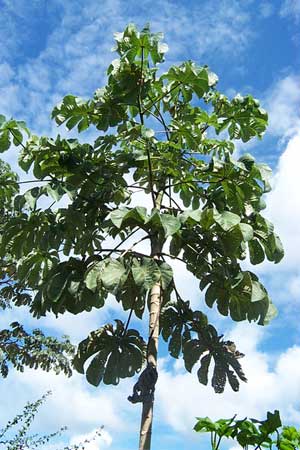
As I traveled west new species appeared, species needing more rain than we had at Dzemul and Telchac Pueblo. The most conspicuous of all these new species, because of their unusual branching pattern and large, spectacularly palmate leaves -- shaped like a hand with thick fingers arising all around the palm -- were the Cecropias, sometimes called Trumpet-trees, CECROPIA PELTATA. That's the Cecropia beside me as I type this at Genesis at the right.
I never saw a single Cecropia in northwestern Yucatan (except in gardens and next to people's homes) but here they're common, practically weed-trees. They have hollow trunks jointed almost like bamboo. The trunks are relatively soft. A sharp machete can cut right through an arm-thick stem in one well-directed swipe.
When I was at the university I was taught that Cecropias were members of the Fig Family. Now I see that gene sequencing has shifted them to, of all things, the Nettle Family, the Urticaceae. Well, if you think about it, both Cecropias and Stinging Nettles produce male flowers on one plant and female ones on another -- they're "dioecious." Also, their inflorescences, or flower clusters, are vaguely similar.
But, here, the species is at home, a valued part of the community.
from the Octoer 13, 2008 Newsletter issue mostly written in Yokdzonot and isued from a ciber in Pisté, central Yucatán, MÉXICO
RAINY ENOUGH FOR CECROPIAS
Two Cecropia species occur in the Yucatán, Cecropia peltata and C. obtusifolia. The one in the picture is C. peltata, which is such a vigorous species that it's become an invasive weed in Hawaii, French Polynesia, West Africa and Malaysia. It's even been nominated for the Global Invasive Species Database's World's Worst Invaders List.
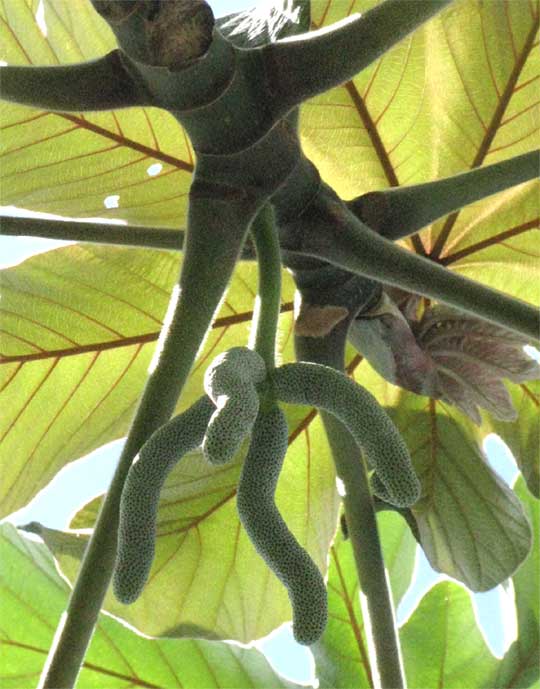
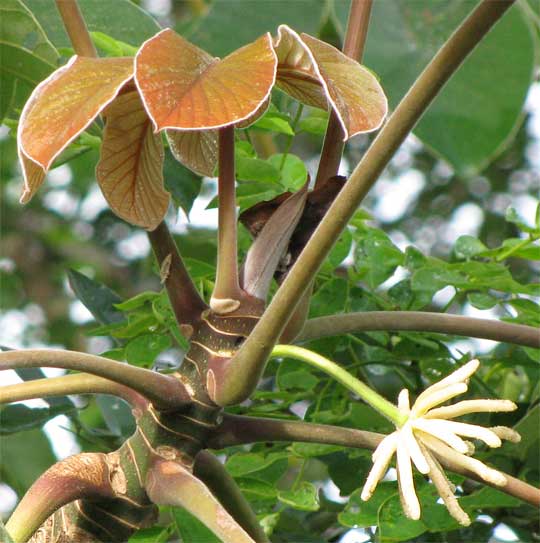
Cecropia flowers are tiny and unisexual. Numerous female flowers are densely packed onto short, thick spikes, and many male flowers cluster on longer, thinner spikes. One way to distinguish C. peltata from C. obtusifolia is that C. peltata's female spikes are less than 10 cm long (4 inches) while C. obtusifolia's are longer than 10 cm. See C. peltata's female spikes below:
Spikes of male flowers are shown below:
Cecropia tree stems are hollow and segmented, some segments with holes in them serving as doors for ants who live in the stems. If a large herbivore comes eating the tree, the ants may drive it away. Cecropia flowers produce sweet nectar the ants like, plus mature female spikes are sweet and succulent, and eaten by birds and mammals. The Maya consider the spikes an emergency food.
Ceropia peltata enjoys high repute as a medicinal plant. Las Plantas Medicinales de México, which calls it Guarumo, reports it as useful against obesity, asthma, liver ailments and diabetes. The trunk's skin contains cecropina, considered to be a powerful heart tonic and diuretic.