PLANTS | ANIMALS | ECOLOGY | FUNGI | GEOLOGY | GARDENING | TOOLS
MEXICAN PLANTS & ANIMALS HOME

Excerpts from Jim Conrad's
Naturalist Newsletter
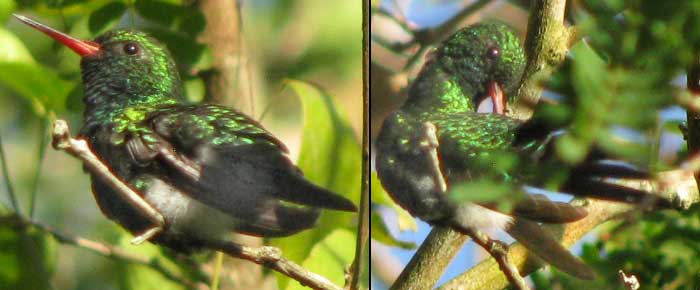
from the November 28, 2010 Newsletter issued from Hacienda Chichen Resort beside Chichén Itzá Ruins, central Yucatán, MÉXICO; limestone bedrock, elevation ~39m (~128ft), ~N20.676°, ~W88.569°
A PREENING MALE CANIVET'S EMERALD
Above you see a glittery, emerald-green, male Canivet's Emerald, CHLOROSTILBON CANIVETII, scratching himself and preening in morning sun.
The image on the left shows how thick-based the bill is, like the similar-looking Broad-billed Hummingbird, which shouldn't occur here. The picture at the right shows the deeply forked tail twisted sideways. The Canivet's used to be called the Fork-tailed Emerald.
Howell reports that members of the Canivet's genus, Chlorostilbon, bear beaks 1-1¼ times that of the head. Broad-billed beaks are 1¼ to 1-1/3 times the thickness. The bill in the image at the left is about the same length as the head, which fits Chlorostilbon, the Canivet's.
This may sound like lots of nitpicking, but when you have several look-alike species, identification often rests on such details. Without seeing the deeply forked tail at the lower right, even with the other clues, I wouldn't have been 100% sure of the ID.
from the May 23, 2010 Newsletter issued from Hacienda Chichen Resort beside Chichén Itzá Ruins, central Yucatán, MÉXICO; limestone bedrock, elevation ~39m (~128ft), ~N20.676°, ~W88.569°
CANIVET'S EMERALD
Normally I don't even try to photograph hummingbirds because they're too fast for me. However, last Sunday a particularly slow one showed up prettily sipping nectar from red Royal Poinciana flowers atop a tree near my hut. You can see it hovering above a flower below:
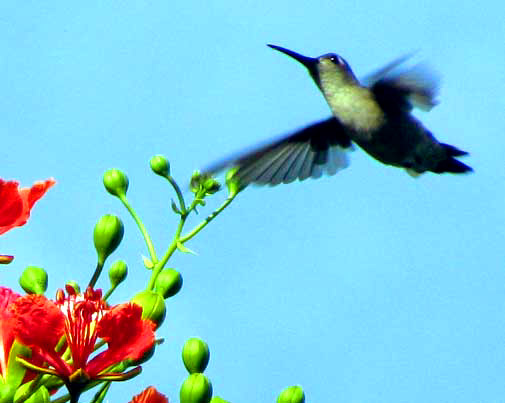
At first I thought that this was a female or immature Ruby-throated Hummingbird, a species that overwinters here. However, that species should be back up North by now. Here in the central Yucatán we have six or seven hummingbird species and of those if it's not a Ruby- throat it must be a female or immature Canivet's Emerald, CHLOROSTILBON CANIVETII.
There's also a small detail barely noticeable in the photo confirming that it's a permanent-resident Canivet's and not a late-leaving Ruby-throat. The detail is the pale patch behind the eye. The female Ruby-throat's pale patch is exactly behind the eye, the forward part of it touching the eye's back side, nearly forming a crescent behind the eye. In the Canivet's the patch is more like a white eyebrow extending from above the eye to down the neck. Still, with this picture it's a hard call to make. Canivet's Emeralds are regarded as fairly common to common in this area.
Canivet's Emeralds, in some books called Fork-tailed Emeralds, are endemic to eastern Mexico, Belize and northern Guatemala. Their habitat is described as brushy woodland and scrub, overgrown clearings, and forest edges mainly in arid to semihumid areas, which is just what we have here.