PLANTS | ANIMALS | ECOLOGY | FUNGI | GEOLOGY | GARDENING | TOOLS
MEXICAN PLANTS & ANIMALS HOME

Excerpts from Jim Conrad's
Naturalist Newsletter
from the February 4, 2006 Newsletter issued from Hacienda San Juan near Telchac Pueblo, Yucatán, MÉXICO
A FRUITING CALABASH-TREE
Among the most eye-catching plants at the hacienda are the Calabash-trees, CRESCENTIA CUJETE, of the Bignonia Family, which also contains Trumpet Creepers and Catalpa trees. Our Calabash-trees are now fruiting. You can see why it is so eye-catching in the picture below:
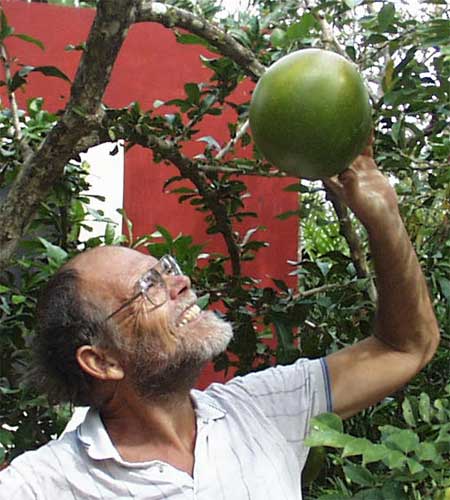
That spherical, soccer-ball-sized fruit in the picture is unlike any other fruit I can think of, though it is indeed uncomfortably similar to my own round, smooth noggin next to it. In the picture, notice how the tree's leaves arise from along thick branches, not mainly at the tips of slender branches, as in most trees. From a distance, Calabash-trees, which are native here, look otherworldly in their scraggliness, and if they bear such fruits as ours do, they're even more mind boggling. Fruits can grow to 20 inches through.
The fruits are gourdlike with hard rinds and soft interiors. In the past people here cut the fruits across their middles, cleaned them out, dried the rinds, and had themselves two perfectly serviceable bowls. Sometimes they decorated them, making them quite nice.
Old fruits lie beneath our trees rotting away. I hope I can catch these new fruits at the right stage and make some old-fashioned bowls for my own use.
from the December 13, 2009 Newsletter issued from Hacienda Chichen Resort beside Chichén Itzá Ruins, central Yucatán, MÉXICO; limestone bedrock, elevation ~39m (~128ft), ~N20.676°, ~W88.569°
THE CALABASH TREE'S CURIOUS BLOSSOM
Three years ago at San Juan Hacienda I introduced you to those wonderful trees who supply the pretty bowls the Maya use, the jícaras (HEE-kah-rahs). In English we call the trees Calabash Trees. They're CRESCENTIA CUJETE and you can still see my round, bald head competing with similar features of a big jícara fruit above..
The Calabash Tree's two-inch-long flowers (5 cm) are almost as interesting as its spherical fruits. You can see a flower, unorthodoxly bloated, fleshy, green, and arising directly from a thick branch, below:
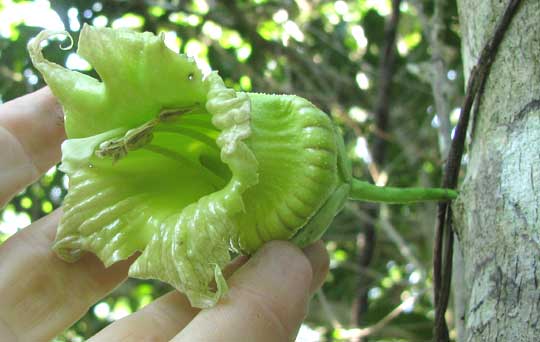
If despite its greenness and odd position on the tree, the manner in which the blossom's four stamens arch upward and hold near the floral tube's ceiling suggest to you the blossoms of Trumpet-Creeper, Catalpa, Jacaranda, Tabebuia and the like, that's right; they and the Calabash Tree are all in the Bignonia Family, the Bignoniaceae.
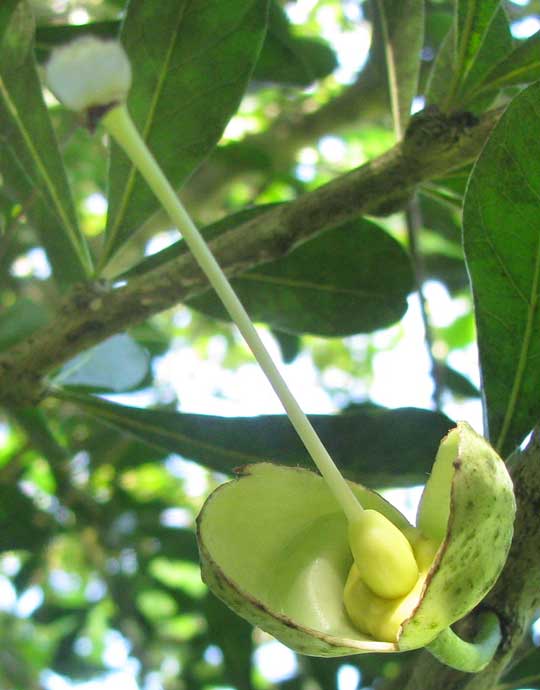
Once the Calabash's flower is pollinated the corolla falls of leaving a two-parted calyx and an ovary arising from the center of a bagel-like "hypogynous disk" (an arrangement characteristic of the Bignonia Family), and that ovary bears an exceedingly long style at the tip of which opens an exceptionally wide stigma. You can see this whole arrangement below:
A shot focusing on the amazing stigma is below:
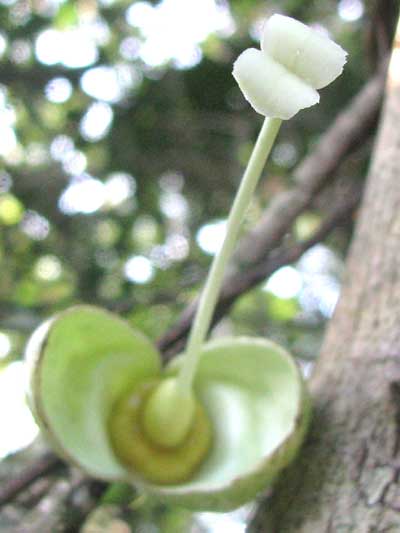
Have you ever seen a stigma more receptive-looking for incoming pollen? Soon after the corolla falls off the long style bearing the stigma collapses, turns brown and falls off.
from the December 3, 2017 Newsletter issued from Rancho Regenesis near Ek Balam about 20kms north of Valladolid, central Yucatán, MÉXICO
JUAN'S JÍCARAS
Last Wednesday after biking to Ek Balam to charge my computer batteries, on return to the rancho I found our Maya worker Juan busy making jícaras, as shown below with the black dog Negrita in the background
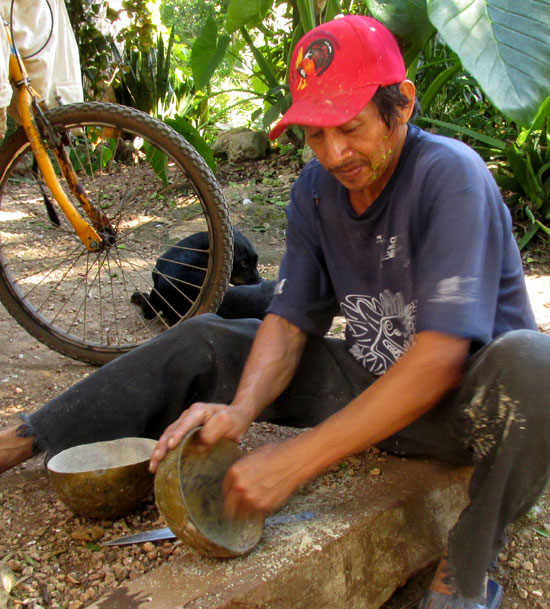
Jícaras are traditional Maya bowls made from the spherical, gourd-like fruits of what in English often is called the Calabash-tree. To make jícara bowls, Calabash-tree fruits must be dried and cured to a certain point that Juan knows when he sees it. When a fruit is ready for cutting, Juan uses a hacksaw to cut it into equal halves, cutting from the center of stem attachment to the fruit's opposite side. In the picture, Juan is scraping tahe soft coating from the fruit's interior. I've seen jícaras very artfully adorned on their exteriors, worthy of holding cloth-covered hot tortillas on the table of the fanciest restaurant.
You might notice that Juan's cheek is plastered with some kind of greenish coagulations. Juan had just had a molar pulled, leaving his jaw hurting, so he took a ripe sweet orange from one of the rancho's trees, with his knife got some green scrapings from the rind, mixed these with a little alcohol and a pinch of salt, and applied the paste where you see it. He says that the pain stopped immediately.