PLANTS | ANIMALS | ECOLOGY | FUNGI | GEOLOGY | GARDENING | TOOLS
MEXICAN PLANTS & ANIMALS HOME

Excerpts from Jim Conrad's
Naturalist Newsletter
from the October 20, 2008 Newsletter written in Yokdzonot, Yucatán, México
ANTHURIUMS AMONG THE ROCKS
Growing thickly around the cenote, but on rocks, is the aroid known as ANTHURIUM SCHLECHTENDALII, seen below:
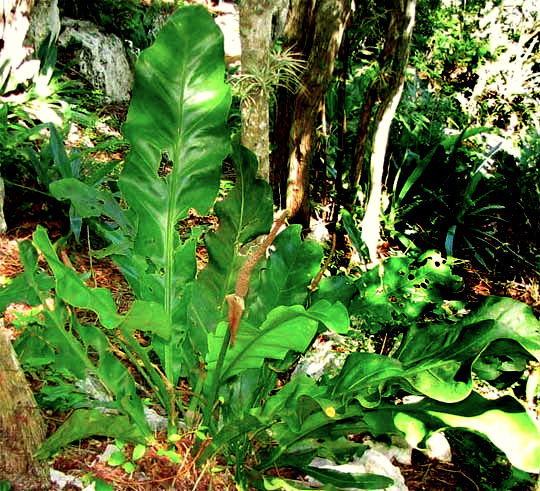
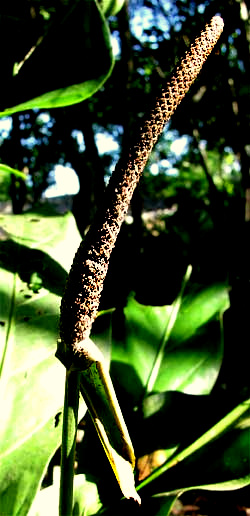 By "aroid" is meant that the plant is a member of the mostly tropical Arum Family, the Araceae. In the above picture note the slender, brown thing arising from the leaf-cluster base. You may know what that is if you're familiar with North America's Jack-in-the-pulpit, which also is an aroid. Remember how in that wildflower's cylindrical, flap-topped "pulpit," (the spathe), "Jack" is a pencil-like structure (the spadix). In the picture the brown item is Anthurium schlechtendalii's spadix while the brown, shriveling part below the spadix is what's left of the fading spathe.
A close-up of the spadix beset with maturing fruits is at the right.
Since each of those brown bumps on the spadix is a fruit, you can deduce that earlier the spadix was mantled with hundreds of tiny flowers, each individual fruit developing from a flower's ovary.
The genus Anthurium embraces about 500 species, some of which are sold in the North as potted plants. Many ornamental hybrids and variants have been developed from the genus and it's always a treat for me when those gaudy, gene-manipulated plants develop spadixes and spathes, thus at least being able to express their natural side that way.
The name Anthurium is from classical Greek and translates to "tail-flower," which seems appropriate when you see the picture.
from the July 4, 2010 Newsletter issued from Hacienda Chichen Resort beside Chichén Itzá Ruins, central Yucatán, MÉXICO; limestone bedrock, elevation ~39m (~128ft), ~N20.676°, ~W88.569°
ANTHURIUM FRUITS
The Anthurium schlechtendalii are fruiting now, and the scarlet fruiting heads rising amidst large, dark green leaves are worth seeing. You can see a typical one near my hut below:
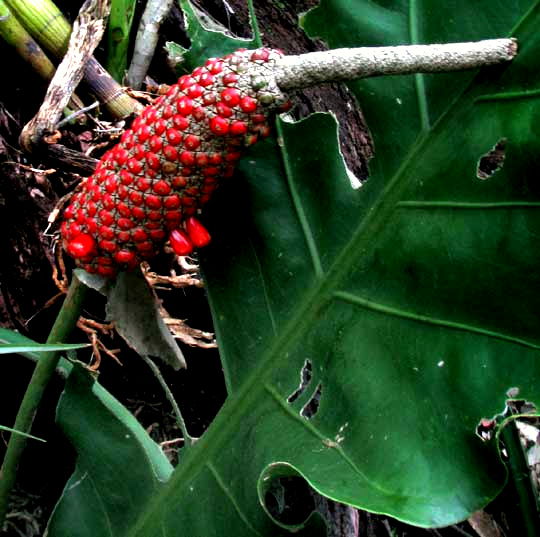
The actual fruits are the red items arranged spirally on the fruiting head. Notice how the most fruits emerge from their seat in the head, making themselves more easily available to any bird or mammal who might come to eat the fruit then in its intestines carry the seed to a new location.
from the February 7, 2010 Newsletter issued from Hacienda Chichen Resort beside Chichén Itzá Ruins, central Yucatán, MÉXICO; limestone bedrock, elevation ~39m (~128ft), ~N20.676°, ~W88.569°
AN ANTHURIUM'S AERIAL ROOTS
This week I also salvaged a waist-high ANTHURIUM SCHLECHTENDALII. That locally common member of the Aroid Family produces lots of thick, white aerial roots, as shown below:
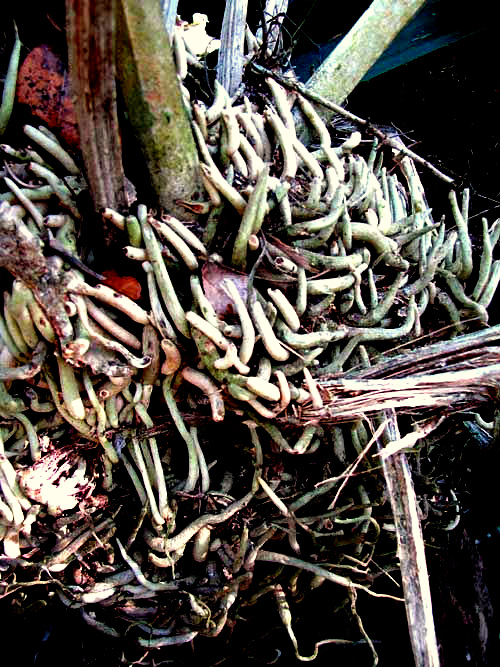
In that picture notice how the roots point upward instead of searching for the ground below. The upward pointing makes sense when you remember that these airborne epiphytic plants are by no means parasitic on the trees they perch in. They derive their nutrients from air, water and whatever organic material happens to accumulate among their roots, so those upward-growing roots are well designed for absorbing moisture from humid morning air.
The roots' thickness and whiteness is provided by mycorrhiza. Mycorrhiza are fungi that convert nutrients that may be present in the environment, but which are chemically unusable, into usable nutrients. The most famous instance of this is when mycorrhiza in a legume plant's nodules covert free atmospheric nitrogen, which is unusable to plants, into forms the plant can use. The mycorrhiza "fix" the nitrogen.
Nowadays it's being realized that many more plants are associated with and dependent on mycorrhiza than was earlier believed. Gradually it's dawning on people that to have healthy plants it's important to assure that the right mycorrhiza are present, and that the mycorrhiza have what they need to survive. Probably people often use harsh chemicals that don't damage the plant itself, but which hurts or kills its mycorrhiza, so the plant suffers indirectly.
One reason I wanted to focus on bromeliads and aroids this week is that a hotel owner across the road can't be convinced that the orchids, bromeliads and aroids on his big trees' branches are NOT parasites. He sends his garden crew into the trees to "clean" them of all their beautiful epiphytes, to "save the trees."
By the way, while writing the above it occurred to me that I wasn't sure whether the word "mycorrhiza" is singular or plural. On the Internet I see that many others have shared my doubt. For a while "mycorrhiza" was considered singular while "mycorrhizae" was considered plural, but then worry arose over the word "mycorrhiza" being derived from Greek roots, but "ae" being a Latin suffix. Therefore today the trend is toward using "mycorrhiza" for both singular and plural -- as is done already with the word "species."