PLANTS | ANIMALS | ECOLOGY | FUNGI | GEOLOGY | GARDENING | TOOLS
MEXICAN PLANTS & ANIMALS HOME

Excerpts from Jim Conrad's
Naturalist Newsletter
from the September 29, 2008 Newsletter written in Sabacché, Yucatán, MÉXICO
elevation ~10m ~33 ft, N20.659°, W89.370°
AN AECHMEA BROMELIAD FRUITING
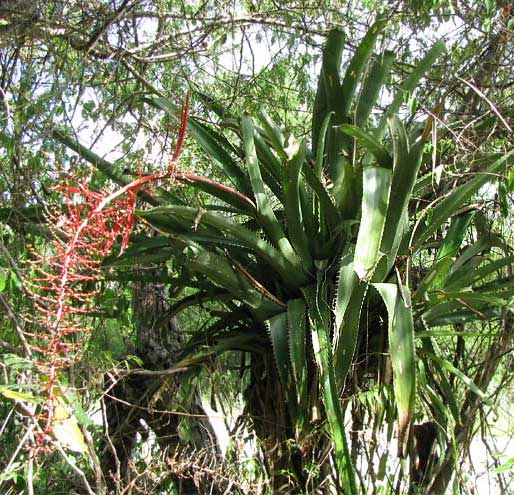
Above you see a hippopotamus-size, epiphytic bromeliad about three feet off the ground. It's an Aechmea, probably AECHMEA BRACTEATA. By "bromeliad" I mean a member of the Bromelia or Pineapple Family, the Bromeliaceae, a family of mostly tree-borne, tropical American plants.
We've often run into bromeliads, especially in humid areas. Spanish Moss back in Mississippi is a bromeliad. In Querétaro bromeliads grew on power lines and at Yerba Buena they constituted an important part of the humid cloudforest flora. Here you'd almost expect it to be too arid for bromeliads, but several species show up. So far Aechmea bracteata has been the largest and most spectacular I've seen of the local species. Most are gray, egg-size to softball-size, rosette-forming, scurfy little beings well camouflaged within the gray bark and thorns of the branches they populate.
It can be hard to identify bromeliads, but Aechmea bracteata has some easily seen field marks. First, in the picture above, notice that the inflorescence, or cluster of flowers, is compound -- small flowers arise from the inflorescence's branches instead of directly from the long, bending-down stem. Also, the lower branches are subtended by long, red bracts, or modified leaves. The sheer size is important, too, this being a big species.
I'm guessing that back during henequen plantation days Aechmea bracteata was almost extirpated from this area. That may be why it's so uncommon now. In this scrub kept perpetually hacked up by firewood gatherers, it's like seeing a Dandelion in a crack in parking-lot pavement -- Nature always trying to come back, always trying to heal Her wounds, to bring diversity into deserts.
from the February 20, 2011 Newsletter issued from Hacienda Chichen Resort beside Chichén Itzá Ruins, central Yucatán, MÉXICO; limestone bedrock, elevation ~39m (~128ft), ~N20.676°, ~W88.569°
AECHMEA BROMELIAD BRACTS
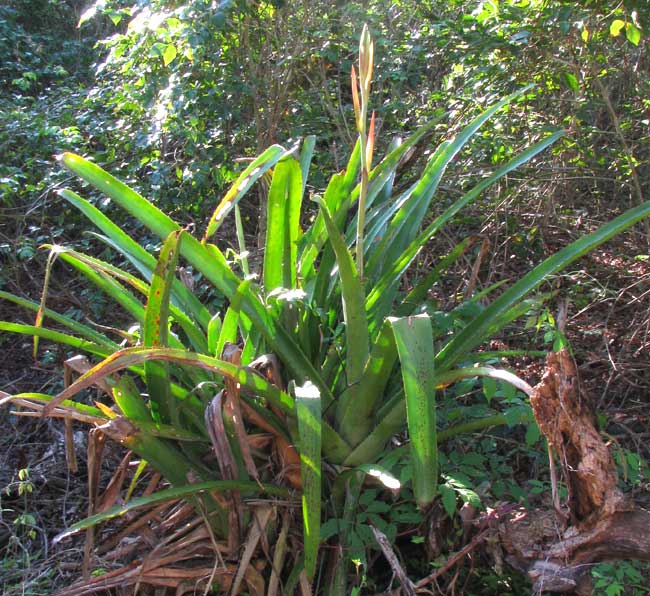
Now the Aechmeas are issuing very handsome spears of immature flower clusters, or inflorescences, shown above. That spear is about five feet tall (1.5m), so these spikes are striking presences here. Normally Aechmeas live on tree branches and in tree forks, but often they fall to the ground and seem to do well there, too. You can see the immature inflorescence close up below:
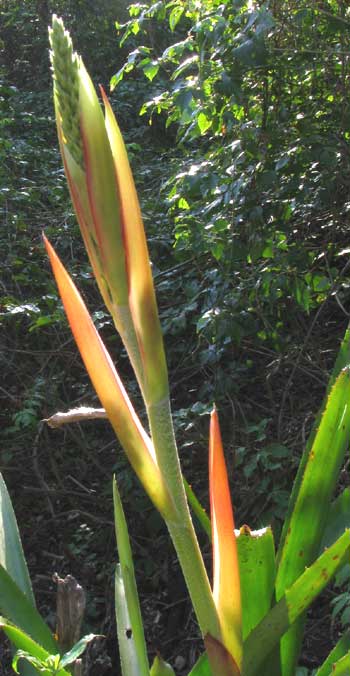
It's something how early morning sunlight catches in the pinkish bracts.
Anyway, once again we come to bracts doing something special, as was the case above with the Acalypha. Fact is, if you do much botanizing, eventually you just have to recognize that many plants bear bracts -- which are modified leaves -- and it's worthwhile to be able to recognize them and figure out what they're doing. The foliaceous bracts on the above Acalypha were serving as oversized calyxes possibly highlighting the mature fruits, causing them to be more visible to whatever animal disseminates them. That's just a guess. You can find bracts doing all kinds of things.
For example, the Aechmea's stiff, sharp-pointed, scoop-shaped bracts clearly dissuade animals from eating the immature flowers. Look at the defense offered by sharp bracts and sepal tips shown below:
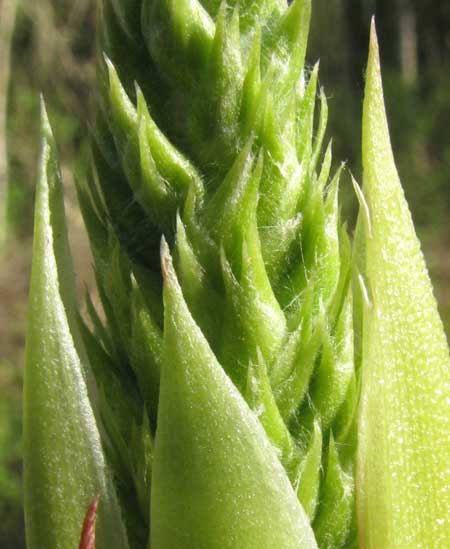
Also, you can imagine that immature flowers inside the wrap-around bracts are protected from cold night air even as now in early morning the sun's first rays heat up the bracts' interior. The extra warmth helps flowers mature faster, since heat generally speeds up biochemical reactions. The bracts are even reddish, protecting fragile genetic material in the developing flowers from being damaged by unfiltered sunlight.
In fact, whenever you see flowers or fruits in any situation it's fun to tarry awhile to figure out how the plant is protecting its most important parts -- its reproductive organs. Is it with simple spines, camouflage, sticky hairs, hard shells, bitter or deadly or maybe hallucinogenic chemicals? Among wild plants nearly always you find one or more defensive mechanism. With domesticated plants often the defenses have been removed by selective breeding.
from the May 9, 2010 Newsletter issued from Hacienda Chichen Resort beside Chichén Itzá Ruins, central Yucatán, MÉXICO; limestone bedrock, elevation ~39m (~128ft), ~N20.676°, ~W88.569°
BIG AECHMEA BROMELIAD FLOWERING
In the Yucatan's arid, scrubby, northwestern corner few bromeliads are to be seen but as you travel southeastward average annual rainfall increases, and so does the occurrence of bromeliads. Here in the central Yucatan it's just becoming rainy enough for bromeliads to appear here and there in impressive, tree-garden arrays. Nowadays one of the landscape's most eye-catching splashes of color is provided by our hippopotamus-size bromeliad, AECHMEA BRACTEATA, which is flowering. You can see a typical plant at the top of this page.
That picture was taken two summers ago in late August near Sabacché, Yucatan, when the plant bore only fruits. In the picture the reddish, arching item at the left is the paniculate fruiting head subtended by several red, long, slender, bracts (modified leaves). The fruits are the pea-sized, spherical items arrayed in great numbers along the panicle's side branches.
Over a month ago our Aechmeas began issuing new flowering heads. The heads themselves remained green or greenish yellow but the long bracts were red almost from the start. I've been waiting for the flowers to appear but this week I realized that the plants have been flowering for a long time, just that the flowers were so small, inconspicuous and ephemeral that I've been overlooking them. You can see a yellow, hardly opened blossom with an ant for scale below:
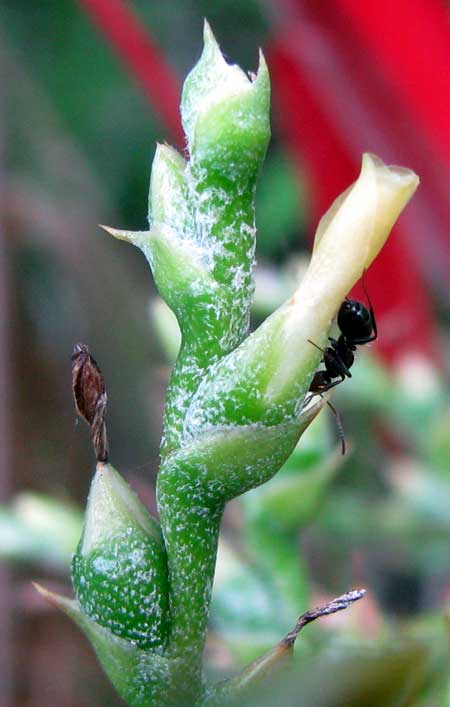
That's a fully developed flower; I've not seen flowers more open in this species.
The ant is collecting nectar. Aechmea bracteata must produce a lot of nectar because most plants I find host many ants, some of them carrying large, shiny globules of nectar between their mandibles.
Besides nectar, Aechmea bracteata provides yet another important service to the local ecosystem by gathering rainwater where each of its blades connects with the center of the plant, forming " inter-leaf spaces". On the internet an abstract of a scientific paper on Aechmea bracteata's ecology reports on a large diversity of aquatic life in inter-leaf space pools -- mostly fly larvae -- as well as terrestrial animals, which are mostly ants, cockroaches, mites and springtails.
A typical clump of Aechmeas, such as in the image from Sabacché, consists not only of one or more flowering mature plants but also there are immature shoots arising from the mature shoots' bases. The immature tufts are called "pups" by bromeliad enthusiasts. Also, there are dead or dying, already-fruited shoots. Bromeliad shoots typically die once they've flowered, though the dying may take a year or two. Dead shoots host their own special communities of animals, mostly invertebrates that eat dead organic matter (detritivores), and ants.