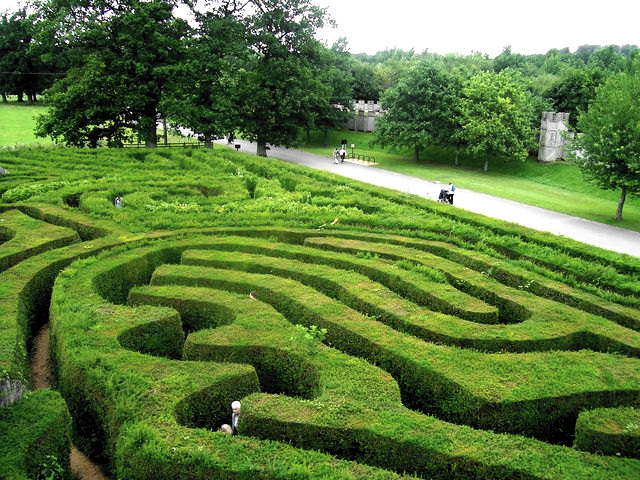
 Maze of more than 16,000 English Yews, at Longleat, Wiltshire, England; image courtesy of Lewis Clarke, via Wikimedia Commons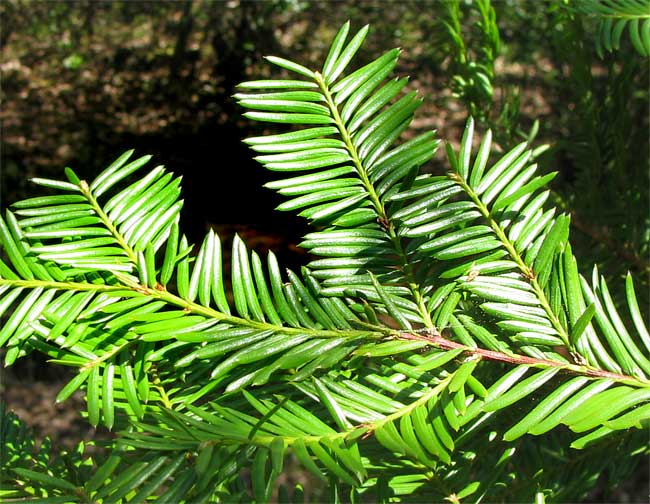
At the left you see what a typical yew branch looks like, this of the Pacific Yew, Taxus brevifolia. Note that the evergreen leaves are flattish, not really needle-like, though they're often referred to as needles. They're spirally attached to the stem, but in most species the blades twist themselves into a flattish plane with their neighbors, giving the stem a flat, feathery appearance. And notice how vigorously the branches branch, the side branches developing about as fast as the leading shoots.
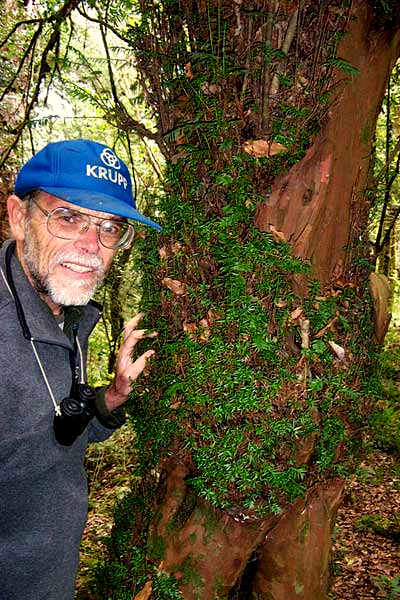
Yews in Nature are much more than obliging victims of hedge clippers, as the formidable trunk of the Mexican Yew, Taxus globosa, at the right shows. It's growing in a chilly cloud forest at an elevation of about 2200 meters (7200ft), in Mexico's Eastern Sierra Madres. Notice how even the trunk issues young stems.
Yews belong to the genus Taxus and have their own family, the Yew Family, the Taxaceae. Currently the Flora of North America Yew page recognizes 6-10 yew species worldwide, though yews are understudied and no one knows for sure how many species there are. Three North American species are recognized, the one commonly found in Canada and the northern US being Taxus canadensis.
YEWS ARE GYMNOSPERMS
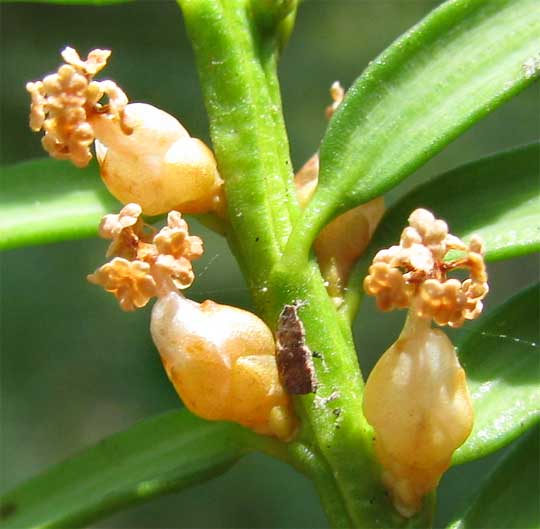
Since yews are gymnosperms, not flowering plants, or angiosperms, they don't produce flowers. They produce cones which either are male or female, sometimes with both sexes on one plant (monoecious) or each plant just bearing cones of one sex (dioecious). Like people, mostly they're dioecious, only sometimes monoecious, plus sometimes they change sex with time. At the left you see a yew's male pollen cones, which drop off once they've shed their pollen.
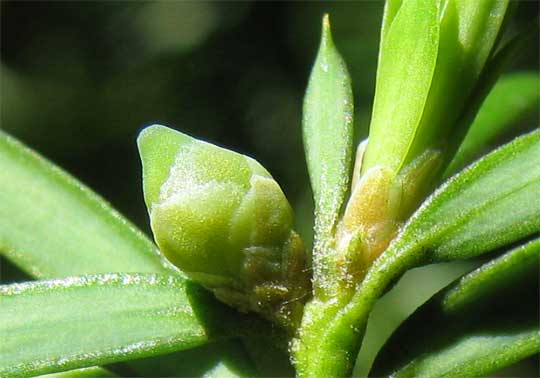
The structure analogous to a female flower, a seed cone, is shown at the right. Seed cones consist of only one or two ovules atop inconspicuous bracts, which mature in one or two seasons, into one-seeded "cones." The word "cones" is placed amid quotation marks because the one-seeded item produced doesn't look like like what we expect a cone to be.
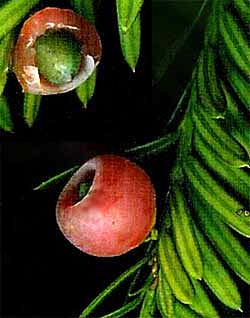
At the right you see two mature yew seed cones about the size of small peas. Single, green seeds peep from cuplike arils, which are soft, juicy tissue highly modified from a cone scale. It makes the cone an attractive food for certain wildlife, like thrushes and waxwings. Something not to be overlooked in the photo is that the seeds are not entirely covered by the aril. They are largely "naked," as is required of all gymnosperms.
The leaves, bark and seeds -- but not the fleshy red aril -- of most yew species are toxic, with long histories of killing people and other animals. That's especially true of the much planted English Yew, Taxus baccata and the Japanese Yew, Taxus cuspidata. Cattle have been poisoned by feeding on Canada's Taxus canadensis, though deer browse fresh foliage apparently with no problems. Moose similarly feed on America's Pacific Yew, Taxus brevifolia, which appears to be much less toxic than other species. Pacific Yews contain the chemical paclitaxel, which disrupts cell division, or mitosis, thus rating as "an effective and well-tolerated treatment in patients with advanced breast cancer," as reported at the National Library of Medicine website.