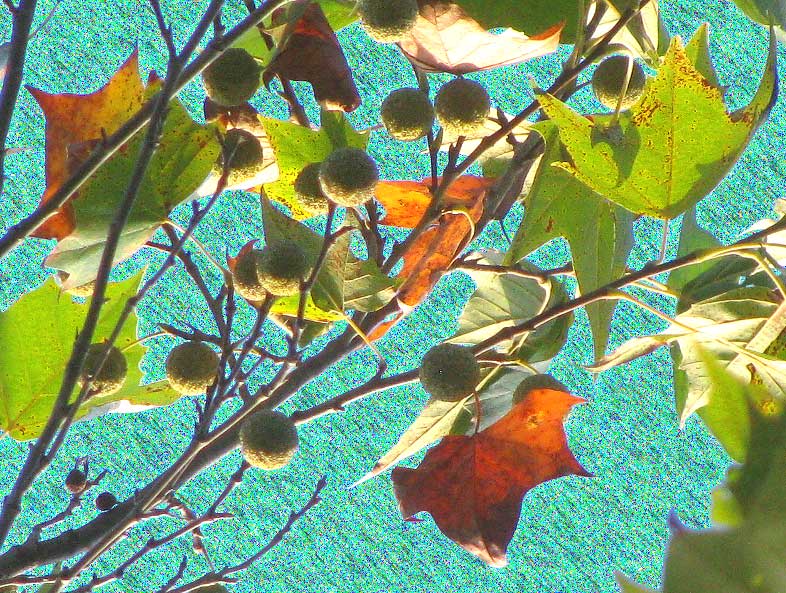
Sometimes it's hard to know whether you're holding a leaf, or a leaflike stem, or just one leaf and not many leaves. On a Sycamore tree branch, like that shown at the left, it's easy to recognize that the leaves are those flat items attached to woody stems by slender little stalks. The leaf is the thing that turns colorful in the fall, and falls off. No problem there.
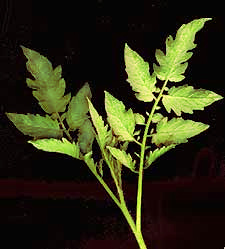
On the other hand, are you sure where the actual leaves are on the tomato sprig in the picture at the right? Is what you see one or more leaves, or a division of just one leaf, or what?
Here are some hints that sometimes can help you decide whether the thing you're seeing is a leaf:
BLADE & PETIOLE
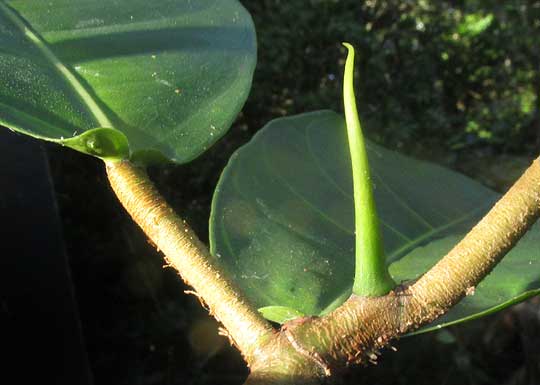
Leaves of most woody trees and bushes consist of a flat blade connected to the woody stem or twig via a slender stalk, the petiole. At the left you see a flat blade's petiole attached to a stem. Blade + petiole = leaf. The slender, green conical item has no blade, for it's a bud. But, then, some leaves have no petioles at all, so this isn't a sure way to recognize a leaf.
BUDS IN PETIOLE AXILS
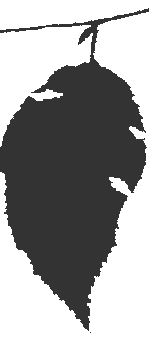
On most woody trees and bushes, at least in the Temperate Zone, a conical, usually scaly bud arises inside the angle formed where the leaf's petiole connects with the stem. In the silhouette of the Hophornbeam tree, Ostrya virginiana, shown at the right, the tree's stem runs across the top, the flat blade hangs down, and the little bud pokes out from its inside angle, known as the axil.
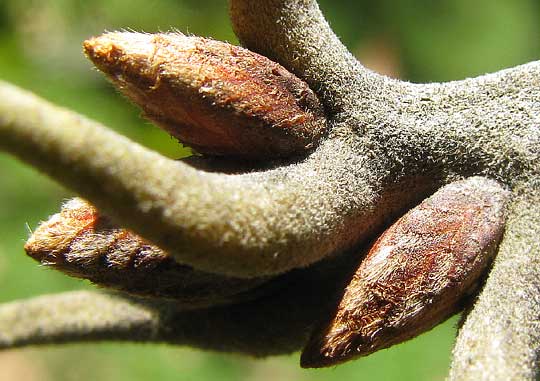
At the left, the single thick item occupying the picture's right side is the stem. It bears three buds, and each bud arises in the axil between the stem and a petiole below the bud. If you see a stem/petiole/bud arrangement like this, you know that the thing above the petiole is a leaf.
COMPOUND LEAVES
Knowing where buds are and are not likely to appear is especially helpful when confronted with leaves divided into subdivisions, or leaflets. That's because buds appear only above the petioles of whole leaves. They don't grow beside a compound leaf's leaflets.
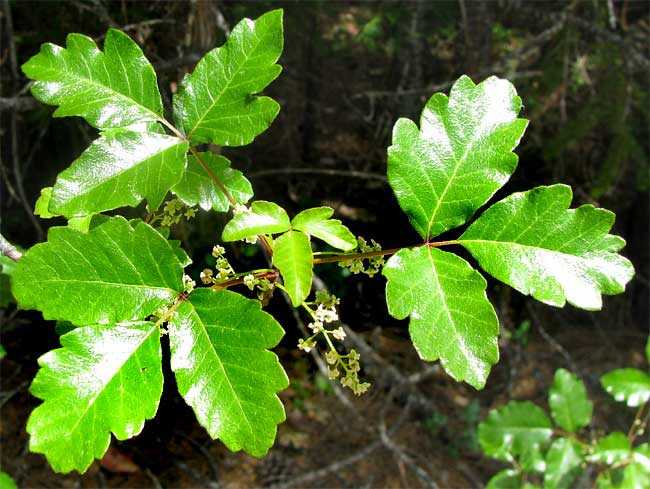
At the right you see the once-compound leaves of one of several Poison Oak species, Toxicodendron diversilobum. On the right-most leaf consisting of three leaflets, note the stiff petiole running horizontally from the leaflets to the stem. This once-compound leaf is of the special kind with only three leaflets, so the word "trifoliate" can be used.
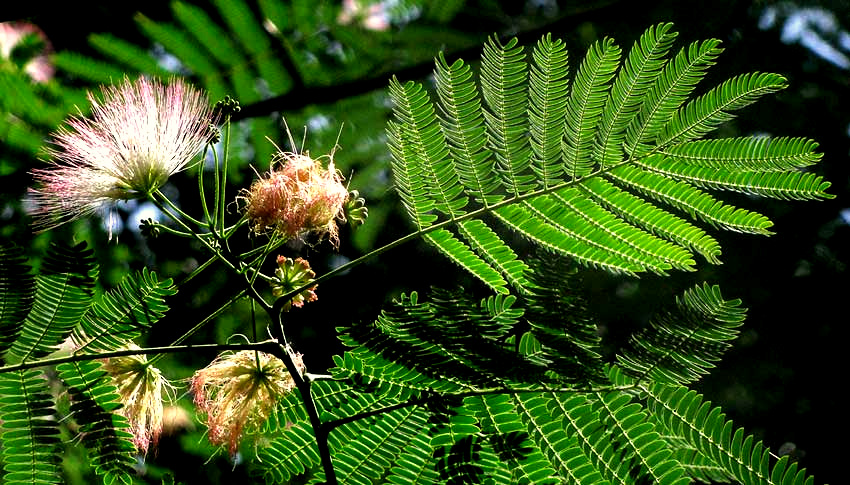
At the left, the twice compound leaf of a Silk Tree, Albizia julibrissin, is one of many species in the Bean Family whose leaves display such a feathery effect. The top, right quarter of that picture is occupied by just one leaf, which is twice-compound, and consists of hundreds of leaflets. Notice that the petiole connected to the stem continues on through the leaf as a slender, straight, stiff rachis, which branches several times along its length. Each of those first divisions has its own stiff rachis, though when it's in a subdivision instead of "rachis" it's called a rachilla.
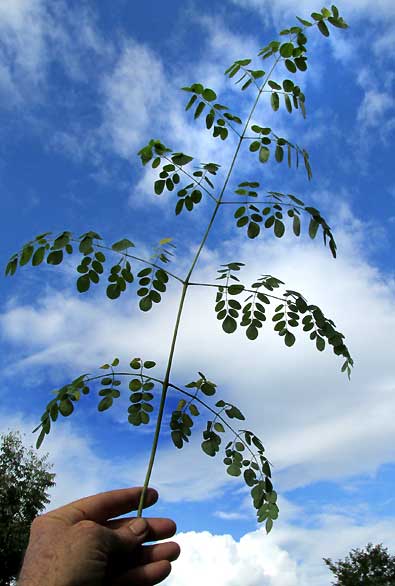
And now test yourself. Can you see the three-times or thrice compound nature of the leaf at the right, of the Moringa tree, Moringa oleifera? do you see the stiff rachis running up the middle of the leaf, like the trunk of a tree with branches? Then that the rachis bears several rachillae, who also branch with rachillae, who finally bear leaflets?
With that Moringa leaf, notice that the left side of the compound leaf is more or less a mirror image of the right side. That an important feature of the vast majority of compound leaves, and sometimes helps us know that what we're seeing is a compound leaf and not a sprout with various leaves.
LEAF SYMMETRY
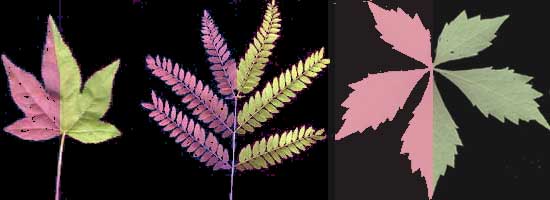
Most but not all leaves, even compound leaves, are shaped in such a way that their right sides are more or less mirror images of their left sides. In other words, they display bilateral symmetry. The three leaves above show this, each leaf's pink side more or less being a mirror image of its other side.
The importance of noticing whether a structure is "bilaterally symmetrical" is that shoots and leaflets usually are irregularly shaped.
LEAVES WITHOUT FLAT BLADES AND PETIOLES
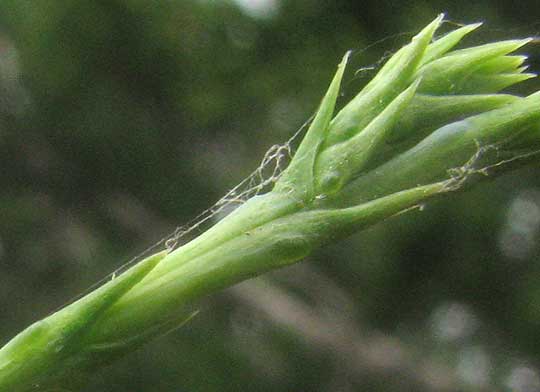
Finally, don't forget that some plants just don't have "standard leaves." At the right, the stiff, sharp-tipped leaves of the Ashe Juniper, Juniperus ashei, consist of scales.
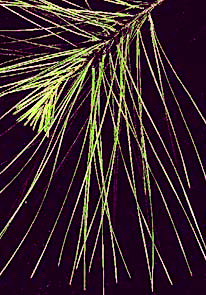
Similarly, look at the 7-inch-long (18 cm) needles of the Loblolly Pine, Pinus taeda, at the left. With pine leaves we can use the special term "needles." In nearly all pines two to six needles are held together in groupings called "fascicles." The question arises as to whether a fascicle of several needles has several leaves, or just one compound leaf. The Flora of North America refers to a single needle as a leaf.
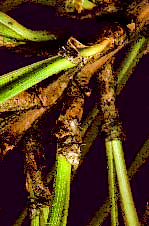
The picture at the right is a close-up showing how pine needles emerge from little woody, stump-like affairs, known as "sheathes," arranged along the pine branch. The Flora of North America describes these woody-looking, scale sheathes as "...2--15 overlapping scale leaves, these (at least firmer basal ones) persisting for life of fascicle or shed after first season."
So even those scaly brown things are collections of leaves!
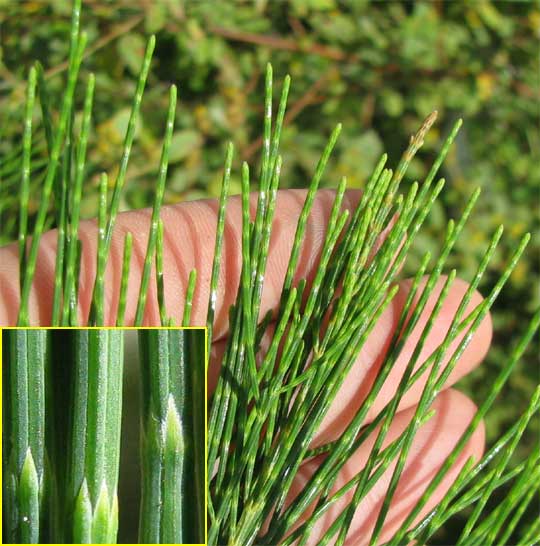
If brown, scaly, pine-branch sheathes can be leaves, then you know that we amateurs sometimes just won't be able to figure things out by just looking at them. At the left, what do you see? That's the foliage of the Australian Pine, Casuarina equisetifolia. Australian Pine isn't a pine at all but rather belongs to a family of flowering plants with foliage like pine needles, and fruits looking like cones, though they're not. In the inset in the picture's lower, left corner, the actual leaves are the tiny, pale, triangular items. Everything else is stem looking like pine needles.
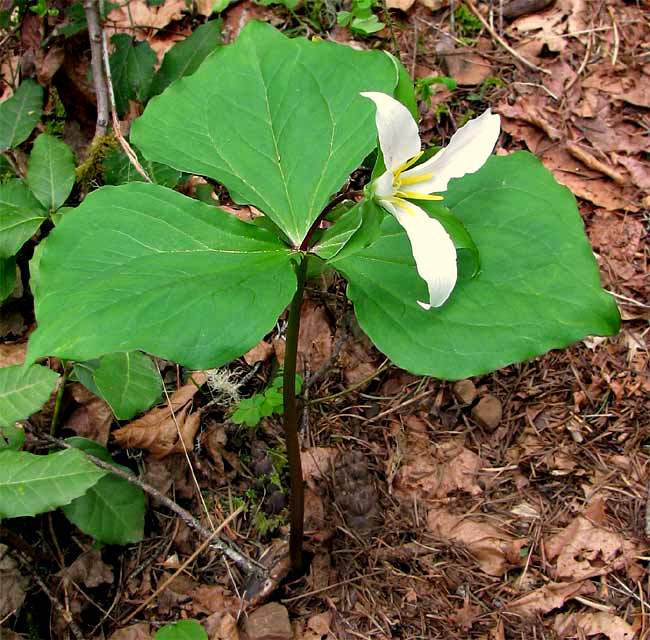
And then there's the trilliums, among the most appreciated of spring wildflowers in moist North American and Asian forests. At the right, that's the Western Trillium, Trillium ovatum. Despite its appearance, this trillium and all trillium species have no leaves. Trillium stems grow underground as rhizomes. What looks like an above-ground stem is a "scape," which is an inflorescence-bearing stem, or peduncle. The authoritative Flora of North America informs us that "...technically the leaflike structures are bracts subtending the flower," "bracts" being modified leaves, but not leaves themselves. Above the leaf-like bracts, the pedicel, three green sepals and three white petals are all what you'd expect them to be.
So, not only can leaves fool you with their peculiar shapes and forms, but there are things out there pretending to be leaves, but they're not.