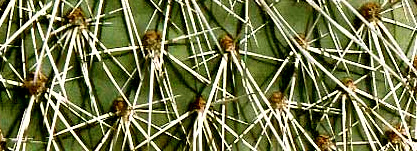
On cattle ranches sometimes army flame-throwers are used to burn spines from wild cacti so cattle can eat the cactus pads. Since de-spined cacti are eaten by cattle with gusto, it's clear that spines do a good job keeping animals from eating cactus bodies.
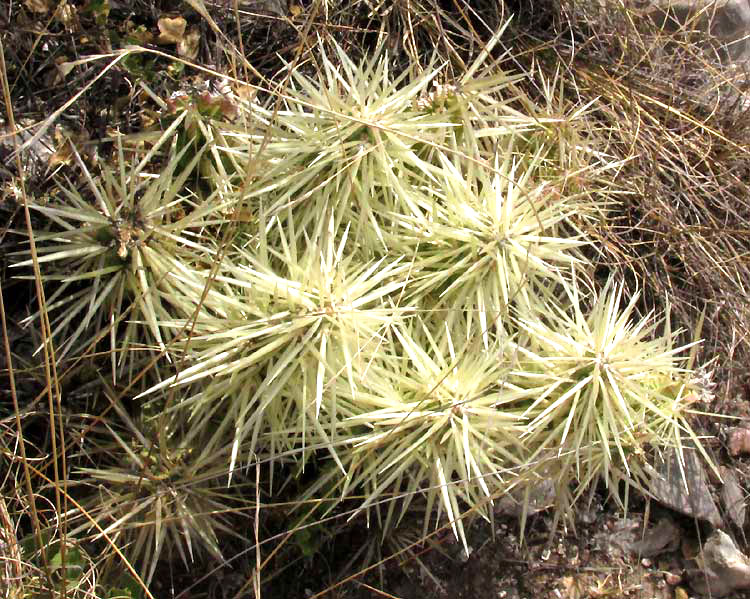
However, as seen on the Sheathed Cholla at the right, Cylindropuntia tunicata, some cacti are so prodigiously spiny that you wonder whether the spines may be doing something other than sticking into the bodies of potential cactus eaters. In fact, a 2008 study by Michael Loik appearing in Physiologia Plantarum reported that cactus spines not only reduce herbivory (plant-eating), but also direct water toward roots and reduce the impacts of high- and low-temperature extremes.
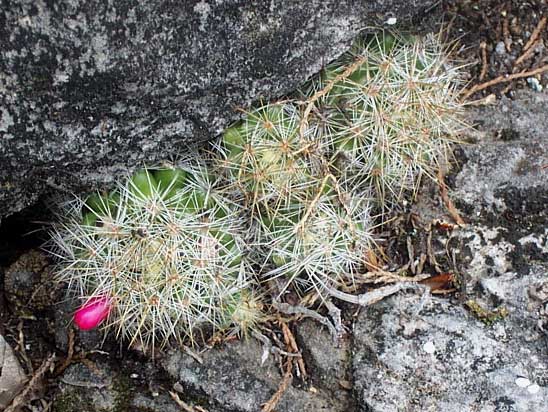
On cacti such as the Nipple Cactus, Mammillaria prolifera, shown at the left, spines might direct water toward roots by collecting dewdrops, which drip off their tips. Such a dense covering of spines can provide some insulation against freezing wind scorching sunlight. Abundant spines also cut down on the plant's ability to photosynthesize food, resulting in slower growth, so producing so many spines has its cost. However, the many-spine strategy apparently is worth the cost to the plant.
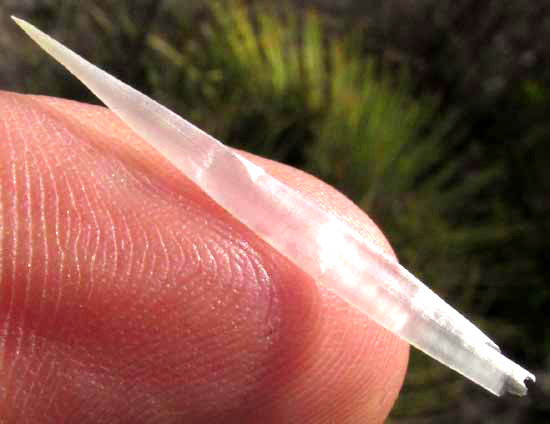
Spines on the previous cholla cactus are encased in sharp-pointed sheathes like the one shown at the right. When a sheathed spine pokes into your leg and withdraws, it leaves the sheath behind. The sheath bears microscopic projections making it hard, and very painful, to pull out. 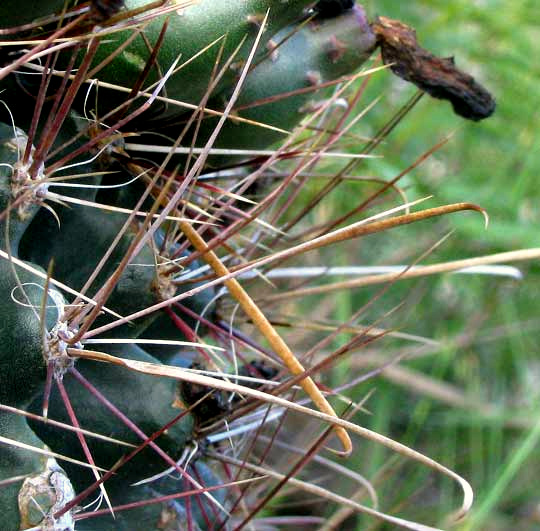 An animal remembers that pain, and is more likely to stay away from that cholla species than other cactus kinds. Staying away from hooked spines of the Texas Barrel Cactus, Ferocactus hamatacanthus, shown at the left is even more assured. Imagine a deer poking a nose among that cactus's spines, then trying to withdraw it.
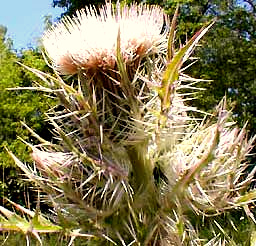
At the right, the Bull Thistle, Cirsium horridulum, reminds us that other plants besides cacti can have spines. Thistles have a special need for spines because the inner core of their stalks, the leaves and flower-bud bottoms -- all trimmed of their spines -- along with the plant's roots, are edible and in fact have long been eaten by hungry people and other animals willing to do all that spine trimming.
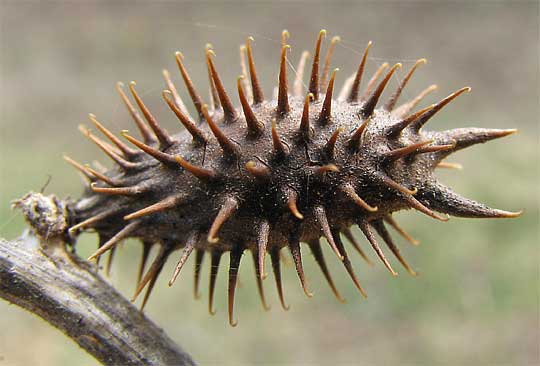
Plant spines are hardly restricted to leaves and stems, as the spiny fruit of the Common Cocklebur, Xanthium strumarium, at the left shows. The hooks on those spines, however, are less likely to impart an memorial puncture -- though that happens -- than to assure that when the hooks are caught in the fur of a passing animal, the fruit will be transported well into new territory before being removed.
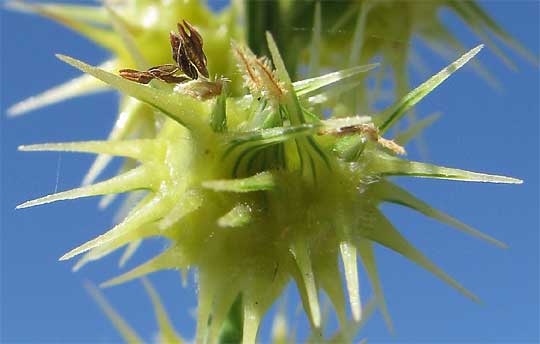
Even grasses can have spines. At the right, spines of Coastal Sandbur grass, Cenchrus spinifex, are hard and sharp enough to dig into a bare foot. The spines arise from a highly reduced and modified structure of the flowering head, called a fascicle, or "burr," surrounding one to four fairly normal grass spikelets.
Finally, what's the difference between spines, thorns and prickles? Everyone doesn't agree on the matter, but a good way to think about the terms is that thorns are modified stems, spines arise from leaves or stipules at leaf-petiole bases, and prickles are outgrowths from the epidermis of a plant. There's a bit of overlap for spines and prickles, and our spiny sandbur grass doesn't fit any of those definitions, but, really, Nature doesn't pay much attention to our human mental concepts.