
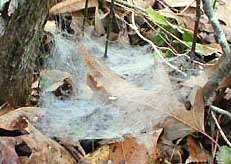
 Nothing is more special about spiders than their use of silk. Moreover, once you begin looking for spider silk, it's just everywhere.
For example, the web at the right is a very common type a funnel web. It consists of a flat, horizontal sheet of web that "funnels" into a tunnel-like hole. That hole is where the spider stays. An insect blunders onto the web, inside the hole the spider feels vibrations of the hapless critter on the web, the spider rushes out, sinks its fangs into the insect, and carries it back into the funnel. As the spider grows it adds new layers to the flat web, so you can judge whether there's a big or small individual inside the tunnel. In the fall, female Funnel Weaver spiders deposit egg sacs in narrow places such as between rocks and loose tree bark, then dies -- sometimes still clinging to her egg sac. Funnel Weaver spiders belong to the family Agelenidae.
 Funnel webs are just one of many kinds of spider webs. In fact, with practice you can learn to look at a web and know which species or general kind of spider constructed it, without seeing the spider itself.
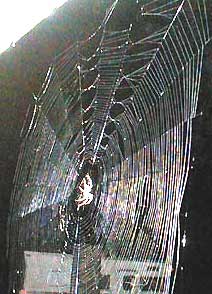
Orb webs such as the one at the left often are built at night, and watching the building take place is a wonderful experience. First the spider constructs a rectangle-like frame of silk suspended between various projections. Then from the future web's center, or hub, inside the frame, numerous rays of sticky silk called radii (singular radius) are strung radiating from the hub to the frame. Finally, many spirals of sticky silk are laid down over the radii. At the left you can see the spider in its hub. If prey gets stuck someplace in the web, the spider knows the prey's location because of vibrations transmitted to the spider via the radii. Actually, there's a lot more to building an orb web than just mentioned. You just need to watch the whole process yourself.
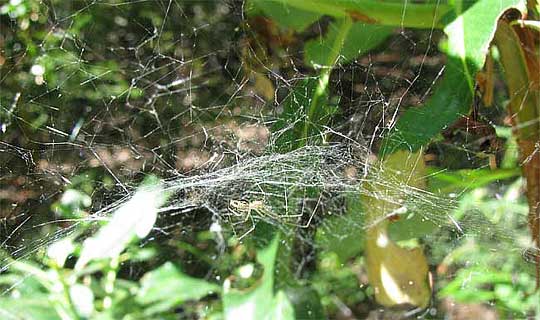
Above you can see a special kind of web known as a dome web. It's created by the Sierra Dome Spider, Neriene litigiosa, of North America's Pacific Northwest region. Can you see the spider hanging upside down beneath the arching dome? The arching dome is sheetlike, so dome webs are regarded as one kind of sheet web. In sheet webs only a few of the threads are sticky, but there's such a maze of them that insects blundering among them often get stuck and taken by the spider.
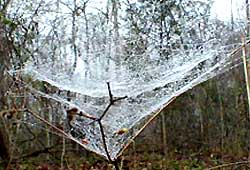 At the left is another sheet web, but this one is obviously built by a different species, probably the Bowl and Doily Spider, Frontinella communis.
The next picture, at the right below, is a classic cobweb, the kind found in house attics, barns, sheds and sometimes even in nature -- beneath leaves, among stones or loose bark. The photo was taken in a barn. Cobwebs such as this are produced by Cobweb Weavers, or combfooted Spiders, of the family Theridiidae. 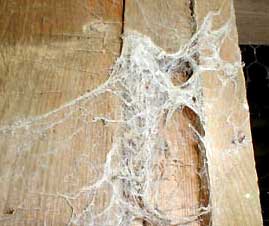
Cobwebs are messy to human eyes, but they do a good job catching prey for the spider. The web's irregular outside threads are sticky. Cobweb Weavers have few or no teeth, thus don't chew their prey, which spiders of related groups usually do.
Not all spiders produce webs. Many, most notably the large, hairy wolf spiders sometimes spotted roving across our backyards as they hunt , and crab spiders, found inside flowers waiting to ambush insects coming for nectar, build no webs. However, they still produce silk, for as they travel they leave "draglines" behind them. If they fall from their perch, they can pull themselves back up the silk to their original position. All spiders make dragline silk.
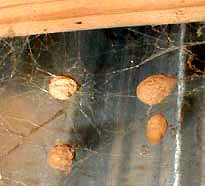 The females of many spider species construct silken egg cases in which they deposit and guard their eggs. The cases at the left were found in the outside corner of a window. The egg cases of some spider species may contain several hundred eggs. Young spiderlings may emerge from the cases several weeks after the cases are produced, or sometimes not until the following spring. Notice how these cases are suspended among silk threads out of the reach of ants and other critters who wouldn't mind a spiderling meal.
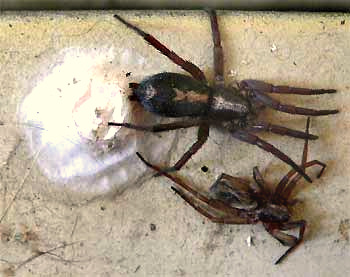
Above you see a female Gnaphosid Spider guarding her white, silken egg sac. Gnaphosids are nocturnal hunters and many have eyes with a silvery layer that reflects light directed toward them at night. In the picture, the silken sac is stuck to the bottom of a metal panel on a clothes drier in a garage in California. The crumpled-up object at the lower right is the spider's discarded exoskeleton, or external skeleton.
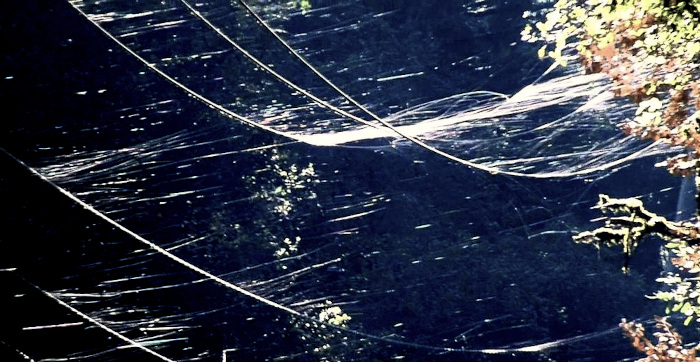
Especially in autumn, spiderlings are apt to climb to the top of almost any tall weed, bush, or fence post, and extrude strands of silk into the wind, rather like releasing a kit into the air. As the silk lines lengthen, the wind tugs harder and harder on them, until finally the spiderling releases its hold on its platform, and the wind bears silk lines and spiderling to new territory -- perhaps just to the next bush, or maybe to the next county or state. This manner of traveling is called ballooning. In the fall, when the blue sky is streaked with silvery streaks of sunlight reflecting from ballooning spiderling silk, the bright streaks are called gossamers.
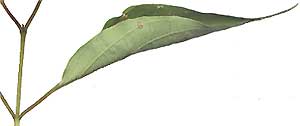
Some spider species pull together the sides of leaves, fix them in place with their silk, and form a kind of tunnel in which they can hide and rest. The picture below shows just such a resting place.
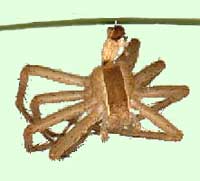 You just never know what a spider will do with its silk. At the right you see the discarded shell, or exoskeleton, of a spider hanging from a grassblade by a tiny thread of silk. Spiders, being arthropods like insects, must shed their rigid "skins," or exoskeletons, as they grow. When a spider was ready to shed its old exoskeleton it attached its rear end, or abdomen, to the grassblade, then as it hang there its exoskeleton split and the spider emerged. What looks like a broad, brown stripe down the spider's back in the picture is actually the split in the back, or carapace, of the spider -- the split from which the growing spider emerged.