Few poisonous snake species occur in North America, and they are all easy to identify as venomous. Several non-venomous snakes
mimic the venomous ones. The venomous ones fall into
two groups:
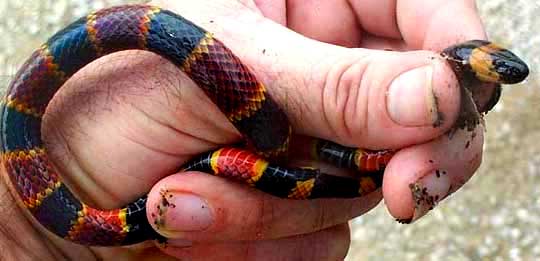
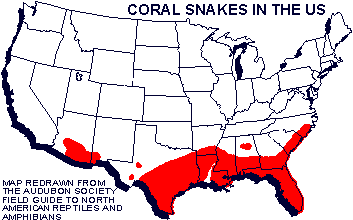
- The Coral Snakes, of which there are 2 species, one of them shown above. Red in the map below shows the approximate distributions of both species, the Eastern Coral Snake living from Texas to North Carolina and the Arizona Coral Snake in southern Arizona and extreme southwestern New Mexico. Therefore, most North American backyards, even if they adjoin a wilderness area, will never harbor a coral snake. Coral snakes are easy to identify, with boldly colored, broad, alternating bands (not long lines) of red, yellow and black. A number of harmless snake species also have broad alternating bands of these colors, but the coral snake's colored bands are arranged in a unique sequence, which you can remember with this poem: Red on yellow/ Will kill a fellow. Thus the red bands are always framed with yellow bands. Most but not all harmless look-alike snakes have their red bands framed with black. Sometimes the yellow bands are almost white.
- The Pit Vipers -- 17 species in all -- include rattlesnakes, copperheads, and water moccasins, found throughout most of the U.S. All members of the pit viper family share two characteristics that separate them from all other North American snakes, except boas and pythons, which are not likely to be encountered except as escapees:
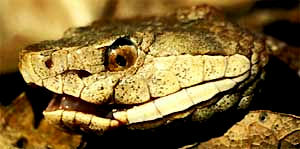
- As the above photo of a Copperhead shows, they have cat-eyes -- the black pupil is shaped like the cross section of a vertically positioned convex lens.
- There's a pit, or hole, between the snake's eyes and its nostrils (thus the name pit viper). This pit is heat-sensitive, enabling the snake to locate warm-blooded prey in total darkness. This is also clearly visible in the above picture, between the bottom of the eye and the bottom of the nostril. See it?
Of course, if you live within easy walking distance of a more or less natural area where pit vipers are known to occur, you won't want to approach any unknown living snake to see if its pupils are convex and if it bears heat-sensitive pits. To identify venomous snakes from beyond striking distance you must study pictures of the poisonous species in your area and commit the details of their appearances to memory. There is no short-cut. Pit vipers do tend to have more or less heart-shaped heads because of the bulging poison glands behind their eyes. However, many harmless snakes also have more or less heart-shaped heads.
All of Europe's venomous snakes are True Vipers (subfamily Viperinae), unlike North America's Pit Vipers (subfamily Crotallinae). Both viper kinds, though, belong to the Viper Family, the Viperidae. In the UK only the Adder is venomous. Germany has two venomous species, the Adder and the Asp. Seven venomous species occur in Italy, all in the Viper Family.