

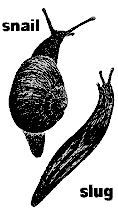
Though most people agree that snails have shells and slugs don't, snails and slugs are practically the same thing. To scientists, the terms "snail" and "slug" have not meaning.
Technically, both snails and slugs are gastropods belonging to the taxonomic class Gastropoda. Beyond that, things get confusing for biologists, as you might guess learning that slug species are scattered through several different families, and some of those families include snail species with shells. Also, some slugs contain small "internal shells." Currently the scientific world can't do much better than to agree that "normally but not always, snails have shells, slugs don't."
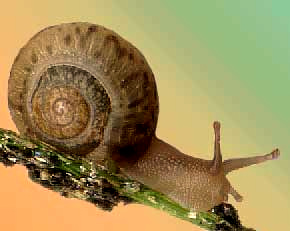 If you're reading this where sometimes it's warm and rainy, you shouldn't have problems finding snails and slugs. They like moist places, such as among bushes on the shady side of the house, or maybe in the garden nibbling on lettuce, at least at night. If dry where you are, you may need to look harder. Often in early morning they'll prowl in dewy places. If it's really dry, you may just have to wait, for your backyard's snails and slugs may well be underground or beneath rocks or fallen trees, in suspended animation, waiting for rain. The one show above at the left was found resting on a slender bunch of grass flowers. In real life this snail's shell is less than half an inch long.
BASIC FEATURES:
Some snail species live on land, while others live aquatic lives. If you've ever watched aquatic snails slowly moving across the glass walls of the inside of a water-filled aquarium, you know the snails' (as well as the slugs') basic features:
- Eye spots at the tips of slender tentacles, such as those seen at the right on the Banded Forest Snail, Monadenia fidelis. The tentacles feel what the simple eye spots may not see. In land snails with two pairs of tentacles, the eye spots reside on the longer upper pair. They can detect movement and shades of gray. The lower pair are used more for touching, and are well equipped with odor-sensing chemoreceptors that enable the snail to smell its environment.
- Mouths directed downward so that food can be taken from the surface being traveled over. Watching an aquatic snail through aquarium glass, you can see the snail's raspy tongue methodically scraping algae off the glass
- Single, broad, muscular, flat-bottom feet, which move the creatures forward
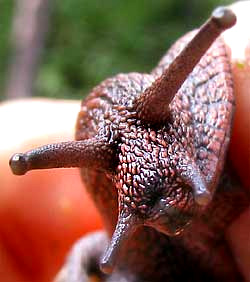
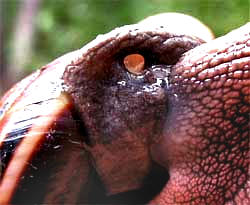 At the left you see the breathing hole of the Banded Forest Snail shown above. At the hole's right you may notice a certain irregularity. That's the anus.
Aquatic snails are somewhat different. For one thing, if you watch them in an aquarium you may see them send a tube up to the water's surface to get air. Also, aquatic snails bear only one pair of tentacles instead of two.
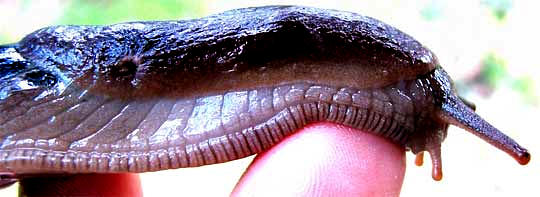
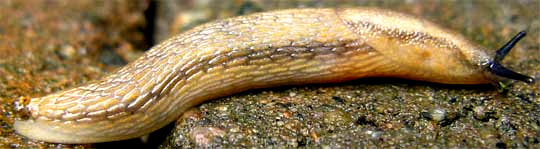
On the above slug, notice that where a snail's shell would be there's a long, leathery thickening almost as if the slug were wearing a cape. That's the mantle fold. Toward the back in the mantle fold you see a hole. Probably you can guess that that's the air hole. A more technical name for the air hole is pneumostome. The top pair of tentacles, the ones bearing the eye spots, are technically known as the cephalic tentacles. The lower power of tentacles are the oral tentacles. The lowest, thick part of the slug -- about half the body's thickness on the left side but becoming thinner toward the head -- is the foot. The foot's bottom surface, which glides over things, is -- you guessed it -- the sole. In this species, the bottom-most part visible in the photo, at the foot's bottom and hiding the sole's edge, is the skirt.
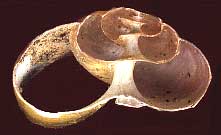 The image at the right shows a snail shell with the top removed. It may take a while to understand what you see, but once you do you'll be able to visualize how the snail and its shell started out very small, and as the snail grew, so did the shell. Of course the shell is hard, so it had to grow in a special way, in a spiraling manner. The part of the shell that grew was the rim surrounding the protruding foot. The rim grew as if it were adding slender, ever larger rings, each below the last. In the image, the dark cavity on the shell's left is where the snail's foot emerged from the intact shell.
HOW SNAILS & SLUGS MOVE
Snails and slugs move by sending wave after wave of small contractions forward from the back of their feet toward the front. If you've lain on your back and inched yourself across the living-room floor by alternately curving and straightening your backbone, you understand the principle, just that with snail and slug feet there are many, many contractions methodically taking place in waves moving forward, instead of one backbone contracting and staightening.
LAND SNAILS & MUCOUS
The vast majority of gastropods are aquatic animals. In fact, snails and slugs are the only mollusk class found on land. The snails in our backyards should more precisely be called land snails.
One adaptation enabling land snails and slugs to survive on land is their ability to produce plenty of slimy mucous. If you've watched a land snail or a slug moving across a dry surface, you may have noticed that it left a silvery trail. This trail is mucous the creature lays down beneath it as it travels Land snails and slugs move upon a layer of mucous.
This mucous in wonderful stuff. For one thing, it prevents moisture in the animals' bodies from being soaked up by the dry terrain being traveled across. Also, it protects the animal's fleshy underparts from sharp objects. Snails and slugs can actually glide across the sharpest razor blade without cutting themselves.
The big danger in the lives of land snails and slugs is drying out. Gardeners know that one way to rid themselves of lettuce-eating snails and slugs is to sprinkle them with salt. The salt causes water to leave their bodies, and they shrivel up fast!
When dry weather comes, land snails and slugs bury themselves in the soil or find some other well protected spot. Snails plug up their shell holes with mucous, and slugs secrete a sort of mucousy cocoon for themselves. Then through the dry spell the animals remain in a state of suspended animation during which their body processes slow to a point almost like death. However, there's enough life in them for them to become active again once enough rain comes to dissolve the mucous and soak into their bodies.
Mucous also comes in handy when a predator such as a toad snatches up a seemingly defenseless slug. The slug secretes such quantities of the stuff that after the toad chews a few times it finds its mouth clogged with sticky, gooey slime.
REPRODUCTION
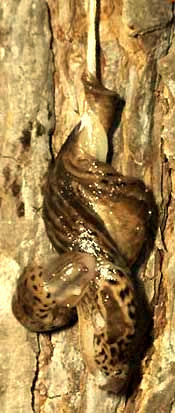 One morning in Couer d'Alene, Idaho, Tom Searcy was having a coffee on his patio when he saw the two slugs shown at the right hanging from a 6-8-inch (15-20cm) string of slime. He took that picture, and picture and when he came back 10-15 minutes later, he found the pale bluish "bloom" shown at the left, and took that picture.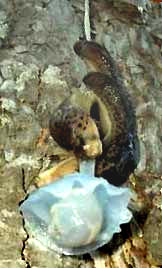
The bluish "bloom" consists of the slugs' joined sex organs, which have been extruded from their bodies and wrapped around one another. When an organism, whether plant or animal, possesses sex organs of both genders, it's said to be hermaphroditic.
Most land snails and slugs do possess both male and female parts. In some species, an individual may behave as male for a while, then as a female.  When snails mate, as in the drawing at the left, two individuals pull up next to one another, arrange themselves so that the male part of one is opposite the female part of the other, and then each ejects sperm into the female opening of the other. In a few snail and slug species, self-fertilization occurs -- an hermaphroditic individual mates with itself and produces offspring.
On the Web, check out the Online Fieldguide to the Freshwater Snails of Florida and Kentucky Slugs.