Excerpts from Jim Conrad's
Naturalist Newsletter
from the October 2, 2005 Newsletter issued from the Sierra Nevada foothills
somewhat east of Placerville, California, USA
DIGGER PINE
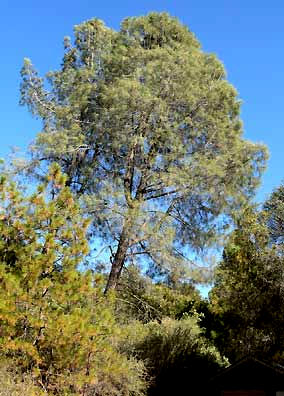 Earlier I've mentioned that around here the main pine is Ponderosa Pine, and that we say we're "going up to the Sugar Pine zone," and "going down to the Digger Pine zone." I've already covered the Ponderosas and the Sugars, and this week I finally got some good pictures of a Digger Pine, seen at the right.
The trunks of both Ponderosa and Sugar Pines are monumentally tall and straight. Digger pine trunks typically are crooked and forked, its wood is coarse-grained and warps badly, and the tree itself seldom rises over 60 feet tall. Its needles, in bundles of three, are pale gray-green, sparse and drooping. The needles of Ponderosa and Sugar pines are dark green and thick.
Much in contrast, the Digger Pine's needles are grayish, stiff and slender, giving the tree such an airy, wispy appearance you can hardly find decent shade beneath it. The only other pine I've seen like it is the Caribbean Pine I got to know while living in Belize. That species typically occupied hot, windblown, sandy flats, so it looks like the species' shared features are adaptations to drought, intense sunlight and hot wind.
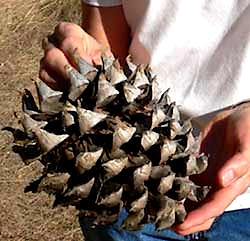 One wonderful thing about Digger Pines is the oversized cones they produce, and the remarkably large, edible seeds that come from those cones. That's a cone at the right. The seeds were much eaten by the natives, and still are very important to wildlife. To top it off, during early summer, long before the forest's main fruits and nuts mature, the young cones possess a soft core that can be eaten.
When I first arrived here a lady known for her liberality and strong sense of egalitarianism advised me to not call these trees Digger Pines. That was because the name Digger came from the "Digger Indians," which was a contemptuous name given by white settlers to the Maidu and other Native Americans who occupied this land first, and who spent a lot of time digging for roots. I find the lady's sentiment admirable but somehow I can't transfer the offense I feel for disrespecting the natives to the tree. The name Digger Pine is rooted in our literature and folklore and it's a good name. The scientific name is PINUS SABINIANA, named for Joseph Sabine, an English lawyer and naturalist born in 1770.
AN EXTRA NOTE: A while back someone asked what they should do about a Digger Pine leaning badly over a road. I asked my friend Fred, whose family has been cutting pine in the foothills for years, and here is what he told me about leaning Digger Pines:
My wife & I live on 120 acres of brush and forest in the Sierra Nevada foothills near Placerville, CA. We have many digger pines on our property, many of which are leaning. That seems to be the way they like to grow.
My parents also live on the property, which my grandparents obtained in 1938. My dad is an old logger and woodcutter, and at 85, has more experience than I do, since I'm only 50. So I consulted him.
He told me he doesn't recall seeing any live digger pines ever fall on our property, even though many are leaning quite precariously. The root systems do go deep into the subsoil looking for water - that's why they're so tolerant of our hot, dry summers.
However, we have seen live, leaning digger pines with a lot of heavy growth break off halfway up the trunk. So that would be more likely to happen if anything happens at all.
Another factor is soil. If the roots are in rocky soil, the tree is less likely to fall than if it were in soft, loose, damp soil.
As a teenager I split plenty of digger pine rounds into firewood. I can tell you from experience that the wood is pitchy, fibrous and very difficult to split.
And it's useless for lumber. While making some lumber from Ponderosa pines on our property 43 years ago, my dad sawed up several digger pines. As the lumber dried, it twisted and warped so badly that it was totally useless. So he tried cutting more digger pine lumber, stacked it to dry, and parked his big heavy bulldozer on top of the lumber pile. The lumber stayed flat - but it warped out to the sides, again so badly that he couldn't use it for anything but firewood.
The only way he could profit from the trees that needed harvesting on our property was to cut it into 20" veneer blocks and sell them to a place that shaved the blocks down into 1/8" thick veneer, which was cut into strips and used to make boxes for produce. This was 45 or 50 years ago.